Association between birth location and short-term outcomes for babies with gastroschisis, congenital diaphragmatic hernia and oesophageal fistula: a systematic review
Systematic review of nineteen cohort studiesMixed results
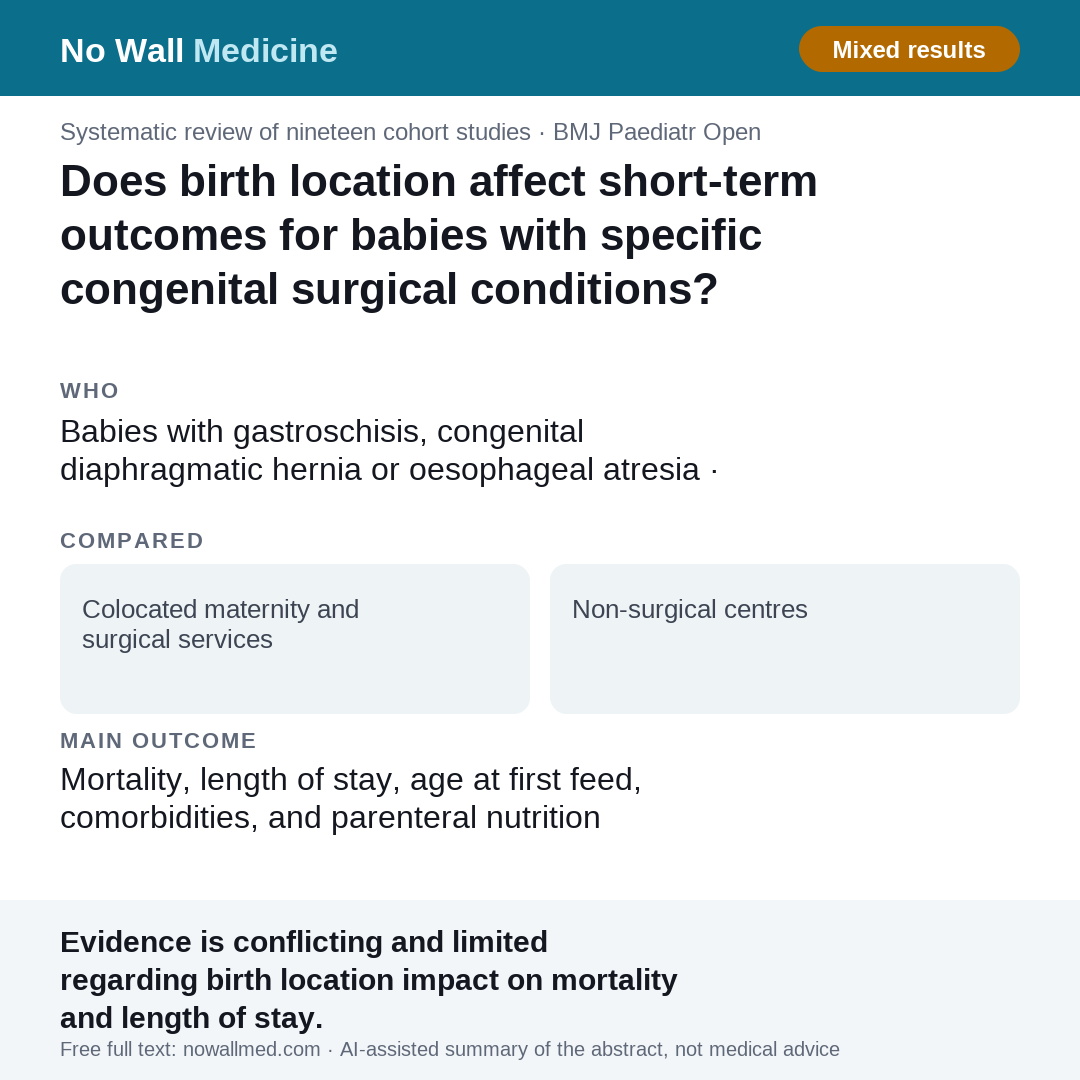
Does birth location affect short-term outcomes for babies with specific congenital surgical conditions?
Who
Babies with gastroschisis, congenital diaphragmatic hernia or oesophageal atresia · High income countries
Compared
Colocated maternity and surgical services
Non-surgical centres
Main outcome
Mortality, length of stay, age at first feed, comorbidities, and parenteral nutrition
Bottom line: Evidence is conflicting and limited regarding birth location impact on mortality and length of stay.
Limitation: Significant heterogeneity, potential for bias and paucity of strong evidence.
BMJ Paediatr Open · 2023-07-21Download image
Clinical question: Does birth location affect short-term outcomes for babies with specific congenital surgical conditions?
Abstract
Background
Neonatal care is commonly regionalised, meaning specialist services are only available at certain units. Consequently, infants with surgical conditions needing specialist care who are born in non-surgical centres require postnatal transfer. Best practice models advocate for colocated maternity and surgical services as the place of birth for infants with antenatally diagnosed congenital conditions to avoid postnatal transfers. We conducted a systematic review to explore the association between location of birth and short-term outcomes of babies with gastroschisis, congenital diaphragmatic hernia (CDH) and oesophageal atresia with or without tracheo-oesophageal fistula (TOF/OA). Methods
We searched MEDLINE, CINAHL, Web of Science and SCOPUS databases for studies from high income countries comparing outcomes for infants with gastroschisis, CDH or TOF/OA based on their place of delivery. Outcomes of interest included mortality, length of stay, age at first feed, comorbidities and duration of parenteral nutrition. We assessed study quality using the Newcastle-Ottawa Scale. We present a narrative synthesis of our findings. Results
Nineteen cohort studies compared outcomes of babies with one of gastroschisis, CDH or TOF/OA. Heterogeneity across the studies precluded meta-analysis. Eight studies carried out case-mix adjustments. Overall, we found conflicting evidence. There is limited evidence to suggest that birth in a maternity unit with a colocated surgical centre was associated with a reduction in mortality for CDH and decreased length of stay for gastroschisis. Conclusions
There is little evidence to suggest that delivery in colocated maternity-surgical services may be associated with shortened length of stay and reduced mortality. Our findings are limited by significant heterogeneity, potential for bias and paucity of strong evidence. This supports the need for further research to investigate the impact of birth location on outcomes for babies with congenital surgical conditions and inform future design of neonatal care systems. Prospero registration number
CRD42022329090.
Abstract reproduced under the article’s CC BY licence.
Topics
Cite this article
Nezafat Maldonado B, Singhal G, Chow L, Hargreaves D, Gale C, Battersby C. Association between birth location and short-term outcomes for babies with gastroschisis, congenital diaphragmatic hernia and oesophageal fistula: a systematic review. BMJ Paediatr Open. 2023. doi:10.1136/bmjpo-2023-002007
Spotted a mistake? Suggest a correction
Top studies every Monday
The week’s key trials and guidelines in your specialties, plus any topics you follow. By email, free.
Get the weekly digest