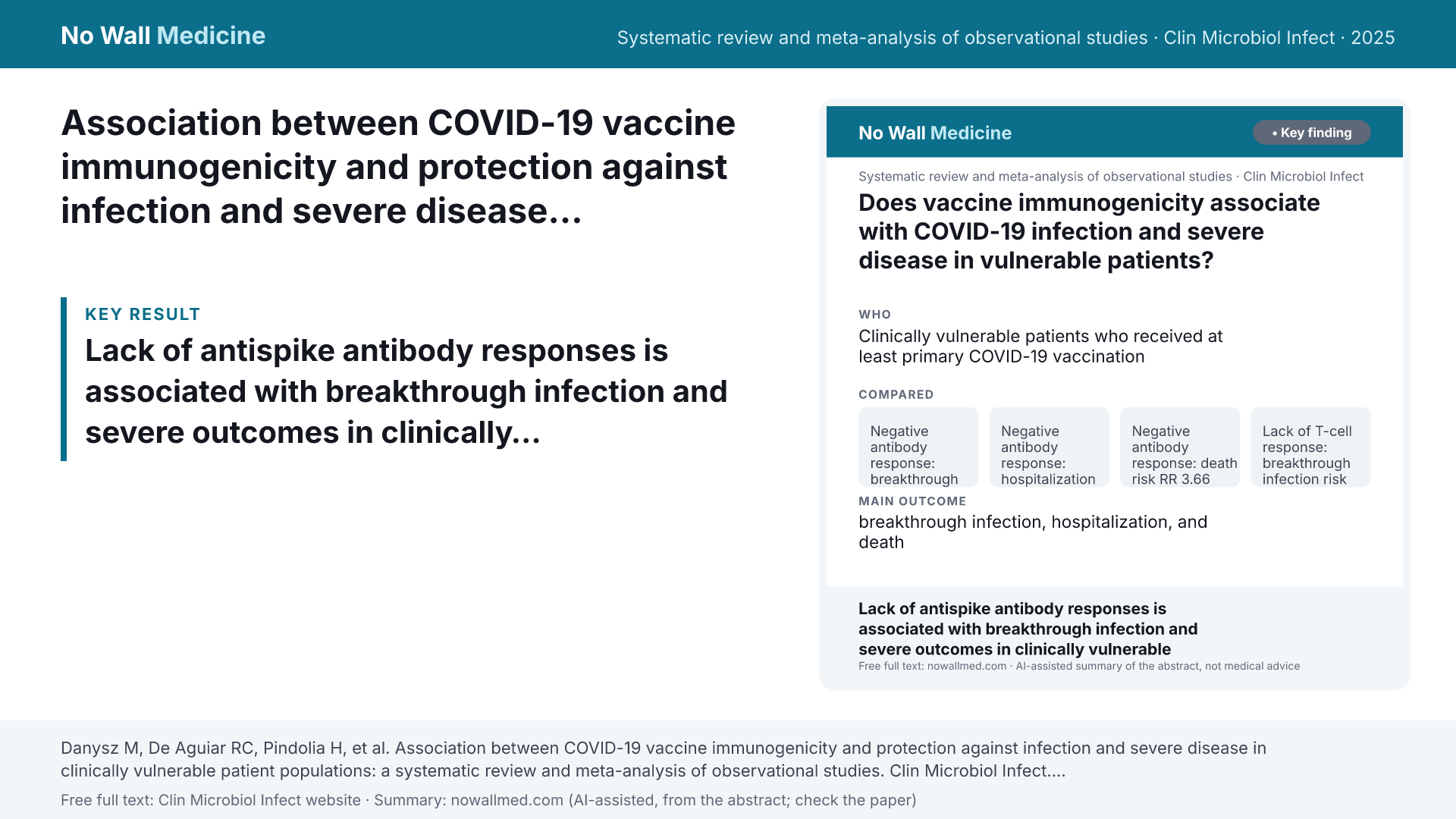
Association between COVID-19 vaccine immunogenicity and protection against infection and severe disease in clinically vulnerable patient populations: a systematic review and meta-analysis of observational studies
Systematic review and meta-analysis of observational studiesBenefit found
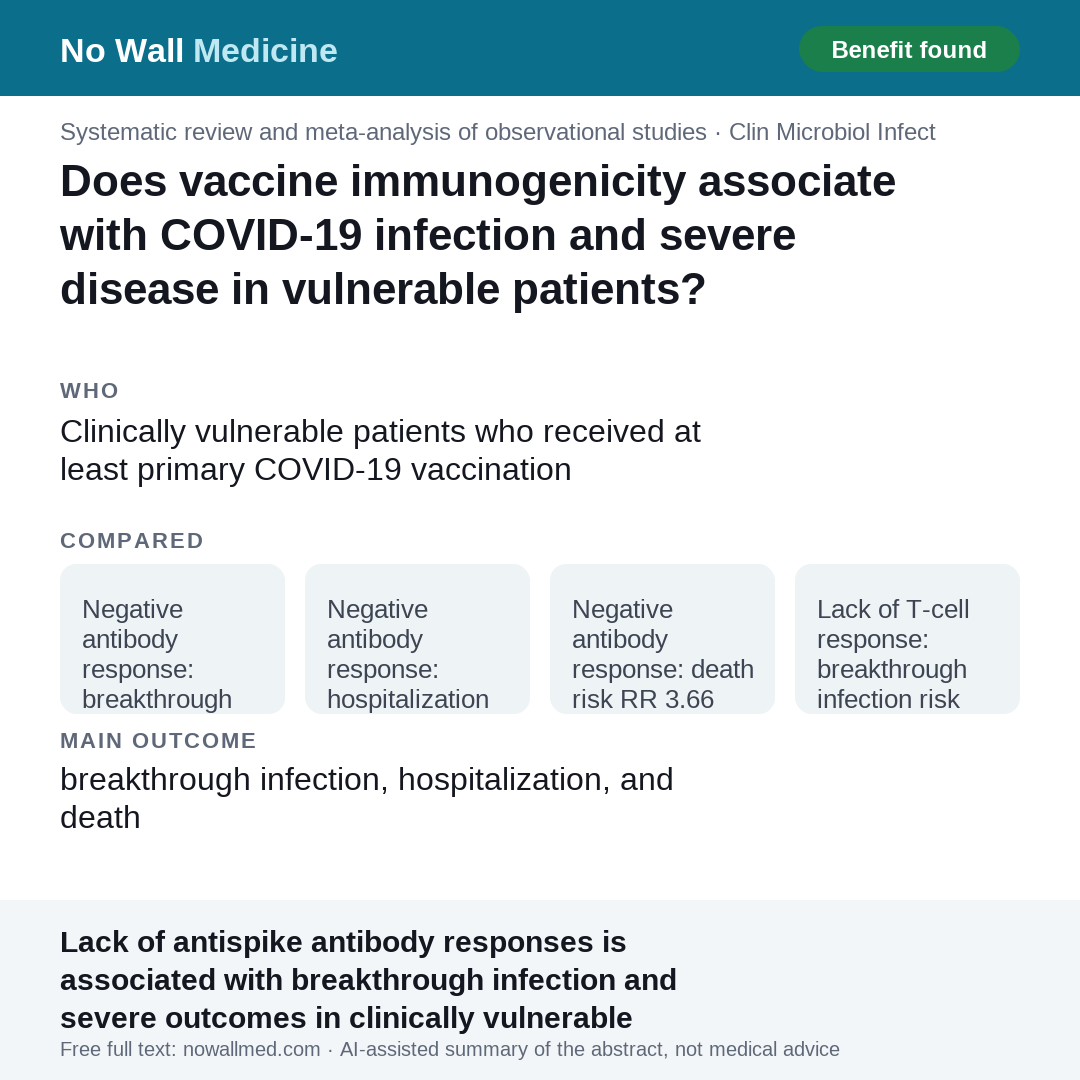
Does vaccine immunogenicity associate with COVID-19 infection and severe disease in vulnerable patients?
Who
Clinically vulnerable patients who received at least primary COVID-19 vaccination
Compared
Negative antibody response: breakthrough infection risk RR 1.82 (1.45-2.29)
Negative antibody response: hospitalization risk RR 5.88 (4.08-8.47)
Negative antibody response: death risk RR 3.66 (1.87-7.15)
Lack of T-cell response: breakthrough infection risk RR 2.08 (1.08-4.04)
Main outcome
breakthrough infection, hospitalization, and death
Bottom line: Lack of antispike antibody responses is associated with breakthrough infection and severe outcomes in clinically vulnerable populations.
Limitation: Most included studies were of poor quality according to the Newcastle-Ottawa Quality Assessment Scale.
Clin Microbiol Infect · 2025-09-27Download image
Clinical question: Does vaccine immunogenicity associate with COVID-19 infection and severe disease in vulnerable patients?
Abstract
Background
The use of measured immune responses in informing risk of breakthrough COVID-19 infection and infection outcomes after vaccination against SARS-CoV-2 in clinically vulnerable patients has not been applied clinically. Objectives
The aim of this study was to investigate the association between measured vaccine immunogenicity and vaccine effectiveness in clinically vulnerable populations. Data sources
PubMed, MEDLINE, EMBASE, and Cochrane Library. Study eligibility criteria
Studies published between March 2020 and January 2025, which reported data on COVID-19 vaccine immunogenicity (antibody and T-cell) and subsequent infection outcomes. Participants
Patients defined as clinically vulnerable by QCOVID criteria, who had received at least the primary course of COVID-19 vaccination. Assessment of risk of bias
The Newcastle-Ottawa Quality Assessment Scale was used to assess the risk of bias. Methods of data synthesis
A random effects meta-analysis model was used to pool relative risks of COVID-19 breakthrough infection (BTI), hospitalization, and death. Unadjusted data were used for the primary analysis due to the lack of adjusted data available in individual studies. Results
We identified 3305 articles, of which 45 observational studies were included in the review. Negative antibody response following COVID-19 vaccination was associated with higher risks of BTI (Relative Risk (RR), 1.82 (1.45-2.29), p < 0.01, I2 = 84.03%), COVID-19-related hospitalization (RR, 5.88 (4.08-8.47), p < 0.01, I2 = 25.59%) and death (RR, 3.66 (1.87-7.15), p < 0.01), I2 = 0%). Lack of T-cell response was associated with a higher risk of BTI (RR, 2.08 (1.08-4.04), p 0.03, I2 = 65.99). Using the Newcastle-Ottawa Quality Assessment Scale, 5 (11%) studies were of good quality, 2 (7%) of fair quality, and 37 (82%) of poor quality. Conclusions
Within the methodological limitations, this study has shown that lack of antispike antibody responses was associated with BTI and severe infection outcomes in clinically vulnerable populations. Further research is required to investigate the current utility of testing to inform the ongoing management of clinically vulnerable persons, such as vaccine booster schedules.
Subject terms
Cite this article
Danysz M, De Aguiar RC, Pindolia H, Stuart B, Spensley K, Ashmore E. Association between COVID-19 vaccine immunogenicity and protection against infection and severe disease in clinically vulnerable patient populations: a systematic review and meta-analysis of observational studies. Clin Microbiol Infect. 2025. doi:10.1016/j.cmi.2025.09.020
Spotted a mistake? Suggest a correction
Top studies every Monday
The week’s key trials and guidelines in your specialties, plus any topics you follow. By email, free.
Get the weekly digest