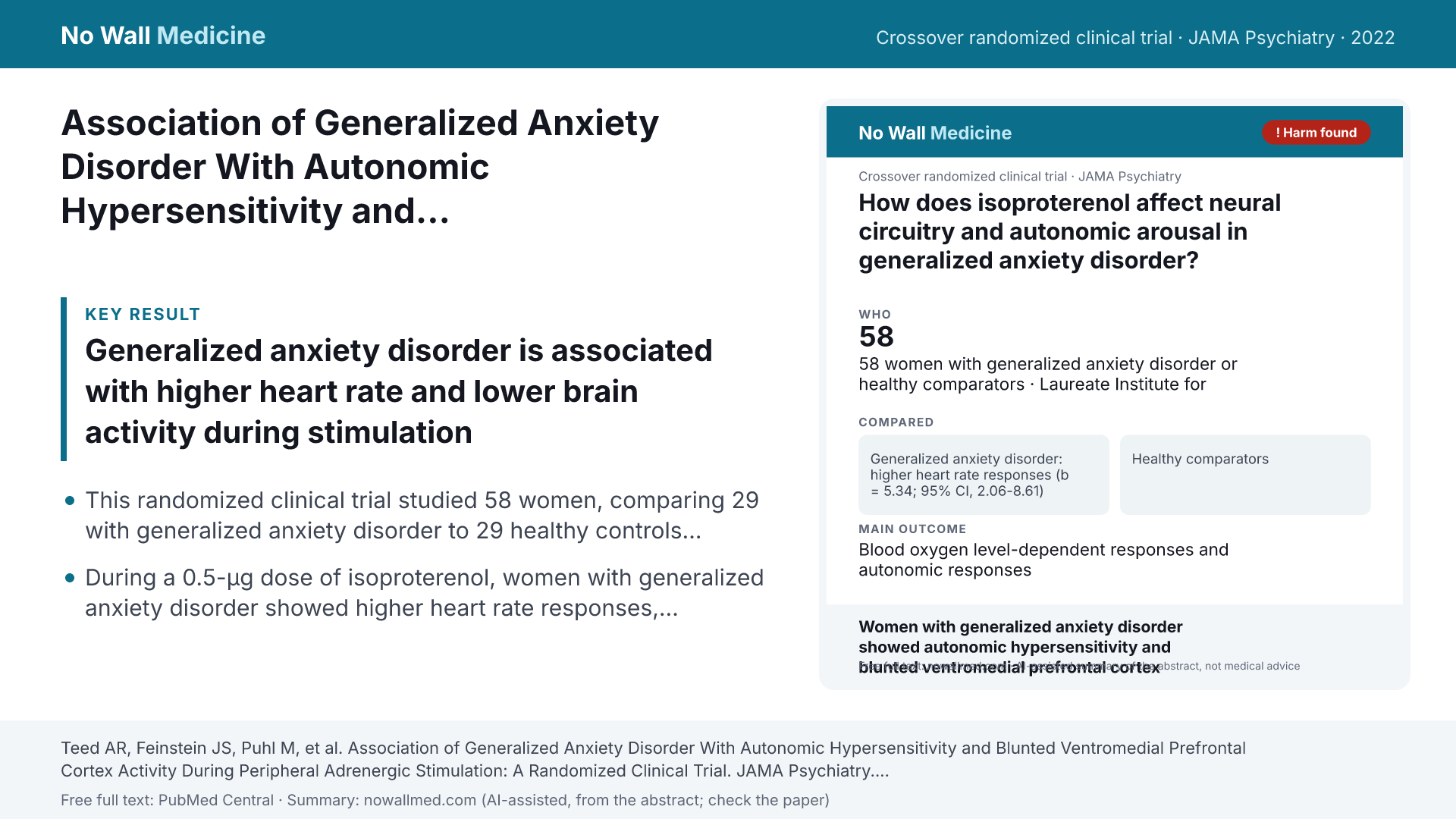
Generalized anxiety disorder is associated with higher heart rate and lower brain activity during stimulation
Association of Generalized Anxiety Disorder With Autonomic Hypersensitivity and Blunted Ventromedial Prefrontal Cortex Activity During Peripheral Adrenergic Stimulation: A Randomized Clinical Trial
Crossover randomized clinical trialHarm found
How does isoproterenol affect neural circuitry and autonomic arousal in generalized anxiety disorder?
Who
58
58 women with generalized anxiety disorder or healthy comparators · Laureate Institute for Brain Research, Oklahoma
Compared
Generalized anxiety disorder: higher heart rate responses (b = 5.34; 95% CI, 2.06-8.61)
Healthy comparators
Main outcome
Blood oxygen level-dependent responses and autonomic responses
Result: Cohen d = 1.55 for ventromedial prefrontal cortex hypoactivation
Bottom line: Women with generalized anxiety disorder showed autonomic hypersensitivity and blunted ventromedial prefrontal cortex activity during adrenergic stimulation.
JAMA Psychiatry · 2022-02-03 · Save PNG
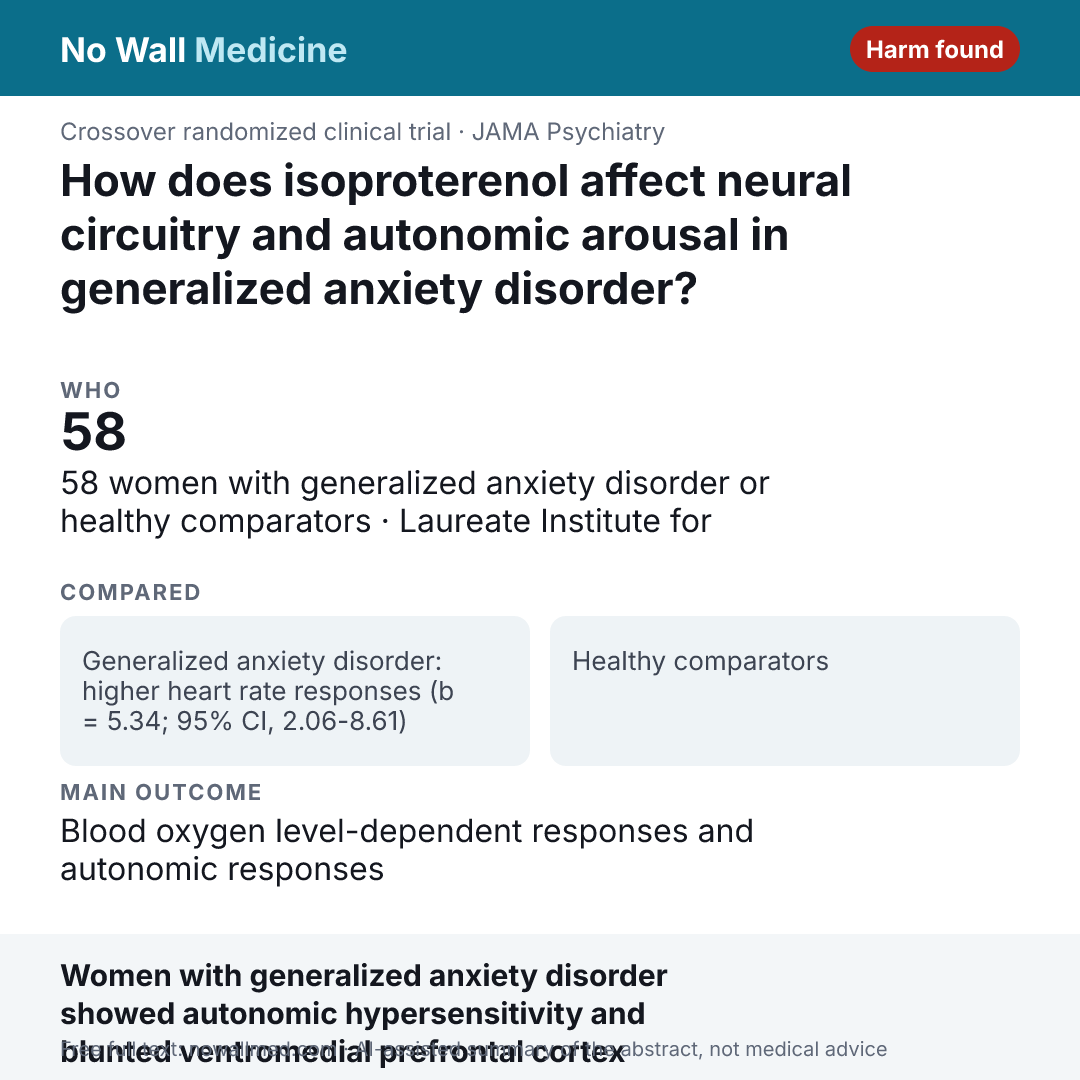
Clinical question: How does isoproterenol affect neural circuitry and autonomic arousal in generalized anxiety disorder?
Key points
- This randomized clinical trial studied 58 women, comparing 29 with generalized anxiety disorder to 29 healthy controls using isoproterenol, a drug that mimics adrenaline.
- During a 0.5-μg dose of isoproterenol, women with generalized anxiety disorder showed higher heart rate responses, higher anxiety, and higher intensity of heart and breathing sensations.
- The group with generalized anxiety disorder also showed lower activity in the ventromedial prefrontal cortex, a brain region involved in regulation, during the drug response.
Headline and key points written with AI from the paper’s abstract, with every number checked against it. Read the paper before relying on them.
Was this summary helpful?
Subject terms
Headline, design, result, key points, caveat and citation as plain text.
Cite this article
Teed AR, Feinstein JS, Puhl M, et al. Association of Generalized Anxiety Disorder With Autonomic Hypersensitivity and Blunted Ventromedial Prefrontal Cortex Activity During Peripheral Adrenergic Stimulation: A Randomized Clinical Trial. JAMA Psychiatry. 2022. doi:10.1001/jamapsychiatry.2021.4225
Spotted a mistake? Suggest a correction