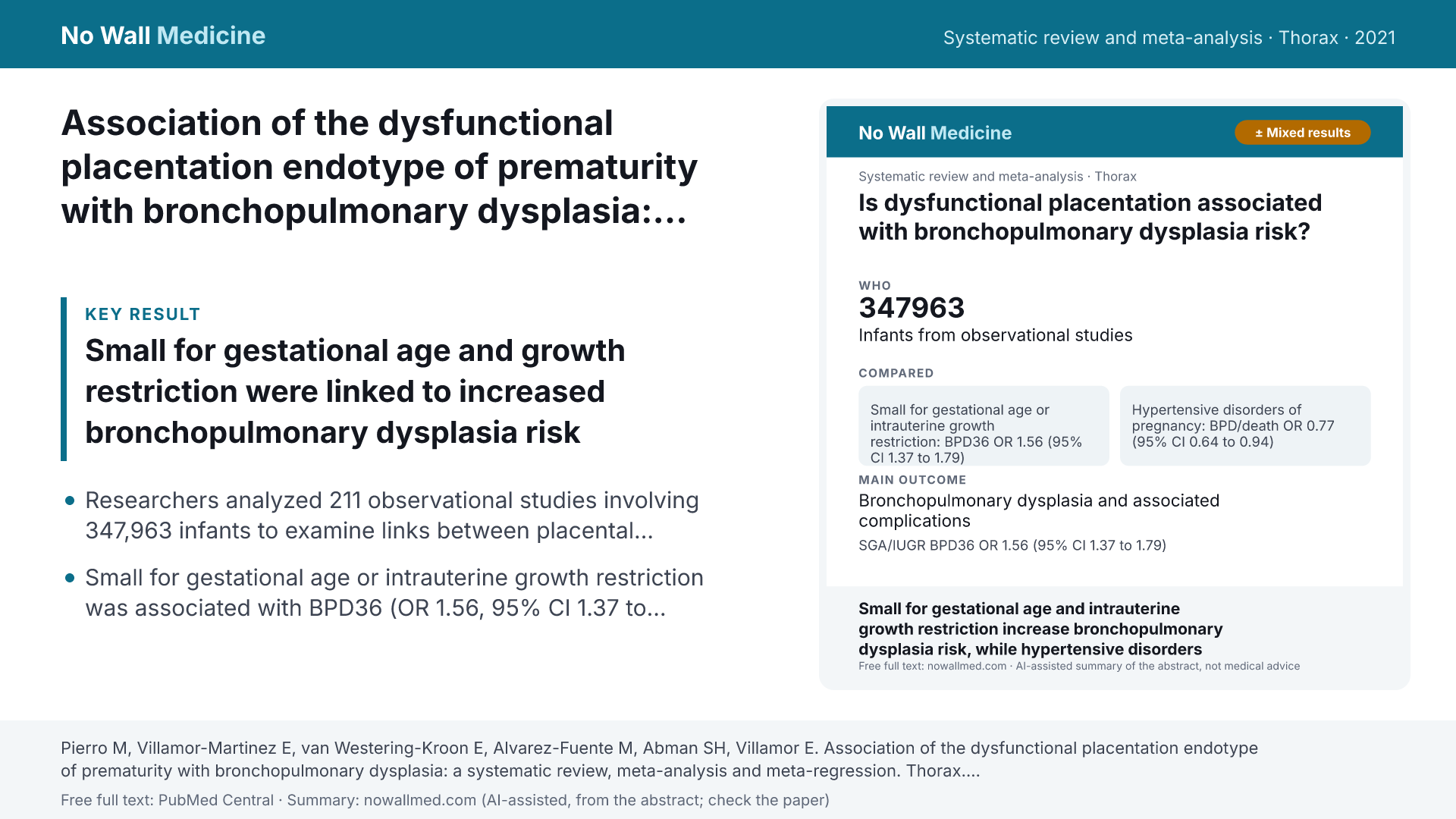
Small for gestational age and growth restriction were linked to increased bronchopulmonary dysplasia risk
Association of the dysfunctional placentation endotype of prematurity with bronchopulmonary dysplasia: a systematic review, meta-analysis and meta-regression
Systematic review and meta-analysisMixed results
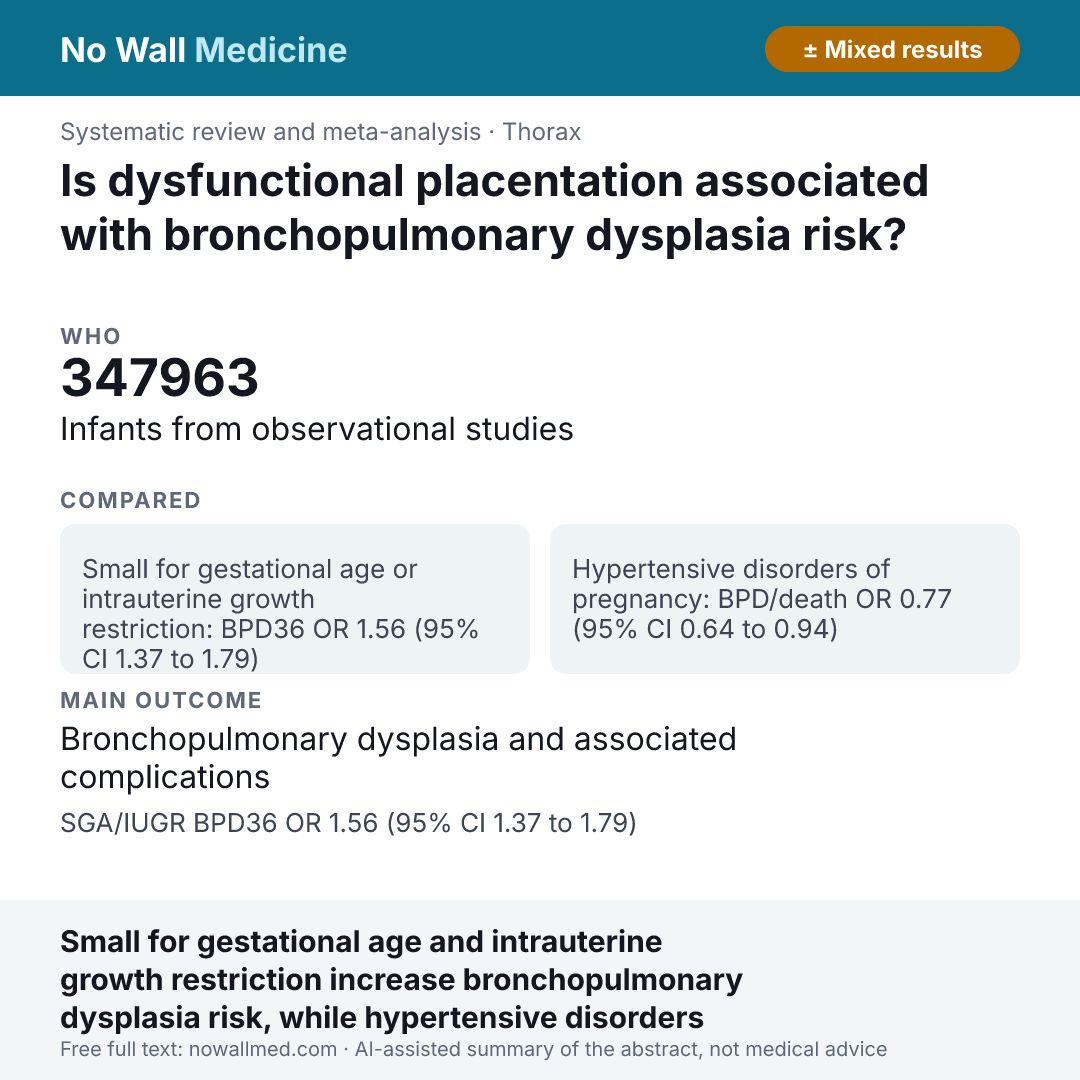
Is dysfunctional placentation associated with bronchopulmonary dysplasia risk?
Who
347963
Infants from observational studies
Compared
Small for gestational age or intrauterine growth restriction: BPD36 OR 1.56 (95% CI 1.37 to 1.79)
Hypertensive disorders of pregnancy: BPD/death OR 0.77 (95% CI 0.64 to 0.94)
Main outcome
Bronchopulmonary dysplasia and associated complications
Result: SGA/IUGR BPD36 OR 1.56 (95% CI 1.37 to 1.79)
Bottom line: Small for gestational age and intrauterine growth restriction increase bronchopulmonary dysplasia risk, while hypertensive disorders show different associations.
Thorax · 2021-07-23 · PROSPERO CRD42018086877
Headline and visual abstract written with AI from the paper’s abstract, with every number checked against it. Read the paper before relying on them.
Was this summary helpful?
Abstract
Background
Antenatal pathological conditions are key in the pathogenesis of bronchopulmonary dysplasia (BPD). Pathophysiological pathways or endotypes leading to prematurity and perinatal lung injury can be clustered into two groups: infection and dysfunctional placentation, which include hypertensive disorders of pregnancy (HDP) and intrauterine growth restriction (IUGR). We conducted a systematic review of observational studies exploring the association between the dysfunctional placentation endotype and BPD. Methods
MEDLINE, Embase and Web of Science databases were searched up to February 2020 for studies reporting data on the diagnosis of HDP, IUGR or small for gestational age (SGA) and BPD risk. BPD was classified as BPD28 (supplemental oxygen on day 28), BPD36 (oxygen at 36 weeks postmenstrual age), severe BPD (≥ 30% oxygen or mechanical ventilation), BPD36/death and BPD-associated pulmonary hypertension. Results
Of 6319 studies screened, 211 (347 963 infants) were included. Meta-analysis showed an association between SGA/IUGR and BPD36 (OR 1.56, 95% CI 1.37 to 1.79), severe BPD (OR 1.82, 95% CI 1.36 to 2.29) and BPD/death (OR 1.91, 95% CI 1.55 to 2.37). Exposure to HDP was not associated with BPD but was associated with decreased odds of BPD/death (OR 0.77, 95% CI 0.64 to 0.94). Both HDP (OR 1.41, 95% CI 1.10 to 1.80) and SGA/IUGR (OR 2.37, 95% CI 1.86 to 3.02) were associated with BPD-associated pulmonary hypertension. Conclusion
When placental vascular dysfunction is accompanied by fetal growth restriction or being born SGA, it is associated with an increased risk of developing BPD and pulmonary hypertension. The placental dysfunction endotype of prematurity is strongly associated with the vascular phenotype of BPD. Prospero registration number
Review protocol was registered in PROSPERO database (ID=CRD42018086877).
Abstract reproduced under the article’s CC BY NC licence.
Subject terms
Cite this article
Pierro M, Villamor-Martinez E, van Westering-Kroon E, Alvarez-Fuente M, Abman SH, Villamor E. Association of the dysfunctional placentation endotype of prematurity with bronchopulmonary dysplasia: a systematic review, meta-analysis and meta-regression. Thorax. 2022;77(3):268-275. doi:10.1136/thoraxjnl-2020-216485
Spotted a mistake? Suggest a correction