Atrial shunt device changed heart structure and function in patients with heart failure
Atrial Shunt Device Effects on Cardiac Structure and Function in Heart Failure With Preserved Ejection Fraction: The REDUCE LAP-HF II Randomized Clinical Trial
Sham-controlled randomized clinical trialMixed results
Does an atrial shunt device affect cardiac structure and function in heart failure patients?
Who
621
Patients with heart failure with preserved or mildly reduced ejection fraction · 89 international medical centers
Compared
Atrial shunt device: mean difference, -5.65 mL
Sham control
Main outcome
Changes in echocardiographic measures from baseline to 24 months
Result: mean difference, -5.65 mL (for left ventricular end-diastolic volume)
Bottom line: Atrial shunting led to left-sided chamber reverse remodeling and increased right-sided chamber volumes but no change in right ventricular function.
JAMA Cardiol · 2024-04-17Download image
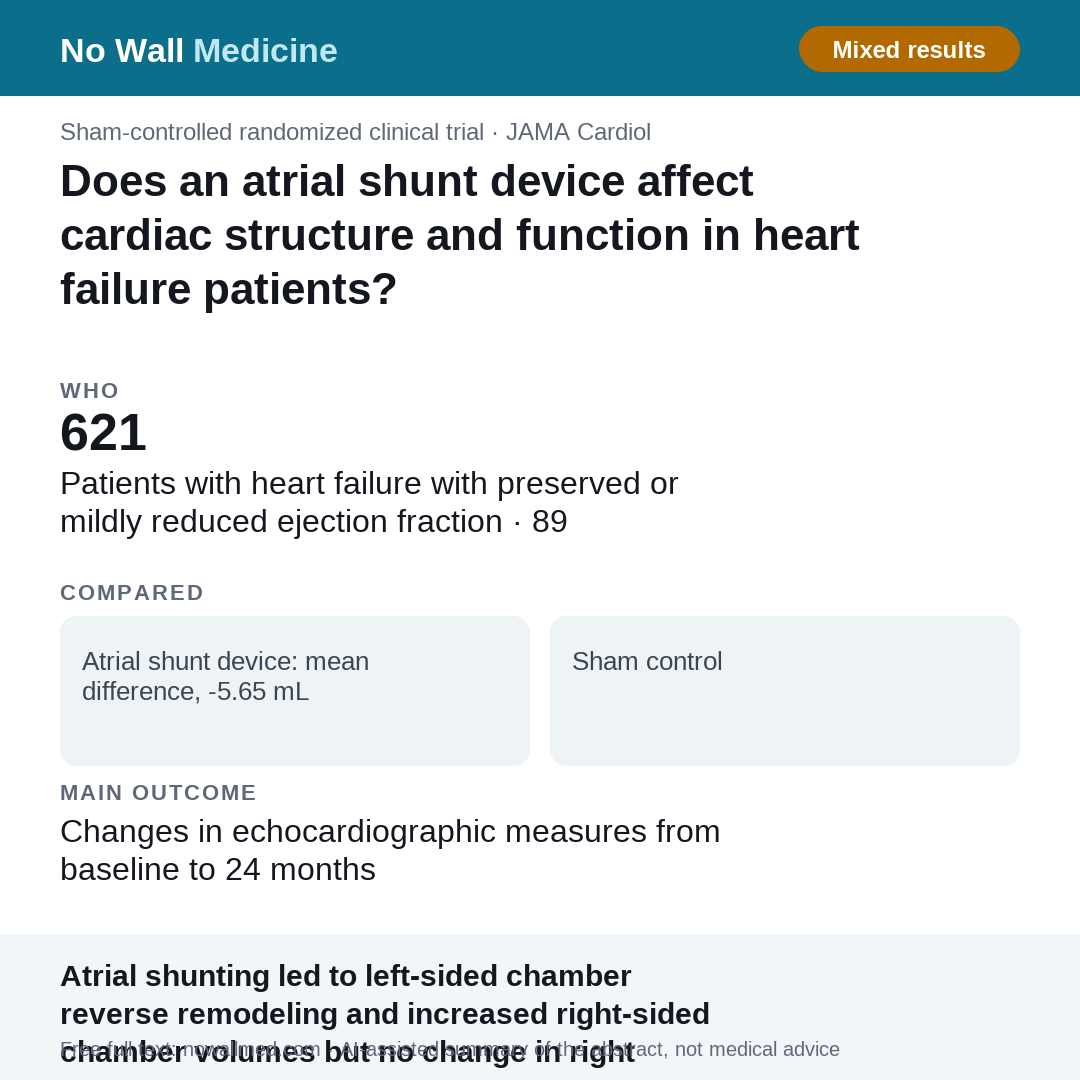
Clinical question: Does an atrial shunt device affect cardiac structure and function in heart failure patients?
Why it matters: It was unknown how an atrial shunt device affects cardiac structure and function in patients with heart failure with preserved or mildly reduced ejection fraction.
Key points
- This randomized clinical trial included 621 patients with heart failure and preserved or mildly reduced ejection fraction who received either an atrial shunt device or a sham control.
- Compared to sham, the shunt group showed a mean difference of -5.65 mL in left ventricular end-diastolic volume, -2.8 mL in left atrial minimal volume, and an increase in right ventricular volume of 9.58 mL.
- In the shunt group, responders had smaller increases in right ventricular end-diastolic volume (mean difference, 5.71 mL vs 15.18 mL) compared to nonresponders.
Headline and key points written with AI from the paper’s abstract, with every number checked against it. Read the paper before relying on them.
Topics
Cite this article
Patel RB, Silvestry FE, Komtebedde J, Solomon SD, Hasenfuß G, Litwin SE. Atrial Shunt Device Effects on Cardiac Structure and Function in Heart Failure With Preserved Ejection Fraction: The REDUCE LAP-HF II Randomized Clinical Trial. JAMA Cardiol. 2024. doi:10.1001/jamacardio.2024.0520
Spotted a mistake? Suggest a correction
Top studies every Monday
The week’s key trials and guidelines in your specialties, plus any topics you follow. By email, free.
Get the weekly digest