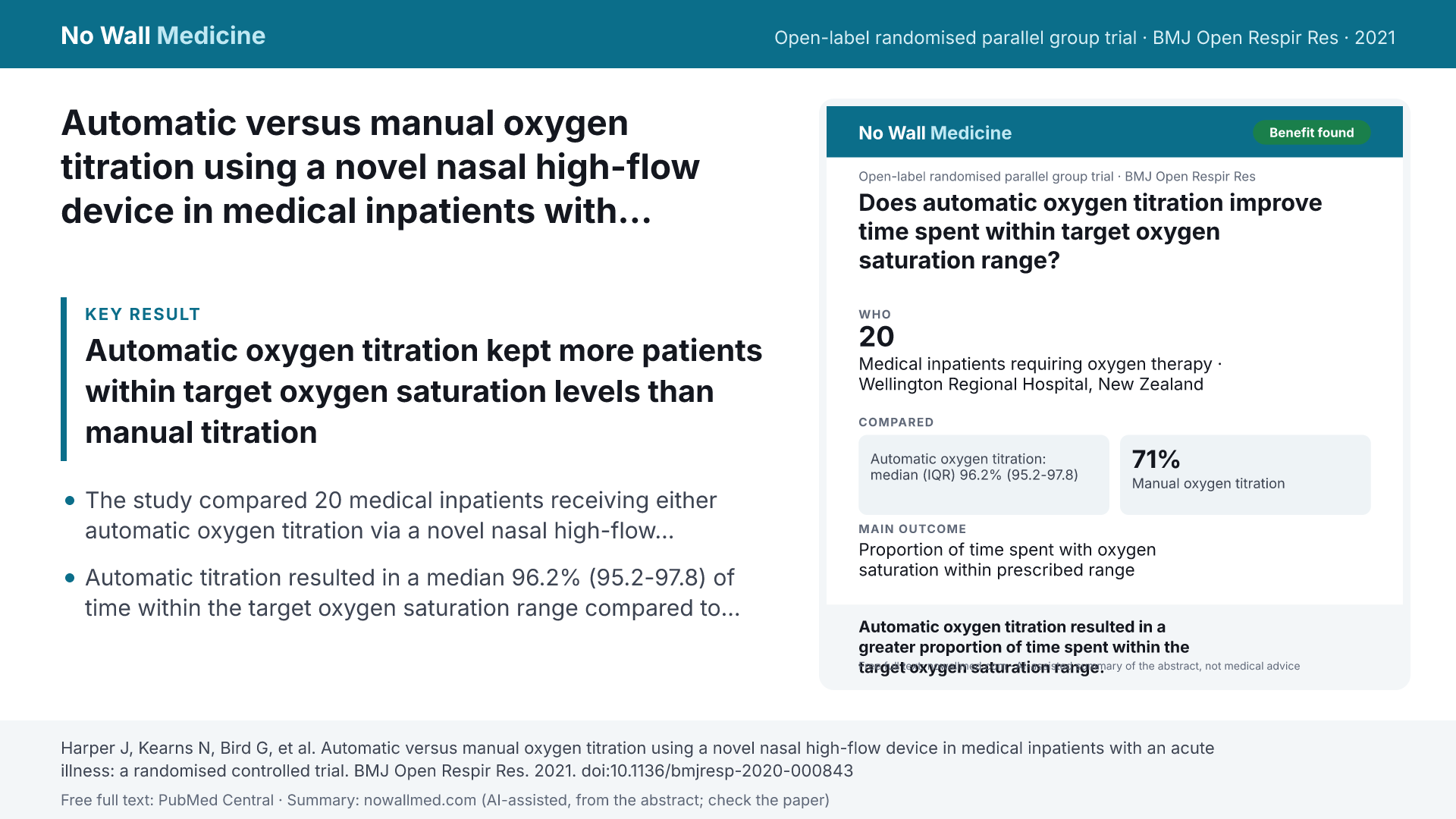
Automatic oxygen titration kept more patients within target oxygen saturation levels than manual titration
Automatic versus manual oxygen titration using a novel nasal high-flow device in medical inpatients with an acute illness: a randomised controlled trial
Open-label randomised parallel group trialBenefit found
Does automatic oxygen titration improve time spent within target oxygen saturation range?
Who
20
Medical inpatients requiring oxygen therapy · Wellington Regional Hospital, New Zealand
Compared
Automatic oxygen titration: median (IQR) 96.2% (95.2-97.8)
71%Manual oxygen titration (59.4-88.3)
Main outcome
Proportion of time spent with oxygen saturation within prescribed range
Result: difference (95% CI) 24.2% (7.9% to 35%)
Bottom line: Automatic oxygen titration resulted in a greater proportion of time spent within the target oxygen saturation range.
BMJ Open Respir Res · 2021-08-07Download image
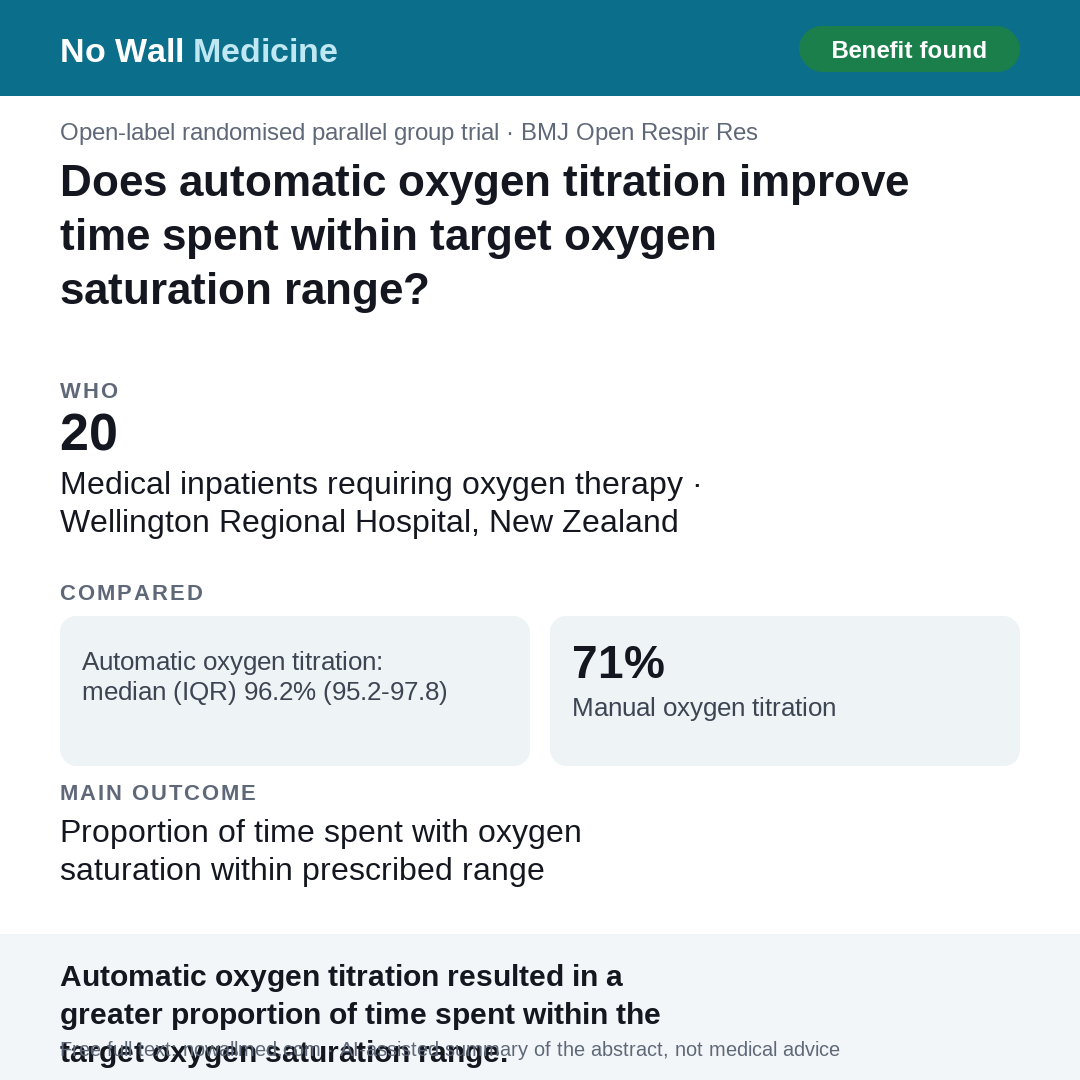
Clinical question: Does automatic oxygen titration improve time spent within target oxygen saturation range?
Why it matters: Manual oxygen titration frequently results in oxygen saturation levels falling outside of the prescribed target range for acutely unwell patients.
Key points
- The study compared 20 medical inpatients receiving either automatic oxygen titration via a novel nasal high-flow device or manual titration using nasal high flow.
- Automatic titration resulted in a median 96.2% (95.2-97.8) of time within the target oxygen saturation range compared to 71% (59.4-88.3) for manual titration.
- Automatic titration was associated with a -1% (-8.2% to -0.04%) difference in time spent with oxygen saturation 2% or more above the target range.
Headline and key points written with AI from the paper’s abstract, with every number checked against it. Read the paper before relying on them.
Was this summary helpful?
Abstract
Background
Guideline recommendations state oxygen should be administered to acutely unwell patients to achieve a target oxygen saturation (SpO2) range. The current practice of manual oxygen titration frequently results in SpO2 outside of a prescribed range. The aim of this study was to assess the efficacy of automatic oxygen titration using a closed-loop feedback system to achieve SpO2 within a prescribed target range METHODS: An open-label randomised parallel group trial was undertaken comparing automatic oxygen titration using a novel nasal high-flow device to manual oxygen titration using nasal high flow. Medical inpatients requiring oxygen therapy in Wellington Regional Hospital, New Zealand with a prescribed target SpO2 range of 88%-92% or 92%-96% were recruited and randomised equally between the interventions for a period of 24 hours. The primary outcome was the proportion of time spent with SpO2 within the prescribed range. Results
20 patients were included in the analysis. Automatic oxygen titration resulted in a median (IQR) 96.2% (95.2-97.8) of time within the target range compared with 71% (59.4-88.3) with manual titration; difference (95% CI) 24.2% (7.9% to 35%), p<0.001. There was a reduction in the time spent with SpO2 ≥2% above and ≥2% below range in the automatic titration group, although the point estimate for the differences were small; -1% (-8.2% to -0.04%), p=0.017 and -2.4% (-11.5% to 0.3%), p=0.05 respectively. Conclusions
Nasal high-flow with automatic oxygen titration resulted in a greater proportion of time spent with SpO2 in target range compared with manual titration. Trial registration
The trial was registered with the Australian and New Zealand Clinical Trials Registry (ACTRN12619000901101).
Abstract reproduced under the article’s CC BY NC licence.
Subject terms
Headline, design, result, key points, caveat and citation as plain text.
Cite this article
Harper J, Kearns N, Bird G, et al. Automatic versus manual oxygen titration using a novel nasal high-flow device in medical inpatients with an acute illness: a randomised controlled trial. BMJ Open Respir Res. 2021. doi:10.1136/bmjresp-2020-000843
Spotted a mistake? Suggest a correction