Smaller ventilation bags were associated with lower survival rates during adult cardiopulmonary resuscitation
Bag size for manual ventilation during cardiopulmonary resuscitation in adult cardiac arrest: a systematic review
Systematic reviewHarm found
Does using smaller-capacity self-inflating bags versus standard-size bags affect cardiopulmonary resuscitation outcomes?
Who
1994
Out-of-hospital cardiac arrest patients and simulation participants
Compared
Smaller ventilation bags (450-700 mL): lower survival with favorable neurological outcome (AOR 0.65, 95% CI 0.43-0.99)
Standard adult bags (1000-1685 mL)
Main outcome
Survival to discharge and favorable neurological outcome
Result: AOR 0.65 (95% CI 0.43-0.99)
Bottom line: Smaller bags may worsen patient outcomes and are not recommended for routine substitution during cardiopulmonary resuscitation.
Limitation: No randomized trials were identified and certainty of evidence was very low.
Resusc Plus · 2026-07-29 · Save PNG
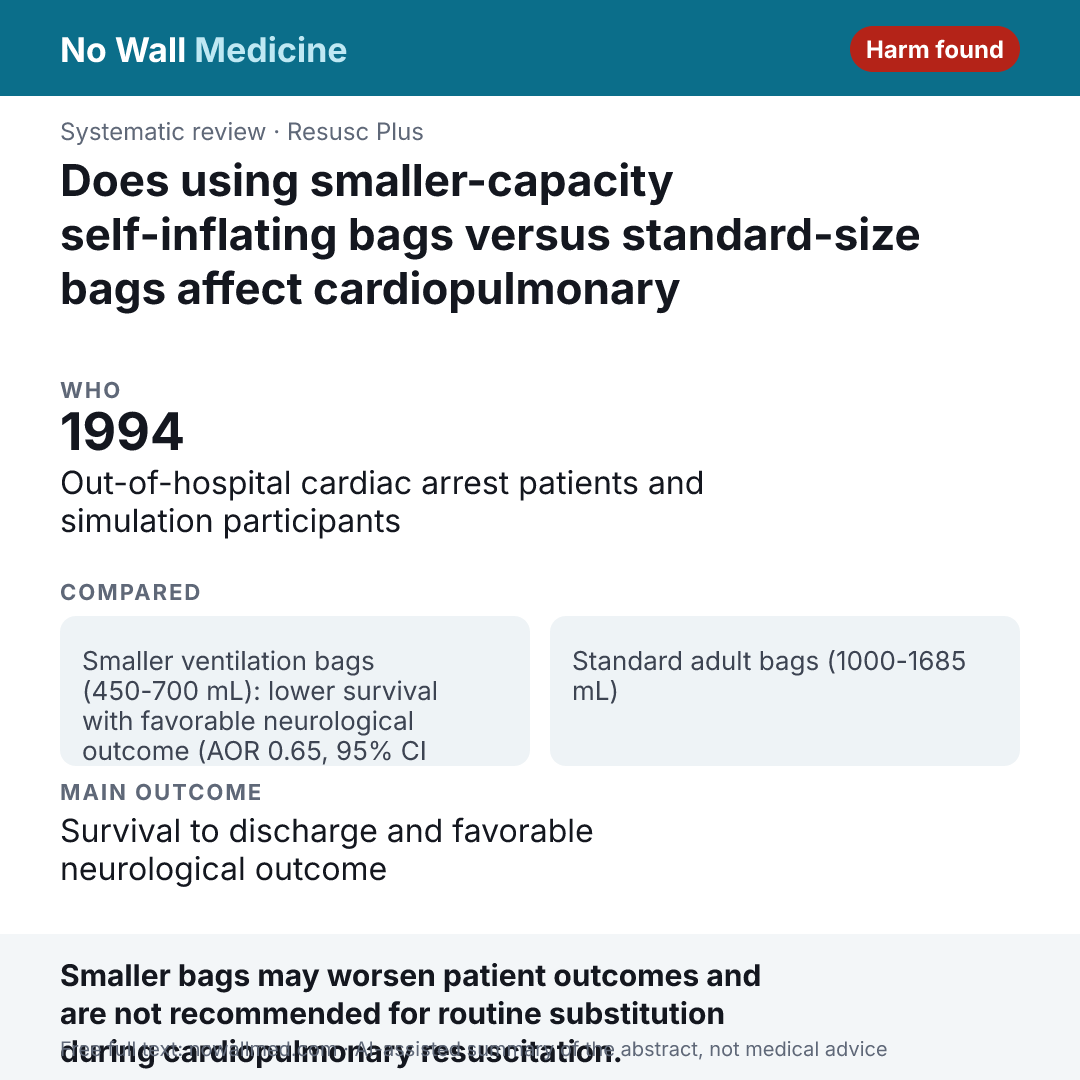
Clinical question: Does using smaller-capacity self-inflating bags versus standard-size bags affect cardiopulmonary resuscitation outcomes?
Key points
- Researchers reviewed one observational study of 1994 out-of-hospital cardiac arrest patients and two simulation studies comparing small bags (450-700 mL) to standard adult bags (1000-1685 mL).
- The use of smaller bags was associated with lower survival with favorable neurological outcome (AOR 0.65, 95% CI 0.43-0.99) and lower event survival (AOR 0.73, 95% CI 0.60-0.90).
- Survival to discharge and return of spontaneous circulation, which is the resumption of a heartbeat, did not differ significantly between the two bag sizes.
Limitation the authors note: The certainty of evidence was very low for all outcomes and no randomized trials were identified.
Headline and key points written with AI from the paper’s abstract, with every number checked against it. Read the paper before relying on them.
Was this summary helpful?
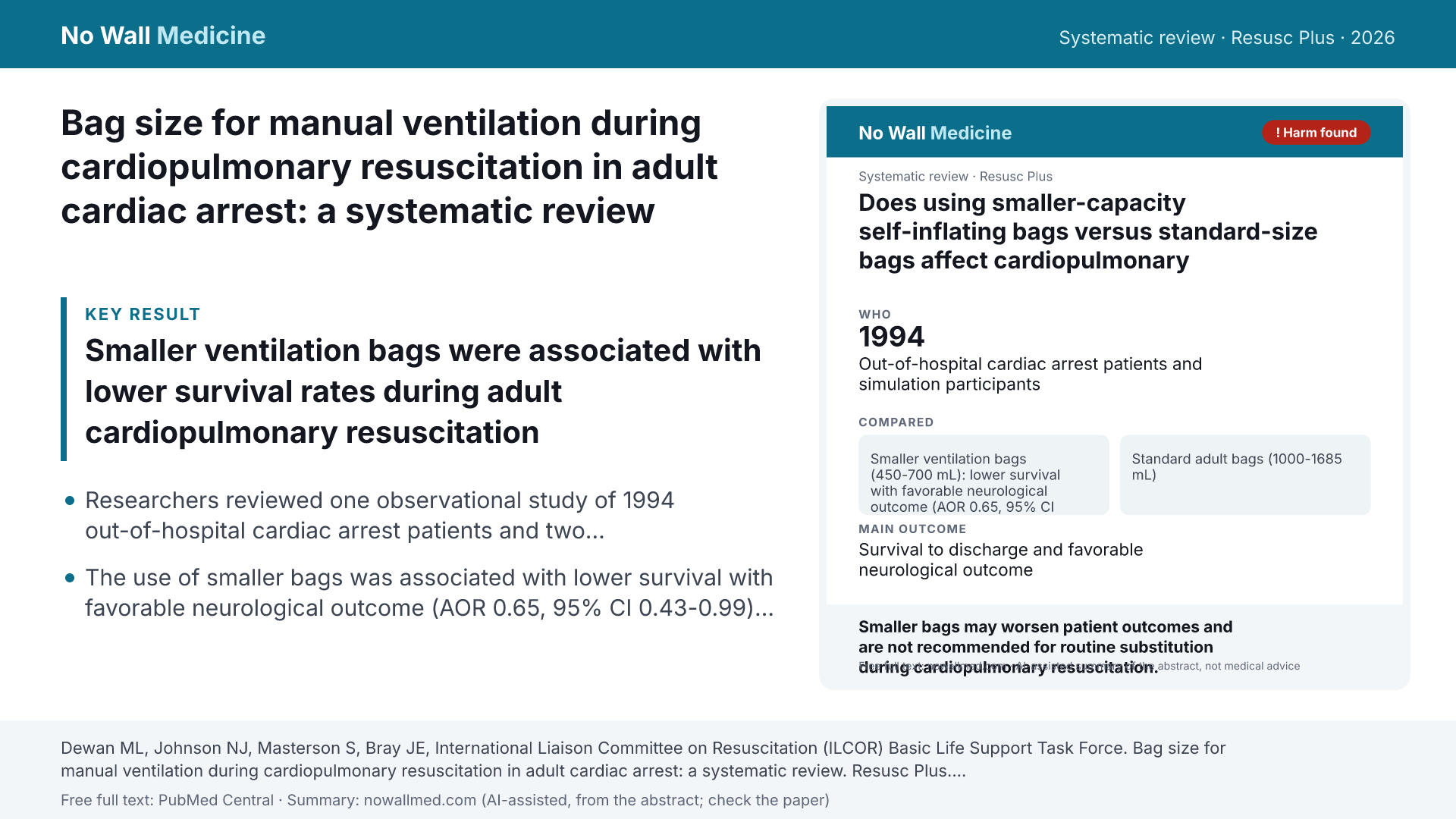
Headline, design, result, key points, caveat and citation as plain text.
Cite this article
Dewan ML, Johnson NJ, Masterson S, Bray JE, International Liaison Committee on Resuscitation (ILCOR) Basic Life Support Task Force. Bag size for manual ventilation during cardiopulmonary resuscitation in adult cardiac arrest: a systematic review. Resusc Plus. 2026;31:101422. doi:10.1016/j.resplu.2026.101422
Spotted a mistake? Suggest a correction