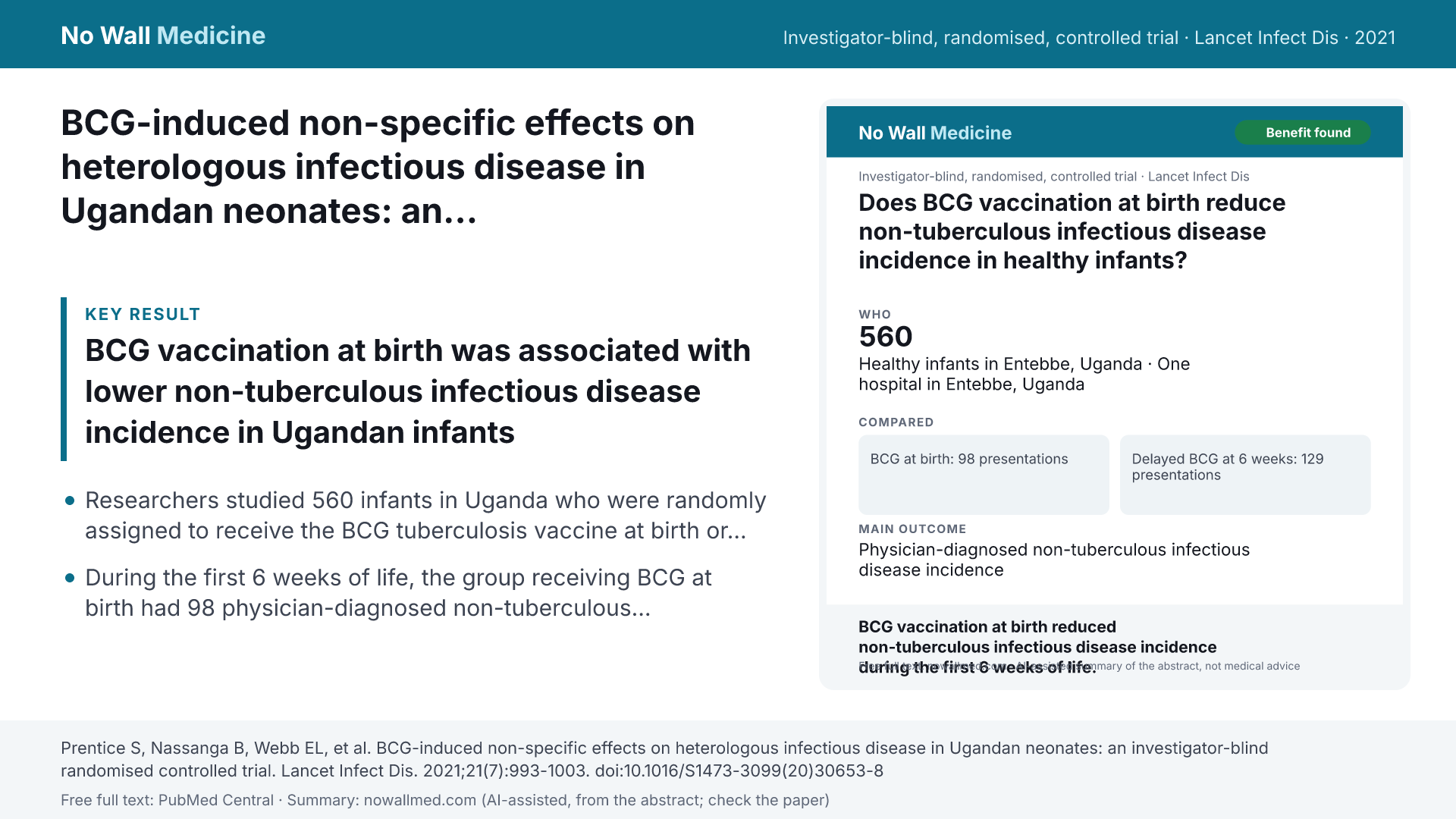
BCG vaccination at birth was associated with lower non-tuberculous infectious disease incidence in Ugandan infants
BCG-induced non-specific effects on heterologous infectious disease in Ugandan neonates: an investigator-blind randomised controlled trial
Investigator-blind, randomised, controlled trialBenefit found
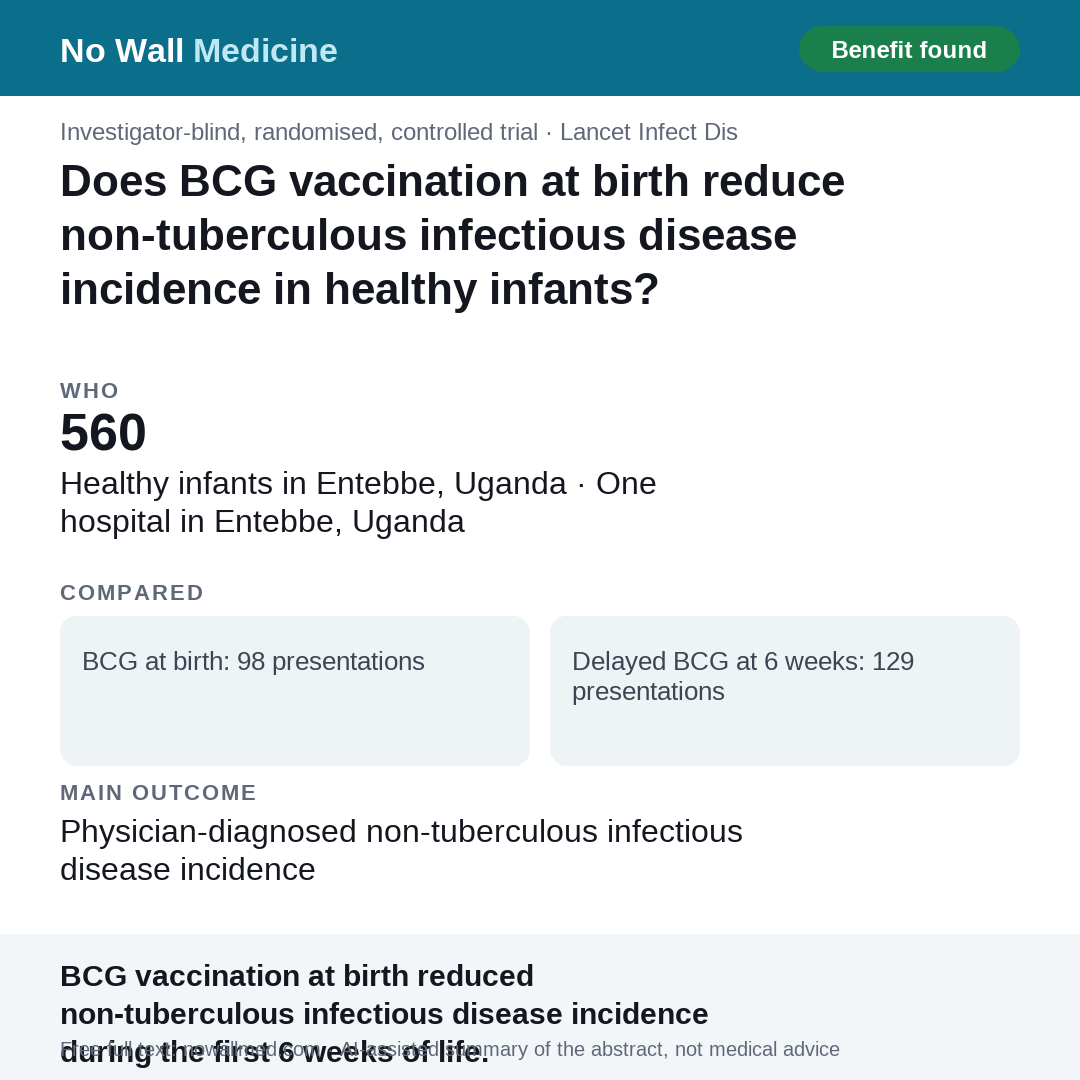
Does BCG vaccination at birth reduce non-tuberculous infectious disease incidence in healthy infants?
Who
560
Healthy infants in Entebbe, Uganda · One hospital in Entebbe, Uganda
Compared
BCG at birth: 98 presentations
Delayed BCG at 6 weeks: 129 presentations
Main outcome
Physician-diagnosed non-tuberculous infectious disease incidence
Result: hazard ratio 0·71 (95% CI 0·53-0·95)
Bottom line: BCG vaccination at birth reduced non-tuberculous infectious disease incidence during the first 6 weeks of life.
Limitation: Parents were not masked to group assignment.
Lancet Infect Dis · 2021-02-17Download image
Clinical question: Does BCG vaccination at birth reduce non-tuberculous infectious disease incidence in healthy infants?
Why it matters: It was unknown if BCG vaccination alters the incidence of non-tuberculous infectious diseases in healthy infants in high-mortality settings or if these effects are mediated by trained innate immunity.
Key points
- Researchers studied 560 infants in Uganda who were randomly assigned to receive the BCG tuberculosis vaccine at birth or at 6 weeks of age.
- During the first 6 weeks of life, the group receiving BCG at birth had 98 physician-diagnosed non-tuberculous infectious disease presentations compared to 129 in the delayed group.
- After the delayed group received their vaccine, there was no significant difference in disease incidence between the two groups, with 88 presentations versus 76 presentations.
Headline and key points written with AI from the paper’s abstract, with every number checked against it. Read the paper before relying on them.
Was this summary helpful?
Abstract
Background
Trials done in infants with low birthweight in west Africa suggest that BCG vaccination reduces all-cause mortality in the neonatal period, probably because of heterologous protection against non-tuberculous infections. This study investigated whether BCG alters all-cause infectious disease morbidity in healthy infants in a different high-mortality setting, and explored whether the changes are mediated via trained innate immunity. Methods
This was an investigator-blind, randomised, controlled trial done at one hospital in Entebbe, Uganda. Infants who were born unwell (ie, those who were not well enough to be discharged directly home from the labour ward because they required medical intervention), with major congenital malformations, to mothers with HIV, into families with known or suspected tuberculosis, or for whom cord blood samples could not be taken, were excluded from the study. Any other infant well enough to be discharged directly from the labour ward was eligible for inclusion, with no limitation on gestational age or birthweight. Participants were recruited at birth and randomly assigned (1:1) to receive standard dose BCG 1331 (BCG-Danish) on the day of birth or at age 6 weeks (computer-generated randomisation, block sizes of 24, stratified by sex). Investigators and clinicians were masked to group assignment; parents were not masked. Participants were clinically followed up to age 10 weeks and contributed blood samples to one of three immunological substudies. The primary clinical outcome was physician-diagnosed non-tuberculous infectious disease incidence. Primary immunological outcomes were histone trimethylation at the promoter region of TNF, IL6, and IL1B; ex-vivo production of TNF, IL-6, IL-1β, IL-10, and IFNγ after heterologous stimulation; and transferrin saturation and hepcidin levels. All outcomes were analysed in the modified intention-to-treat population of all randomly assigned participants except those whose for whom consent was withdrawn. This trial is registered with the International Standard Randomised Controlled Trial Number registry (#59683017). Findings
Between Sept 25, 2014, and July 31, 2015, 560 participants were enrolled and randomly assigned to receive BCG at birth (n=280) or age 6 weeks (n=280). 12 participants assigned to receive BCG at birth and 11 participants assigned to receive BCG at age 6 weeks were withdrawn from the study by their parents shortly after randomisation and were not included in analyses. During the first 6 weeks of life before the infants in the delayed vaccination group received BCG vaccination, physician-diagnosed non-tuberculous infectious disease incidence was lower in infants in the BCG at birth group than in the delayed group (98 presentations in the BCG at birth group vs 129 in the delayed BCG group; hazard ratio [HR] 0·71 [95% CI 0·53-0·95], p=0·023). After BCG in the delayed group (ie, during the age 6-10 weeks follow-up), there was no significant difference in non-tuberculous infectious disease incidence between the groups (88 presentations vs 76 presentations; HR 1·10 [0·87-1·40], p=0·62). BCG at birth inhibited the increase in histone trimethylation at the TNF promoter in peripheral blood mononuclear cells occurring in the first 6 weeks of life. H3K4me3 geometric mean fold-increases were 3·1 times lower at the TNF promoter (p=0·018), 2·5 times lower at the IL6 promoter (p=0·20), and 3·1 times lower at the IL1B promoter (p=0·082) and H3K9me3 geometric mean fold-increases were 8·9 times lower at the TNF promoter (p=0·0046), 1·2 times lower at the IL6 promoter (p=0·75), and 4·6 times lower at the IL1B promoter (p=0·068), in BCG-vaccinated (BCG at birth group) versus BCG-naive (delayed BCG group) infants. No clear effect of BCG on ex-vivo production of TNF, IL-6, IL-1β, IL-10, and IFNγ after heterologous stimulation, or transferrin saturation and hepcidin concentration, was detected (geometric mean ratios between 0·68 and 1·68; p≥0·038 for all comparisons). Interpretation
BCG vaccination protects against non-tuberculous infectious disease during the neonatal period, in addition to having tuberculosis-specific effects. Prioritisation of BCG on the first day of life in high-mortality settings might have significant public-health benefits through reductions in all-cause infectious morbidity and mortality. Funding
Wellcome Trust. Translations
For the Luganda and Swahili translations of the abstract see Supplementary Materials section.
Abstract reproduced under the article’s CC BY licence.
Subject terms
Cite this article
Prentice S, Nassanga B, Webb EL, et al. BCG-induced non-specific effects on heterologous infectious disease in Ugandan neonates: an investigator-blind randomised controlled trial. Lancet Infect Dis. 2021. doi:10.1016/S1473-3099(20)30653-8
Spotted a mistake? Suggest a correction