Bendamustine and high-dose cytarabine regimens showed similar progression-free survival rates
Bendamustine or high-dose cytarabine-based induction with rituximab in transplant-eligible mantle cell lymphoma
Retrospective adjusted comparison of two independent cohortsNo clear difference
Are bendamustine or high-dose cytarabine-based induction treatments better for mantle cell lymphoma?
Who
Transplant-eligible patients with stage II-IV mantle cell lymphoma · British Columbia Cancer and MCL Younger trial
Compared
Rituximab plus bendamustine: 90% overall response rate
Rituximab, cyclophosphamide, doxorubicin, vincristine, prednisone, dexamethasone, cytarabine, cisplatin: 94% overall response rate
Main outcome
progression-free survival
Result: hazard ratio 0.79 (95% confidence interval 0.45 to 1.37)
Bottom line: Rituximab plus bendamustine is a feasible first-line treatment with outcomes comparable to R-CHOP/R-DHAP in mantle cell lymphoma.
Blood Adv · 2022-04-20Download image
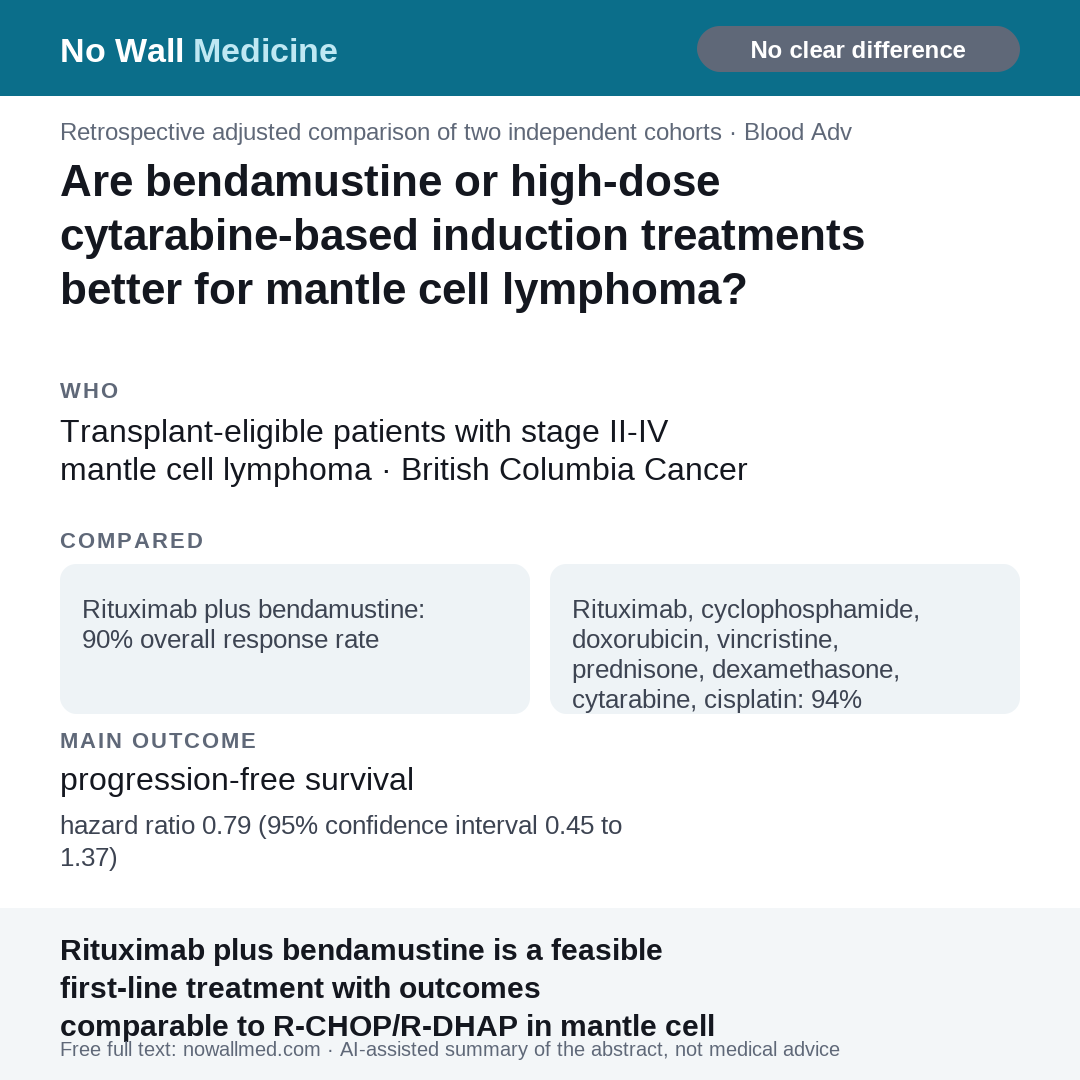
Clinical question: Are bendamustine or high-dose cytarabine-based induction treatments better for mantle cell lymphoma?
Why it matters: The effectiveness of bendamustine versus high-dose cytarabine-based induction with rituximab in mantle cell lymphoma was unknown
Key points
- 97 patients received rituximab plus bendamustine, compared to 232 patients on rituximab, cyclophosphamide, doxorubicin, vincristine, prednisone, dexamethasone, cytarabine, cisplatin.
- The hazard ratio for progression-free survival was 0.79, with a 95% confidence interval of 0.45-1.37.
- Overall response rates were 90% for rituximab plus bendamustine and 94% for the comparison regimen.
Limitation the authors note: The study had a retrospective design for one of the cohorts
Headline and key points written with AI from the paper’s abstract, with every number checked against it. Read the paper before relying on them.
Was this summary helpful?
Abstract
The objective of this study was to explore differences in outcomes between first-line rituximab plus bendamustine (R-B) and R-CHOP/R-DHAP (rituximab, cyclophosphamide, doxorubicin, vincristine, prednisone, dexamethasone, cytarabine, cisplatin) in transplant-eligible patients with mantle cell lymphoma (MCL). A population-based cohort of 97 patients aged 18 to 65 years with stage II-IV MCL, consecutively treated with R-B was retrospectively identified at BC Cancer. Baseline characteristics, response rates, and outcomes were compared with the cohort of 232 patients with MCL randomized to the R-CHOP/R-DHAP arm of the MCL Younger trial. The primary endpoint was the hazard ratio (HR) of the progression-free survival (PFS) comparison between both groups, adjusted for MCL International Prognostic Index (MIPI), Ki67 index, and blastoid/ pleomorphic morphology. Ann Arbor stage, lactate dehydrogenase, MIPI, blastoid morphology, and MCL35 assignments were similar between both groups. The overall response rate (ORR) to R-B was 90% (54% complete response [CR]); 77% of patients proceeded to autologous stem cell transplantation (ASCT) and 78% received maintenance rituximab (MR). The ORR to R-CHOP/R-DHAP was 94% (54% CR); 78% proceeded to ASCT and 2% received MR. There were no differences in PFS in unadjusted (HR, 0.87; 95% confidence interval [CI], 0.53-1.41; P = .56) or adjusted (HR, 0.79; 95% CI, 0.45-1.37; P = .40) comparisons. There were no clear differences in secondary endpoints in unadjusted or adjusted analyses. This retrospective adjusted comparison of 2 independent cohorts of younger patients with MCL suggests that R-B with ASCT and maintenance rituximab is a feasible and effective first-line treatment, with outcomes comparable to R-CHOP/R-DHAP with ASCT.
Abstract reproduced under the article’s CC BY NC ND licence.
Subject terms
Cite this article
Villa D, Hoster E, Hermine O, Klapper W, Szymczyk M, Bosly A. Bendamustine or high-dose cytarabine-based induction with rituximab in transplant-eligible mantle cell lymphoma. Blood Adv. 2022. doi:10.1182/bloodadvances.2022007371
Spotted a mistake? Suggest a correction
Top studies every Monday
The week’s key trials and guidelines in your specialties, plus any topics you follow. By email, free.
Get the weekly digest