Indocyanine green fluorescence imaging was associated with lower anastomotic leakage rates in rectal cancer surgery
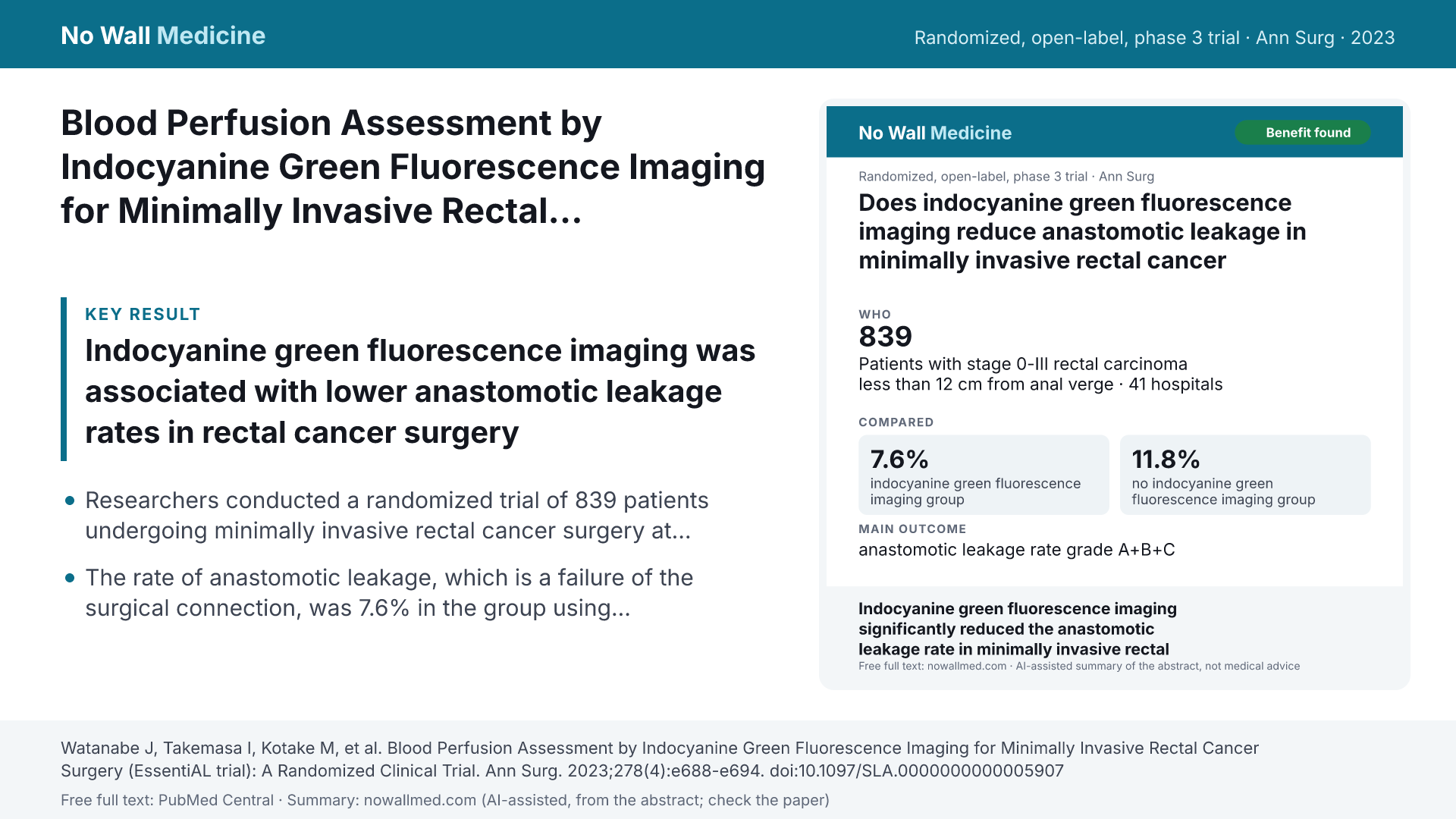
Blood Perfusion Assessment by Indocyanine Green Fluorescence Imaging for Minimally Invasive Rectal Cancer Surgery (EssentiAL trial): A Randomized Clinical Trial
Randomized, open-label, phase 3 trialBenefit found
Does indocyanine green fluorescence imaging reduce anastomotic leakage in minimally invasive rectal cancer surgery?
Who
839
Patients with stage 0-III rectal carcinoma less than 12 cm from anal verge · 41 hospitals in Japan
Compared
7.6%indocyanine green fluorescence imaging group
11.8%no indocyanine green fluorescence imaging group
Main outcome
anastomotic leakage rate grade A+B+C
Result: relative risk 0.645 (95% confidence interval 0.422-0.987)
Bottom line: Indocyanine green fluorescence imaging significantly reduced the anastomotic leakage rate in minimally invasive rectal cancer surgery.
Ann Surg · 2023-05-23 · Save PNG
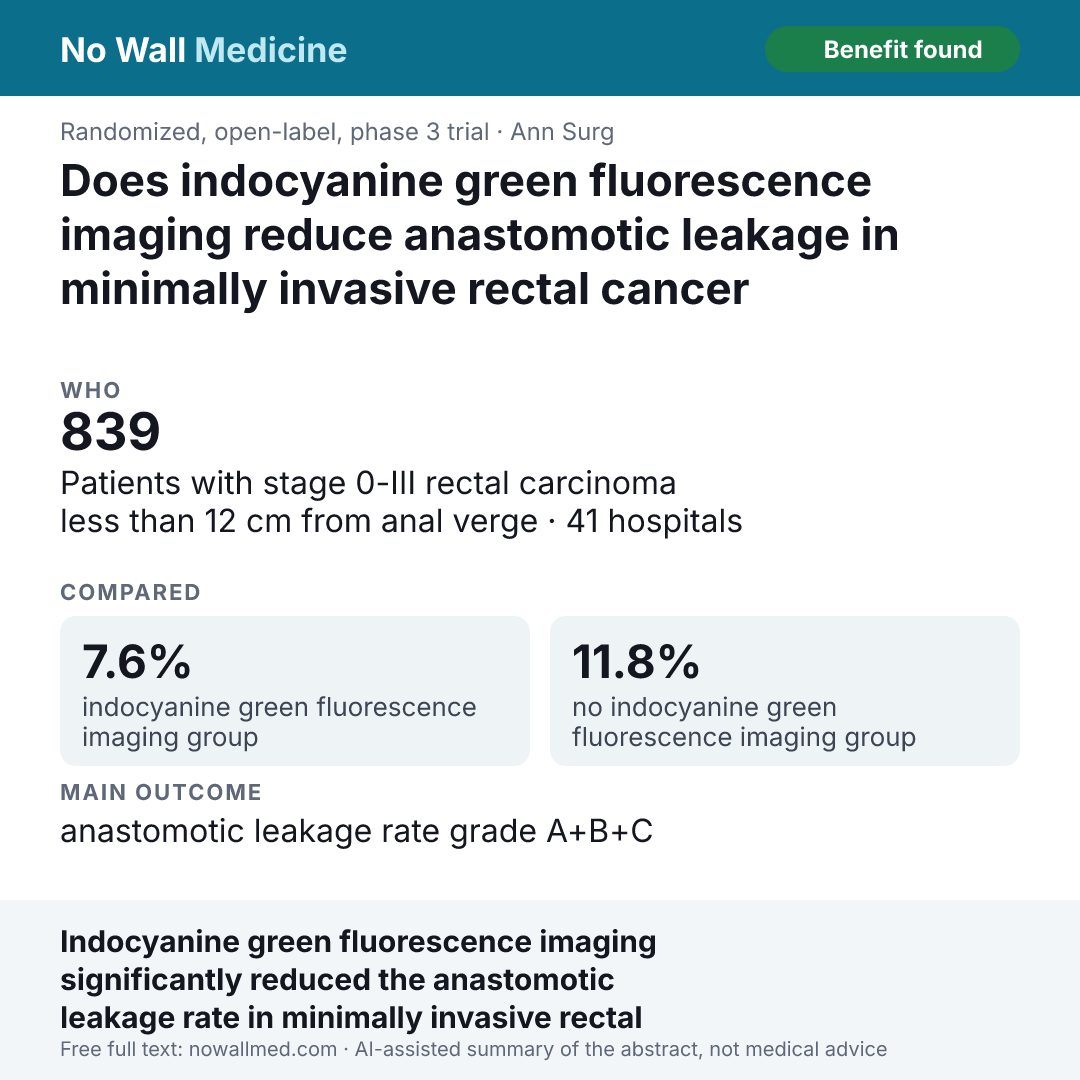
Clinical question: Does indocyanine green fluorescence imaging reduce anastomotic leakage in minimally invasive rectal cancer surgery?
Why it matters: The role of indocyanine green fluorescence imaging in reducing anastomotic leakage during minimally invasive rectal cancer surgery is controversial in published literature.
Key points
- Researchers conducted a randomized trial of 839 patients undergoing minimally invasive rectal cancer surgery at 41 hospitals in Japan.
- The rate of anastomotic leakage, which is a failure of the surgical connection, was 7.6% in the group using fluorescence imaging compared to 11.8% in the group without it.
- The group using fluorescence imaging had a reoperation rate of 0.5% compared to 2.4% in the group without the imaging tool.
Headline and key points written with AI from the paper’s abstract, with every number checked against it. Read the paper before relying on them.
Was this summary helpful?
Subject terms
Headline, design, result, key points, caveat and citation as plain text.
Cite this article
Watanabe J, Takemasa I, Kotake M, et al. Blood Perfusion Assessment by Indocyanine Green Fluorescence Imaging for Minimally Invasive Rectal Cancer Surgery (EssentiAL trial): A Randomized Clinical Trial. Ann Surg. 2023;278(4):e688-e694. doi:10.1097/SLA.0000000000005907
Spotted a mistake? Suggest a correction