Indocyanine green fluorescence angiography did not significantly reduce clinical anastomotic leaks in rectal cancer surgery
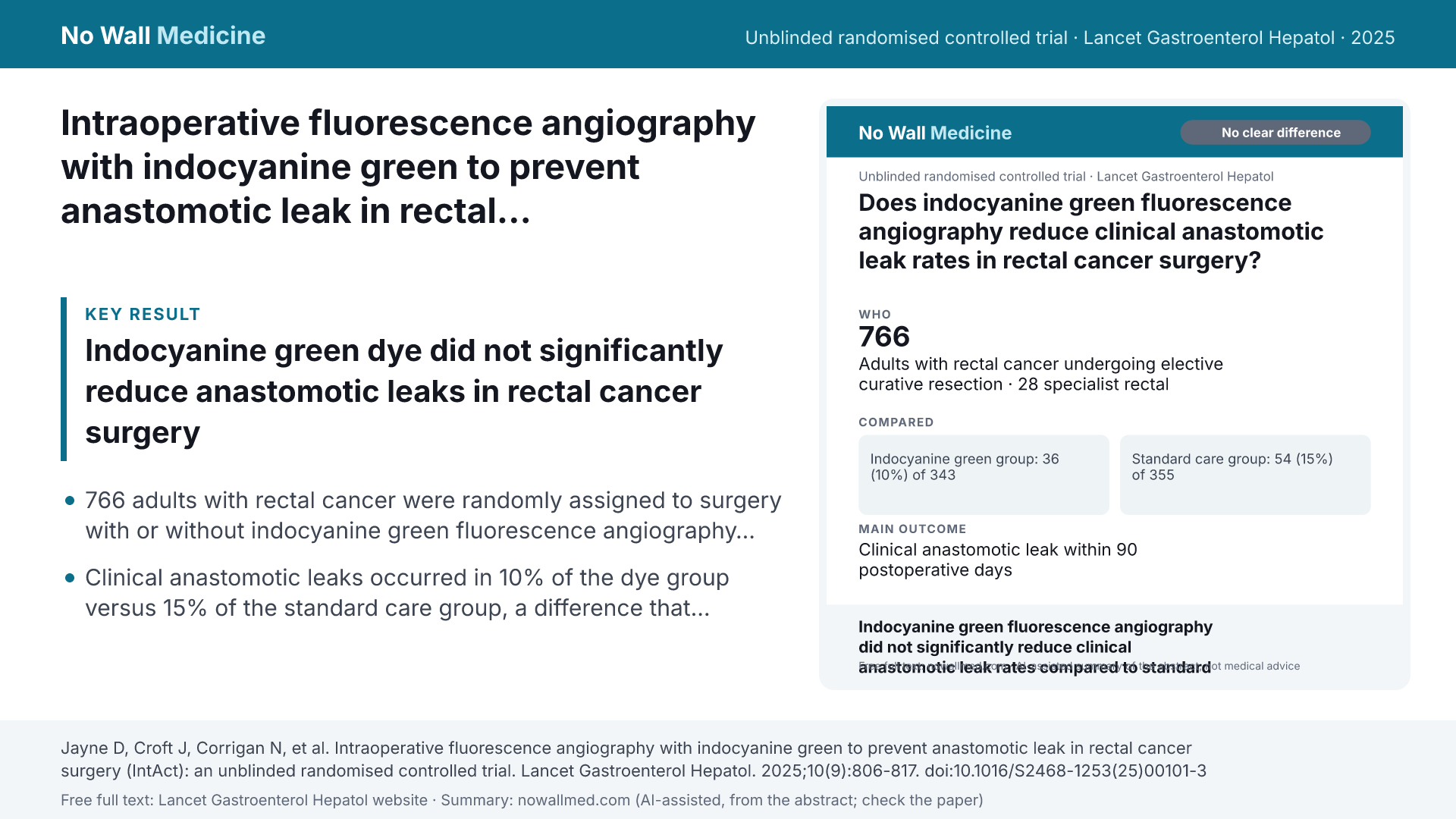
Intraoperative fluorescence angiography with indocyanine green to prevent anastomotic leak in rectal cancer surgery (IntAct): an unblinded randomised controlled trial
Unblinded randomised controlled trialNo clear difference
Does indocyanine green fluorescence angiography reduce clinical anastomotic leak rates in rectal cancer surgery?
Who
766
Adults with rectal cancer undergoing elective curative resection · 28 specialist rectal cancer centres across eight European countries
Compared
Indocyanine green group: 36 (10%) of 343
Standard care group: 54 (15%) of 355
Main outcome
Clinical anastomotic leak within 90 postoperative days
Result: adjusted odds ratio 0·667 (95% CI 0·419-1·060)
Bottom line: Indocyanine green fluorescence angiography did not significantly reduce clinical anastomotic leak rates compared to standard care.
Funded by: National Institute for Health and Care Research
Lancet Gastroenterol Hepatol · 2025-07-18Download image
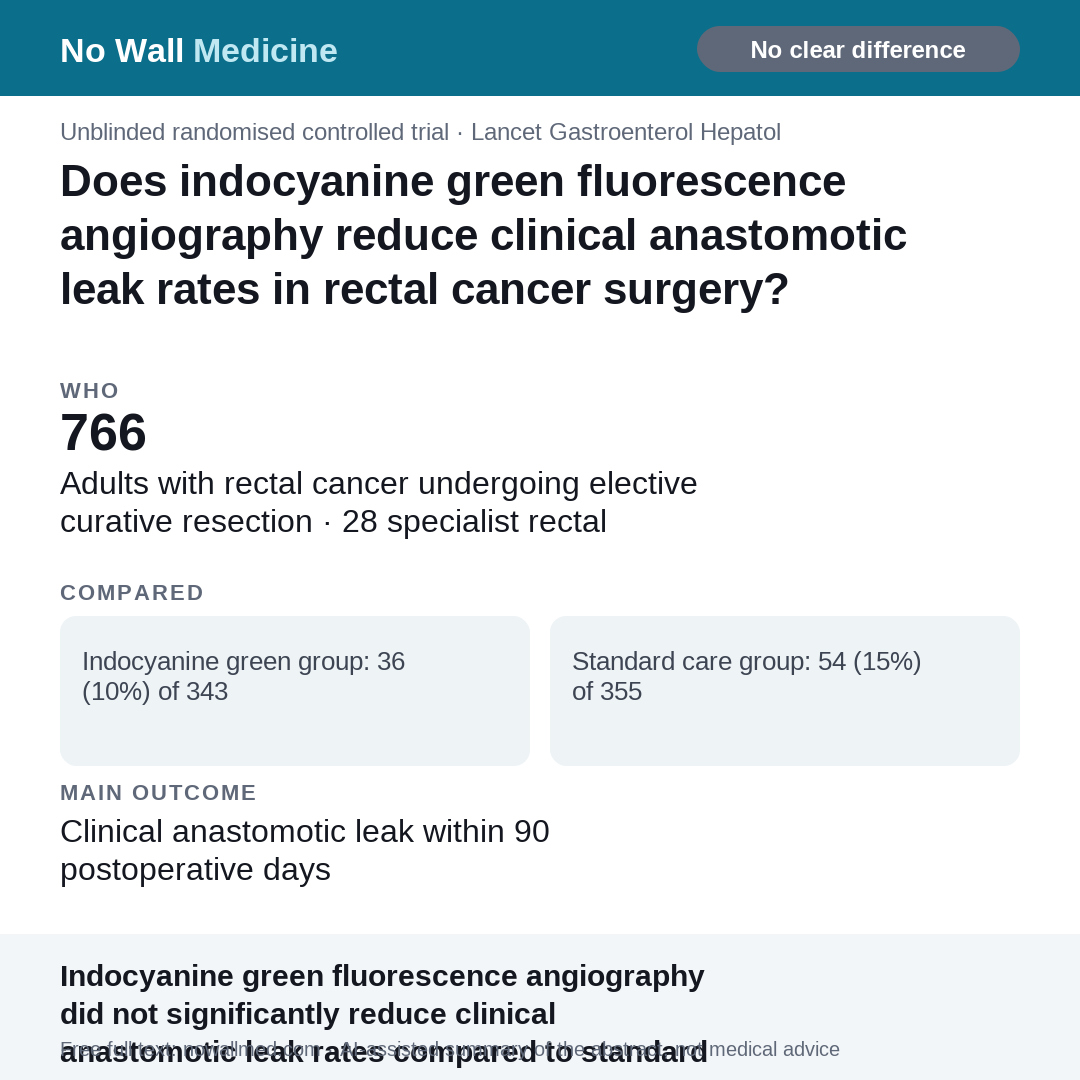
Clinical question: Does indocyanine green fluorescence angiography reduce clinical anastomotic leak rates in rectal cancer surgery?
Why it matters: Data are mixed on whether indocyanine green fluorescence angiography can reduce the high rate of anastomotic leaks in patients undergoing surgery for rectal cancer.
Key points
- Researchers conducted a randomized controlled trial involving 766 adults undergoing surgery for rectal cancer across 28 specialist centers in eight European countries.
- Clinical anastomotic leaks occurred in 10% of 343 patients in the indocyanine green group and 15% of 355 patients in the standard care group.
- The difference in clinical anastomotic leak rates between the two groups was not statistically significant (p=0.087).
Headline and key points written with AI from the paper’s abstract, with every number checked against it. Read the paper before relying on them.
Was this summary helpful?
Abstract
Background
Data are mixed on whether indocyanine green (ICG) fluorescence angiography can reduce the high rate of anastomotic leaks in patients undergoing surgery for rectal cancer. Therefore, we aimed to investigate the safety and efficacy of ICG fluorescence angiography in reducing the rate of clinical anastomotic leaks in these patients. Methods
IntAct was an unblinded randomised controlled trial conducted at 28 specialist rectal cancer centres across eight European countries. Adults (≥18 years) with rectal cancer (lower margin of cancer ≤15 cm from the anal verge) medically fit for elective, curative, laparoscopic or robotic high or low anterior resection were eligible. Patients not undergoing colorectal or anal anastomosis and those with synchronous colonic tumours or recurrent or locally advanced rectal cancer requiring extended or multi-visceral excision were excluded. Eligible participants were randomly assigned (1:1) by use of minimisation with a random element to undergo surgery with or without ICG (standard care). Resections and anastomoses were done per surgeon preference. In the ICG group, surgeons first marked proximal transection levels via standard white-light laparoscopy and then administered an intravenous bolus of 0·1 mg/kg of ICG for perfusion assessment. A second 0·1 mg/kg ICG assessment was done following anastomosis. In the standard care group, only a white-light assessment of bowel perfusion was performed. The primary endpoint was the rate of clinical anastomotic leak (grades B or C, per the International Study Group of Rectal Cancer) within 90 postoperative days. Analyses were done in the intention-to-treat population for complete cases. This trial is registered with the ISRCTN registry (ISRCTN13334746) and is now complete. Findings
Between Oct 20, 2017, and Aug 15, 2023, 2534 patients were assessed for eligibility and 766 participants were randomly assigned (383 to the ICG group and 383 to the standard care group). 501 (65%) of 766 participants were male, 726 (95%) were of White ethnicity, and the median age was 64·0 years (IQR 56·0-72·0). 343 patients in the ICG group and 355 in the standard care group were included in the intention-to-treat analysis. The rates of anastomotic leak were 11 (3%) of 343 in the ICG group and 20 (6%) in the standard care group for grade A, 11 (3%) and 31 (9%) for grade B, and 25 (7%) and 23 (6%) for grade C. Within 90 days, a clinical anastomotic leak occurred in 90 (13%) of 698 participants: 36 (10%) of 343 in the ICG group and 54 (15%) of 355 in the standard care group (adjusted odds ratio 0·667 [95% CI 0·419-1·060]; p=0·087). There were no serious adverse events related to ICG. Interpretation
Although IntAct did not show a significant benefit for ICG fluorescence angiography, a signal towards a reduction in clinical anastomotic leak rate was observed. The benefit of ICG could be in preventing grade A or B leaks, given similar rates of grade C leaks between groups. Future research is needed to standardise ICG fluorescence assessment and understand its relevance to anastomotic leak. Funding
National Institute for Health and Care Research Efficacy and Mechanism Evaluation Programme.
Abstract reproduced under the article’s CC BY licence.
Subject terms
Cite this article
Jayne D, Croft J, Corrigan N, Quirke P, Cahill RA, Ainsworth G. Intraoperative fluorescence angiography with indocyanine green to prevent anastomotic leak in rectal cancer surgery (IntAct): an unblinded randomised controlled trial. Lancet Gastroenterol Hepatol. 2025. doi:10.1016/S2468-1253(25)00101-3
Spotted a mistake? Suggest a correction