Mild hypercapnia was associated with higher cardiac index and stroke volumes after cardiac arrest
Cardiovascular changes induced by targeted mild hypercapnia after out of hospital cardiac arrest. A sub-study of the TAME cardiac arrest trial
Randomized, single-centre, prospective sub-studyBenefit found
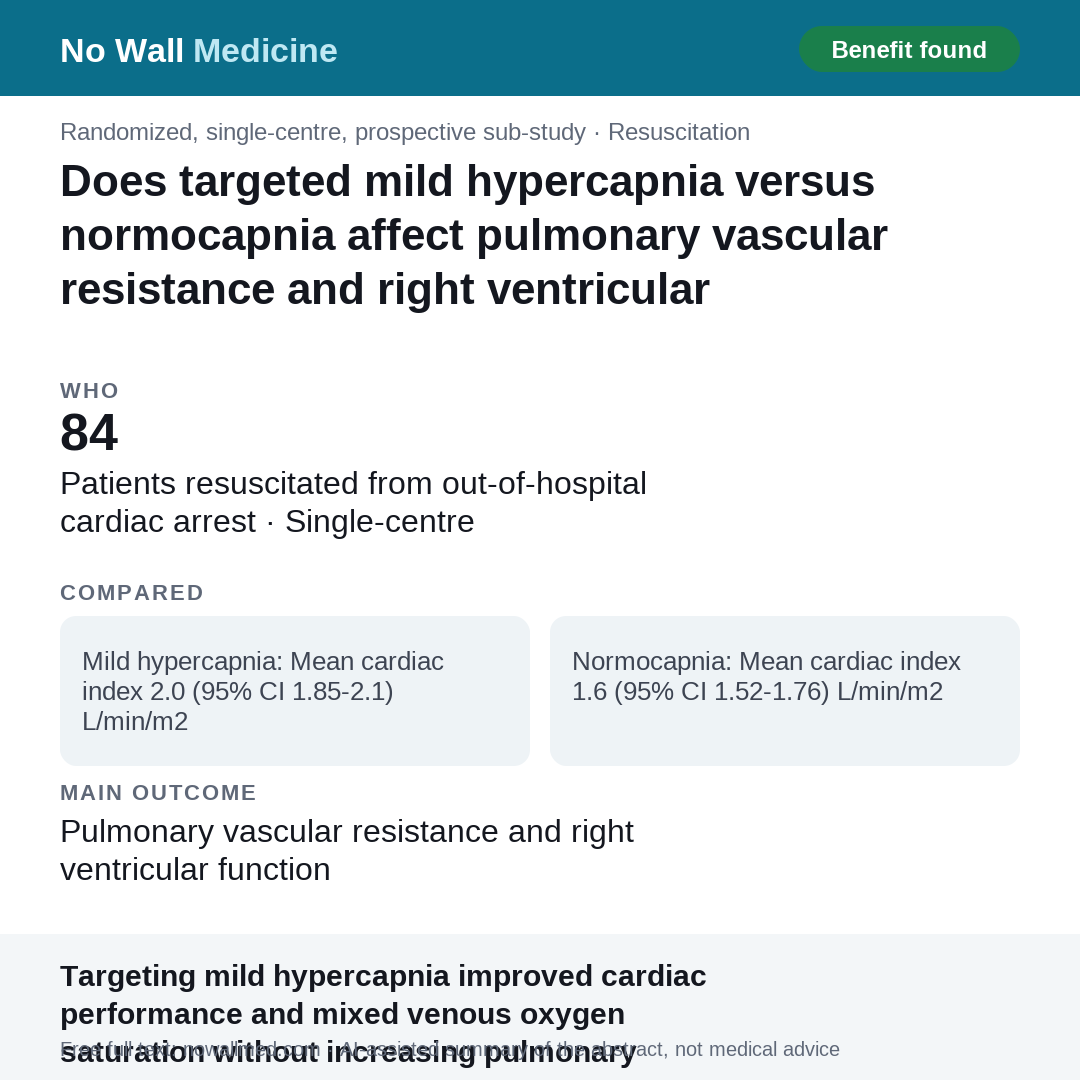
Does targeted mild hypercapnia versus normocapnia affect pulmonary vascular resistance and right ventricular function?
Who
84
Patients resuscitated from out-of-hospital cardiac arrest · Single-centre
Compared
Mild hypercapnia: Mean cardiac index 2.0 (95% CI 1.85-2.1) L/min/m2
Normocapnia: Mean cardiac index 1.6 (95% CI 1.52-1.76) L/min/m2
Main outcome
Pulmonary vascular resistance and right ventricular function
Bottom line: Targeting mild hypercapnia improved cardiac performance and mixed venous oxygen saturation without increasing pulmonary vascular resistance.
Resuscitation · 2023-09-15Download image
Clinical question: Does targeted mild hypercapnia versus normocapnia affect pulmonary vascular resistance and right ventricular function?
Why it matters: It was unknown if targeting mild hypercapnia, or elevated carbon dioxide levels, would cause detrimental effects on pulmonary vascular resistance and right ventricular function in patients resuscitated from cardiac arrest.
Key points
- Researchers studied 84 patients resuscitated from out-of-hospital cardiac arrest who were randomized to mild hypercapnia or normocapnia for 24 hours.
- The mild hypercapnia group had a higher mean cardiac index of 2.0 (95% CI 1.85-2.1) L/min/m2 compared to 1.6 (95% CI 1.52-1.76) L/min/m2 in the normocapnia group.
- Pulmonary vascular resistance index, pulmonary artery pulsatility index, and right atrial pressure did not differ between the two groups.
Headline and key points written with AI from the paper’s abstract, with every number checked against it. Read the paper before relying on them.
Topics
Cite this article
Melberg MB, Flaa A, Andersen GØ, Sunde K, Bellomo R, Eastwood G. Cardiovascular changes induced by targeted mild hypercapnia after out of hospital cardiac arrest. A sub-study of the TAME cardiac arrest trial. Resuscitation. 2023. doi:10.1016/j.resuscitation.2023.109970
Spotted a mistake? Suggest a correction
Top studies every Monday
The week’s key trials and guidelines in your specialties, plus any topics you follow. By email, free.
Get the weekly digest