Adjusting kidney replacement therapy to carbon dioxide levels was associated with higher bicarbonate levels
Standard vs. carbone dioxide adapted kidney replacement therapy in hypercapnic ARDS patients: a randomized controlled pilot trial (BigBIC)
Randomized, controlled pilot studyMixed results
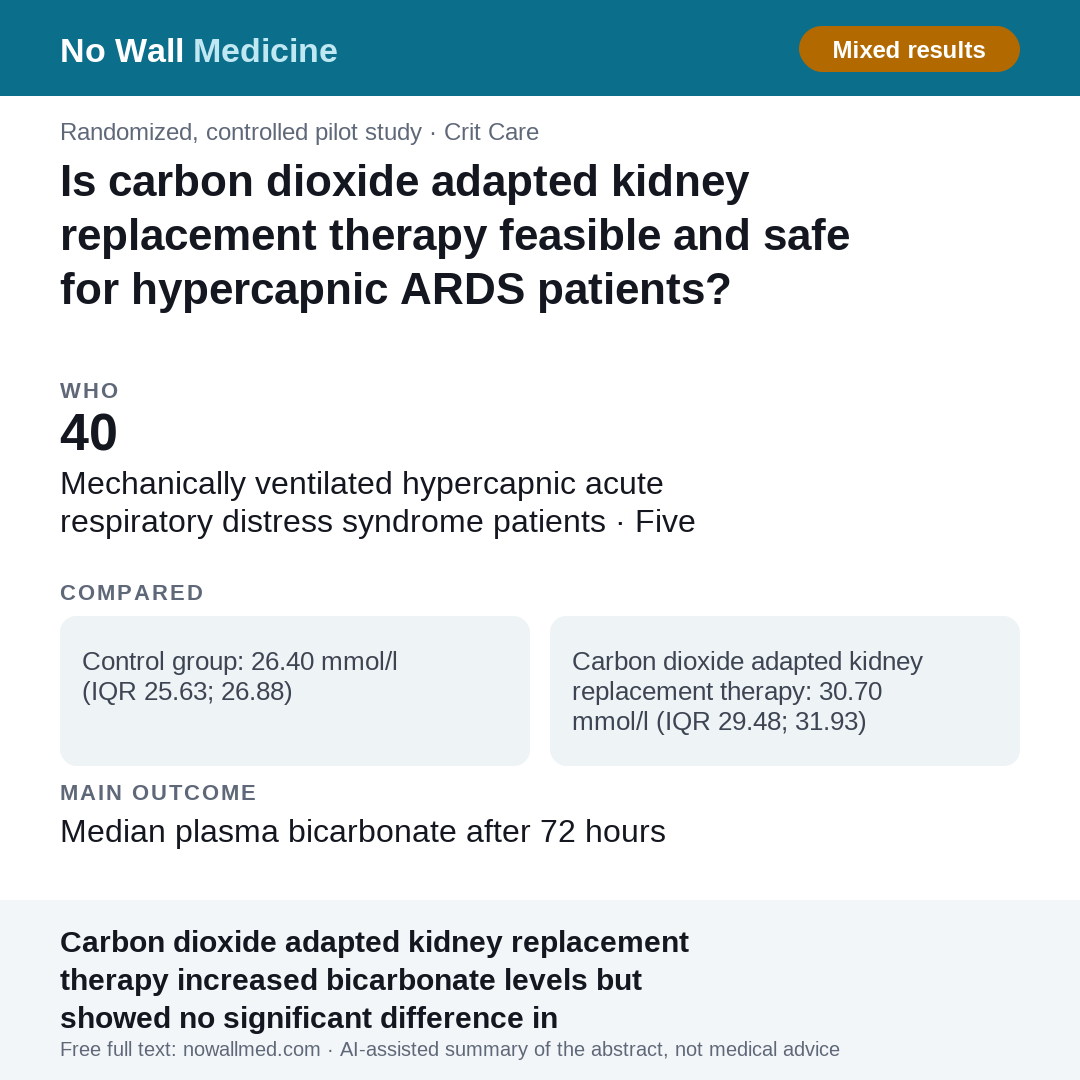
Is carbon dioxide adapted kidney replacement therapy feasible and safe for hypercapnic ARDS patients?
Who
40
Mechanically ventilated hypercapnic acute respiratory distress syndrome patients · Five intensive care units in Berlin, Germany
Compared
Control group: 26.40 mmol/l (IQR 25.63; 26.88)
Carbon dioxide adapted kidney replacement therapy: 30.70 mmol/l (IQR 29.48; 31.93)
Main outcome
Median plasma bicarbonate after 72 hours
Bottom line: Carbon dioxide adapted kidney replacement therapy increased bicarbonate levels but showed no significant difference in thirty-day mortality.
Crit Care · 2024-06-11Download image
Clinical question: Is carbon dioxide adapted kidney replacement therapy feasible and safe for hypercapnic ARDS patients?
Why it matters: Current kidney replacement therapy protocols do not account for how the kidneys naturally compensate for high carbon dioxide levels in patients with acute respiratory distress syndrome.
Key points
- Researchers studied 40 mechanically ventilated patients with acute respiratory distress syndrome who were randomized to either standard kidney replacement therapy or therapy adapted to carbon dioxide levels.
- After 72 hours, the median plasma bicarbonate was 30.70 mmol/l (IQR 29.48; 31.93) in the adapted group compared to 26.40 mmol/l (IQR 25.63; 26.88) in the control group.
- Thirty-day mortality was 63% in the control group and 42% in the intervention group, but this difference was not statistically significant (p = 0.26).
Headline and key points written with AI from the paper’s abstract, with every number checked against it. Read the paper before relying on them.
Topics
Cite this article
Kunz JV, Hansmann H, Fähndrich M, Pigorsch M, Bethke N, Peters H. Standard vs. carbone dioxide adapted kidney replacement therapy in hypercapnic ARDS patients: a randomized controlled pilot trial (BigBIC). Crit Care. 2024. doi:10.1186/s13054-024-04979-z
Spotted a mistake? Suggest a correction
Top studies every Monday
The week’s key trials and guidelines in your specialties, plus any topics you follow. By email, free.
Get the weekly digest