Cervical cerclage and cervical pessary show similar rates of preterm birth before 34 weeks
Cervical cerclage versus cervical pessary with or without vaginal progesterone for preterm birth prevention in twin pregnancies and a short cervix: A two-by-two factorial randomised clinical trial
Two-by-two factorial randomised clinical trialMixed results
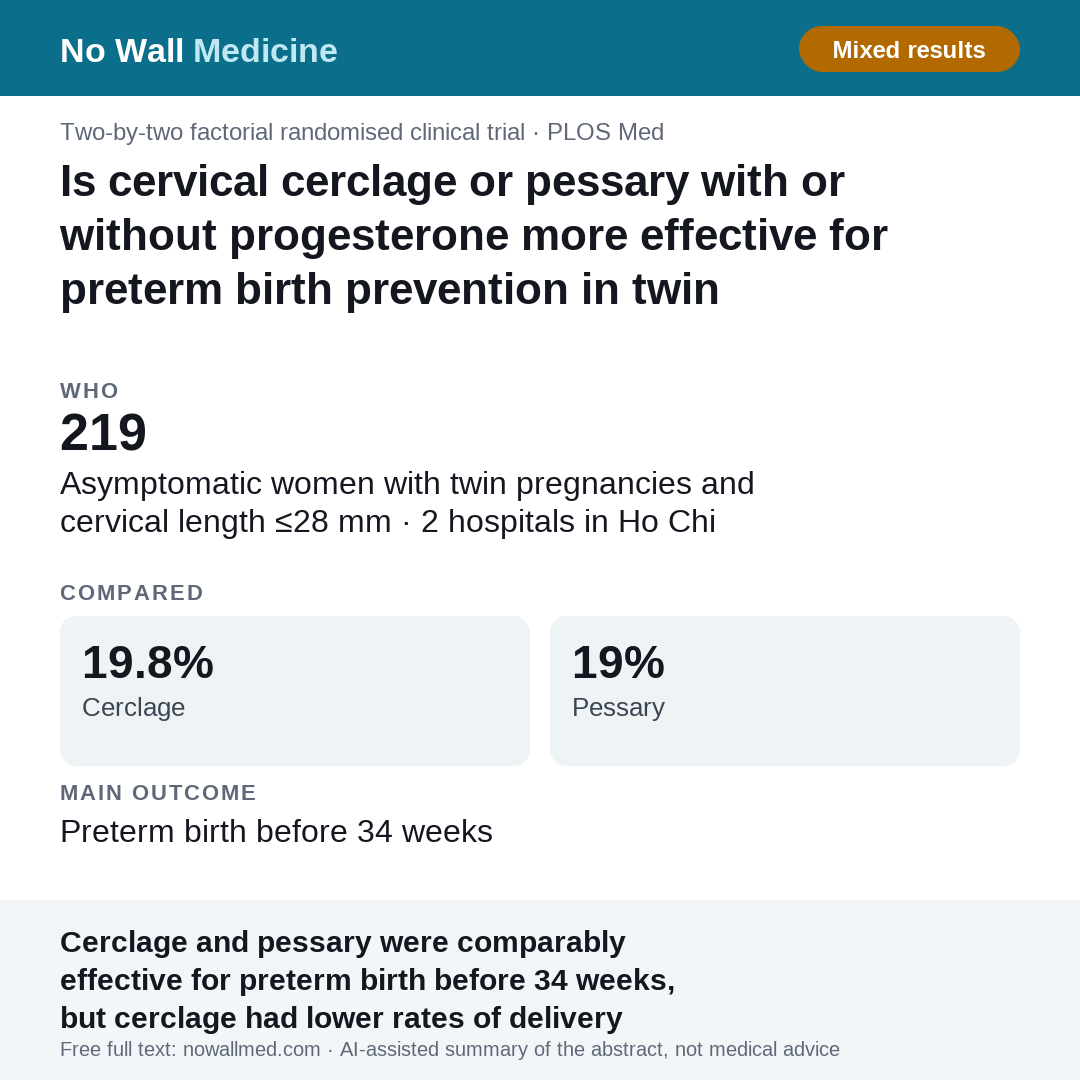
Is cervical cerclage or pessary with or without progesterone more effective for preterm birth prevention in twin pregnancies?
Who
219
Asymptomatic women with twin pregnancies and cervical length ≤28 mm · 2 hospitals in Ho Chi Minh City, Vietnam
Compared
19.8%Cerclage
19%Pessary
Main outcome
Preterm birth before 34 weeks
Result: relative risk 1.04 (95% CI 0.60 to 1.8)
Bottom line: Cerclage and pessary were comparably effective for preterm birth before 34 weeks, but cerclage had lower rates of delivery before 28 weeks.
Limitation: The study was prematurely terminated following an interim analysis.
PLOS Med · 2025-02-21Download image
Clinical question: Is cervical cerclage or pessary with or without progesterone more effective for preterm birth prevention in twin pregnancies?
Why it matters: The comparative effectiveness of cervical cerclage versus a cervical pessary, with or without progesterone, is unknown for preventing preterm birth in twin pregnancies with a short cervix.
Key points
- Researchers studied 219 asymptomatic women with twin pregnancies and a short cervix of 28 mm or less, comparing cervical cerclage (a stitch in the cervix) to a cervical pessary.
- Preterm birth before 34 weeks occurred in 19.8% of the cerclage group and 19% of the pessary group, while deliveries before 28 weeks were 1% in the cerclage group versus 8.6% in the pessary group.
- Perinatal death occurred in 1% of the cerclage group compared to 5.8% in the pessary group, though preterm birth rates before 24 or 32 weeks were not significantly different.
Limitation the authors note: The study was prematurely terminated following an interim analysis.
Headline and key points written with AI from the paper’s abstract, with every number checked against it. Read the paper before relying on them.
Topics
Cite this article
He YTN, Pham HNH, Nguyen TC, Bui TQ, Vuong NT, Nguyen DTN. Cervical cerclage versus cervical pessary with or without vaginal progesterone for preterm birth prevention in twin pregnancies and a short cervix: A two-by-two factorial randomised clinical trial. PLOS Med. 2025. doi:10.1371/journal.pmed.1004526
Spotted a mistake? Suggest a correction
Top studies every Monday
The week’s key trials and guidelines in your specialties, plus any topics you follow. By email, free.
Get the weekly digest