Self-inflating bags and anatomic masks were associated with higher forces during simulated neonatal ventilation
Characterising applied forces during positive pressure ventilation: a randomised cross-over simulation study
Randomised cross-over simulation studyMixed results
How do mask, device, and expertise affect applied force during simulated ventilation?
Who
51
Neonatal healthcare providers categorized as novices and experts · A quiet, empty room in the children's hospital
Compared
Self-inflating bag: 16.03 (6.96) N
T-piece: 14.31 (5.16) N
Anatomic mask: 16.07 (6.80) N
Round mask: 14.26 (5.35) N
Main outcome
Applied force on the face and head
Bottom line: Force applied to the head varies by mask type, device type, and provider expertise level.
BMJ Paediatr Open · 2024-07-24Download image
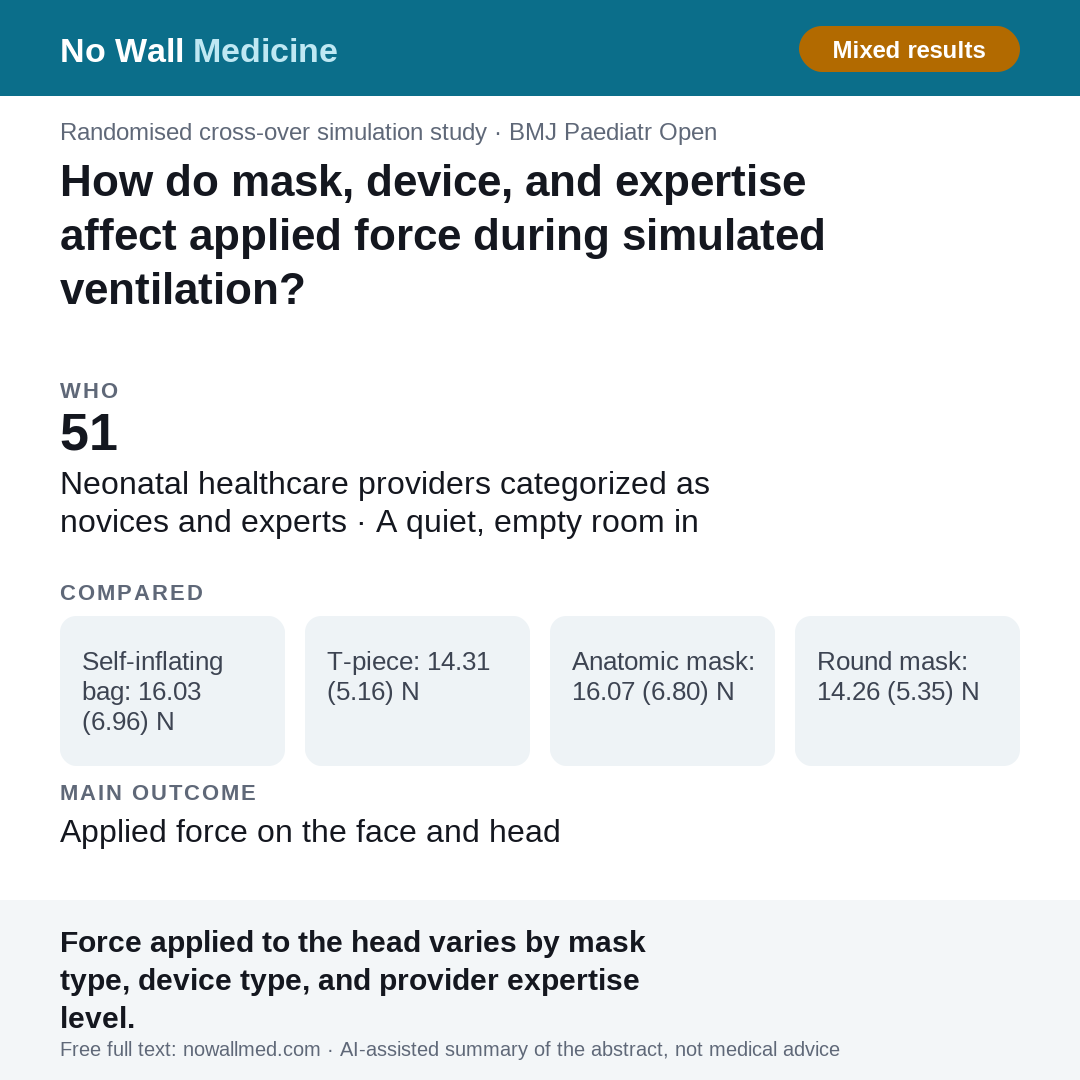
Clinical question: How do mask, device, and expertise affect applied force during simulated ventilation?
Why it matters: The amount of force applied to a newborn's face and head during positive pressure ventilation—a method of breathing support—is not well characterized.
Key points
- Researchers studied 51 neonatal healthcare providers categorized as novices or experts using different masks and ventilation devices during a 2 minute simulation.
- Force applied to the head was higher with the self-inflating bag at 16.03 (6.96) N compared to the T-piece at 14.31 (5.16) N.
- Experts applied more equal force around the mask rim than novices, with a median of 0.46 (0.26-0.79) N versus 0.65 (0.24-1.18) N.
Headline and key points written with AI from the paper’s abstract, with every number checked against it. Read the paper before relying on them.
Abstract
Objective
To characterise applied force on the face and head during simulated mask ventilation with varying mask, device and expertise level. Design
Randomised cross-over simulation study. Setting
A quiet, empty room in the children's hospital. Participants
Neonatal healthcare providers, categorised as novices and experts in positive pressure ventilation (PPV). Interventions
PPV for 2 min each in a 2×2 within-subjects design with two masks (round and anatomic) and two ventilation devices (T-piece and self-inflating bag (SIB)). Main outcome measures
Applied force (Newton (N)) measured under the head and at four locations on the manikin's face (nasal bridge, mentum, left and right zygomatic arches) and symmetry of force applied around the mask rim. Results
For the 51 participants, force applied to the head was greater with the SIB than the T-piece (mean (SD): 16.03 (6.96) N vs 14.31 (5.16) N) and greater with the anatomic mask than the round mask (mean (SD): 16.07 (6.80) N vs 14.26 (5.35) N). Underhead force decreased over the duration of PPV for all conditions. Force measured on the face was greatest at the left zygomatic arch (median (IQR): 0.97 (0.70-1.43) N) and least at the mentum (median (IQR): 0.44 (0.28-0.61) N). Overall, experts applied more equal force around the mask rim compared with novices (median (IQR): 0.46 (0.26-0.79) N vs 0.65 (0.24-1.18) N, p<0.001). Conclusion
We characterised an initial dataset of applied forces on the face and head during simulated PPV and described differences in force when considering mask type, device type and expertise.
Abstract reproduced under the article’s CC BY NC licence.
Topics
Cite this article
Hannan J, Weiner G, Stirling L. Characterising applied forces during positive pressure ventilation: a randomised cross-over simulation study. BMJ Paediatr Open. 2024. doi:10.1136/bmjpo-2024-002828
Spotted a mistake? Suggest a correction
Top studies every Monday
The week’s key trials and guidelines in your specialties, by email. Free.
Get the weekly digest