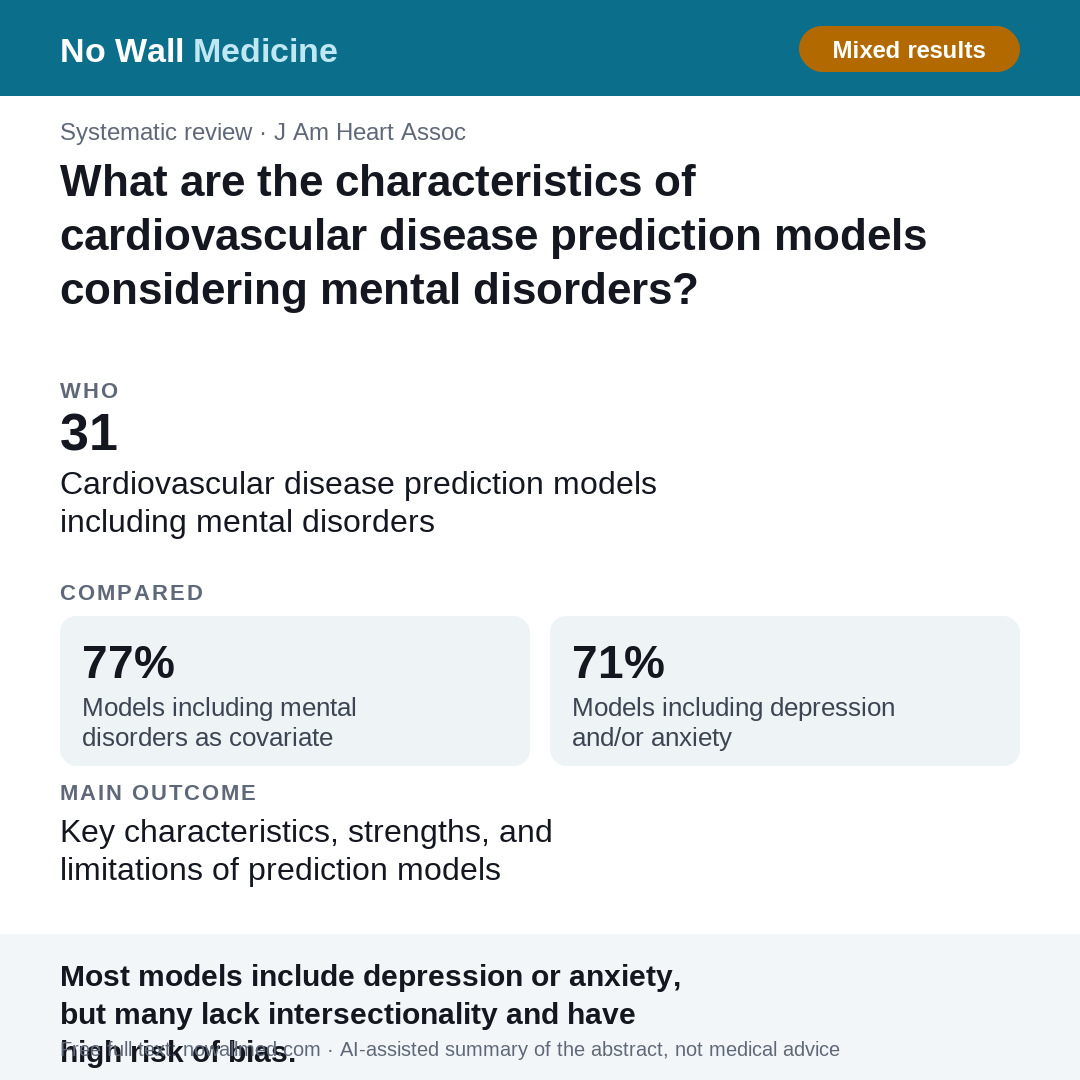
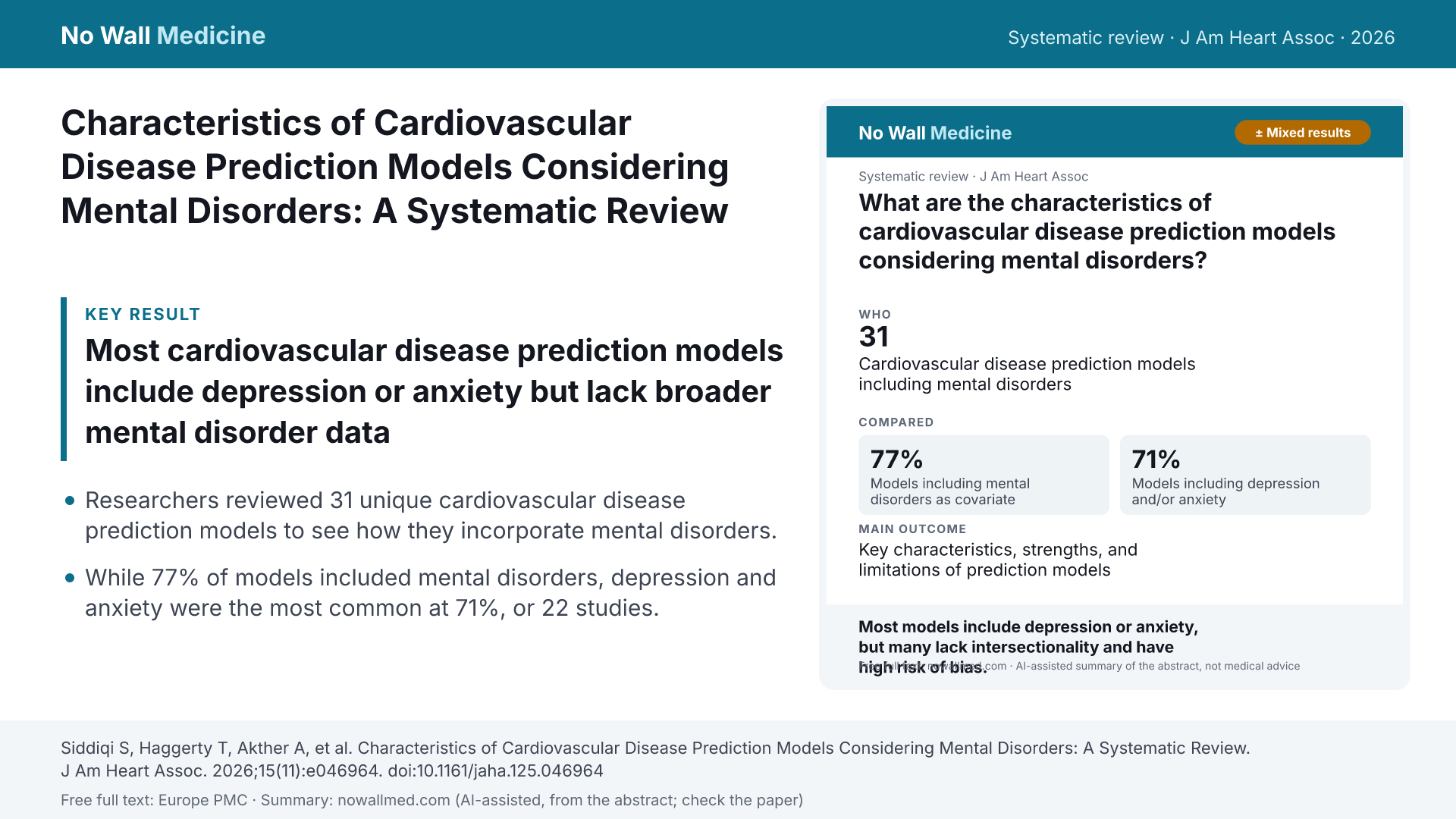
Most cardiovascular disease prediction models include depression or anxiety but lack broader mental disorder data
Characteristics of Cardiovascular Disease Prediction Models Considering Mental Disorders: A Systematic Review
Systematic reviewMixed results
What are the characteristics of cardiovascular disease prediction models considering mental disorders?
Who
31
Cardiovascular disease prediction models including mental disorders
Compared
77%Models including mental disorders as covariate
71%Models including depression and/or anxiety
Main outcome
Key characteristics, strengths, and limitations of prediction models
Bottom line: Most models include depression or anxiety, but many lack intersectionality and have high risk of bias.
Limitation: The majority of identified models had analytic concerns and only one had low risk of bias.
J Am Heart Assoc · 2026-05-29Download image
Clinical question: What are the characteristics of cardiovascular disease prediction models considering mental disorders?
Why it matters: Mental disorders are robust predictors of cardiovascular disease and mortality, yet it is unclear how well current prediction models incorporate them.
Key points
- Researchers reviewed 31 unique cardiovascular disease prediction models to see how they incorporate mental disorders.
- While 77% of models included mental disorders, depression and anxiety were the most common at 71%, or 22 studies.
- Only one study was identified with a low risk of bias, while most models had analytic concerns.
Limitation the authors note: The majority of the identified models had analytic concerns and only one study was found to have a low risk of bias.
Headline and key points written with AI from the paper’s abstract, with every number checked against it. Read the paper before relying on them.
Was this summary helpful?
Abstract
Background
Prognostic models for cardiovascular disease (CVD) risk have commonly included predictors such as cholesterol levels. Mental disorders are robust predictors of CVD and associated mortality, leading to approximately 2-fold increases in risk. This systematic review aimed to narratively summarize the key characteristics, strengths, and limitations of all CVD prediction models that consider mental disorders. Methods
A literature search with medical subject headings/key terms related to CVD, mental disorders and prognostic modeling was conducted in Medline and EMBASE. Included studies were: cohort studies of CVD prediction model development, validation, or recalibration that included mental disorders as prognostic factors/covariate(s), or the population of interest. All studies were screened by 2 independent reviewers, followed by data extraction. The Prediction Model Risk Of Bias Assessment Tool was used to critically appraise bias. A narrative synthesis was used to summarize mental disorder and sociodemographic factor/intersectionality inclusion. Results
There were 31 unique models identified (n=35 records including external validations). Considering these, 77% included mental disorders as a covariate, whereby depression and/or anxiety were the most considered (71%, n=22 studies). Most models were published within the last 5 years, included measures of socioeconomic status; however, many models lacked intersectionality considerations. Only one study was identified with a low risk of bias, while the majority had analytic concerns. Conclusions
Depression and/or anxiety were the most commonly considered mental disorders in modeling, despite larger associations with CVD for other disorders. Further CVD prediction modeling should consider a broader array of mental disorders, and limit methodological biases.
Abstract reproduced under the article’s CC BY-NC-ND licence.
Subject terms
Cite this article
Siddiqi S, Haggerty T, Akther A, et al. Characteristics of Cardiovascular Disease Prediction Models Considering Mental Disorders: A Systematic Review. J Am Heart Assoc. 2026. doi:10.1161/jaha.125.046964
Spotted a mistake? Suggest a correction