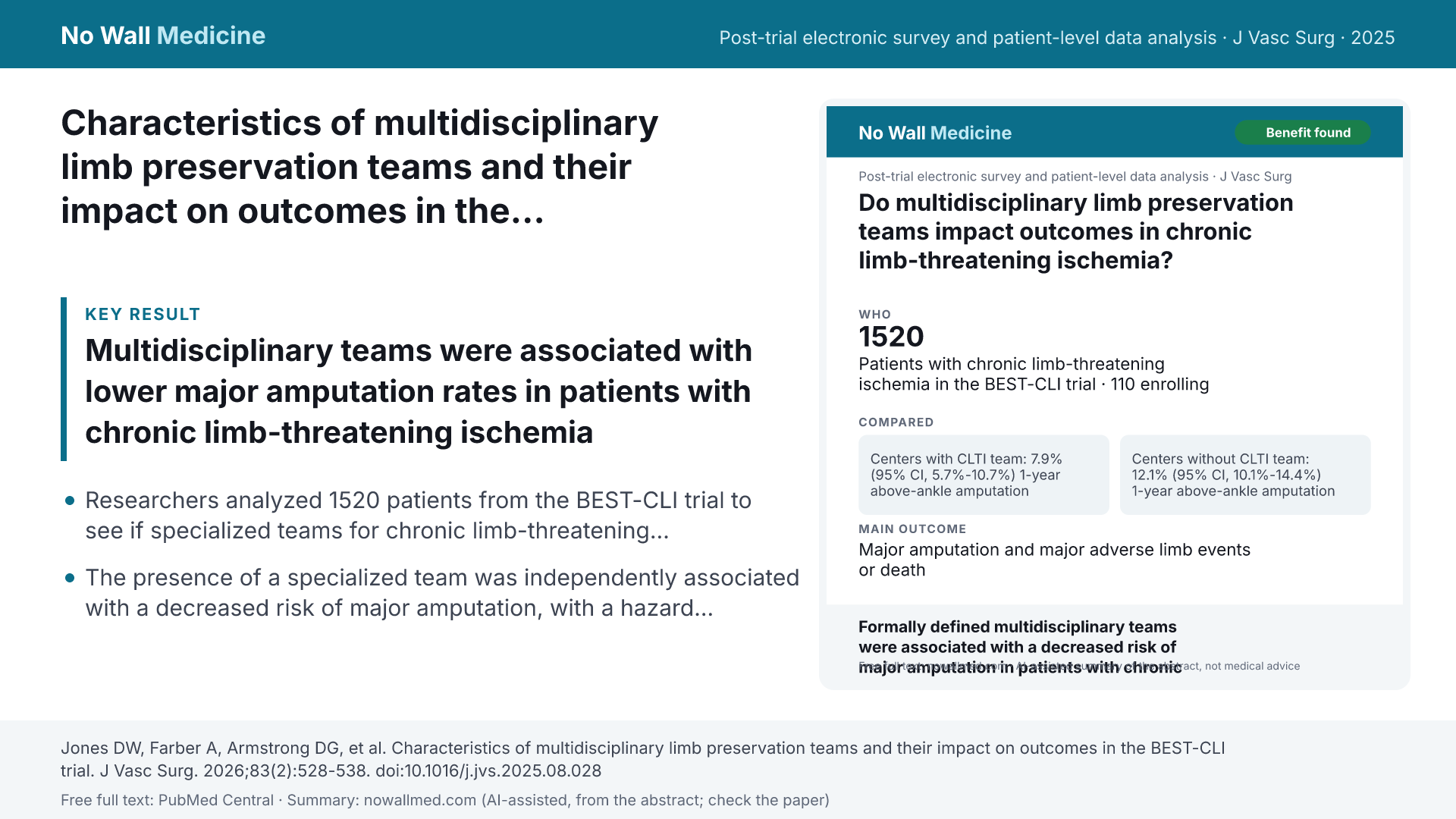
Multidisciplinary teams were associated with lower major amputation rates in patients with chronic limb-threatening ischemia
Characteristics of multidisciplinary limb preservation teams and their impact on outcomes in the BEST-CLI trial
Post-trial electronic survey and patient-level data analysisBenefit found
Do multidisciplinary limb preservation teams impact outcomes in chronic limb-threatening ischemia?
Who
1520
Patients with chronic limb-threatening ischemia in the BEST-CLI trial · 110 enrolling sites
Compared
Centers with CLTI team: 7.9% (95% CI, 5.7%-10.7%) 1-year above-ankle amputation
Centers without CLTI team: 12.1% (95% CI, 10.1%-14.4%) 1-year above-ankle amputation
Main outcome
Major amputation and major adverse limb events or death
Result: hazard ratio 0.60 (95% CI, 0.42-0.86) for major amputation
Bottom line: Formally defined multidisciplinary teams were associated with a decreased risk of major amputation in patients with chronic limb-threatening ischemia.
J Vasc Surg · 2025-08-28Download image
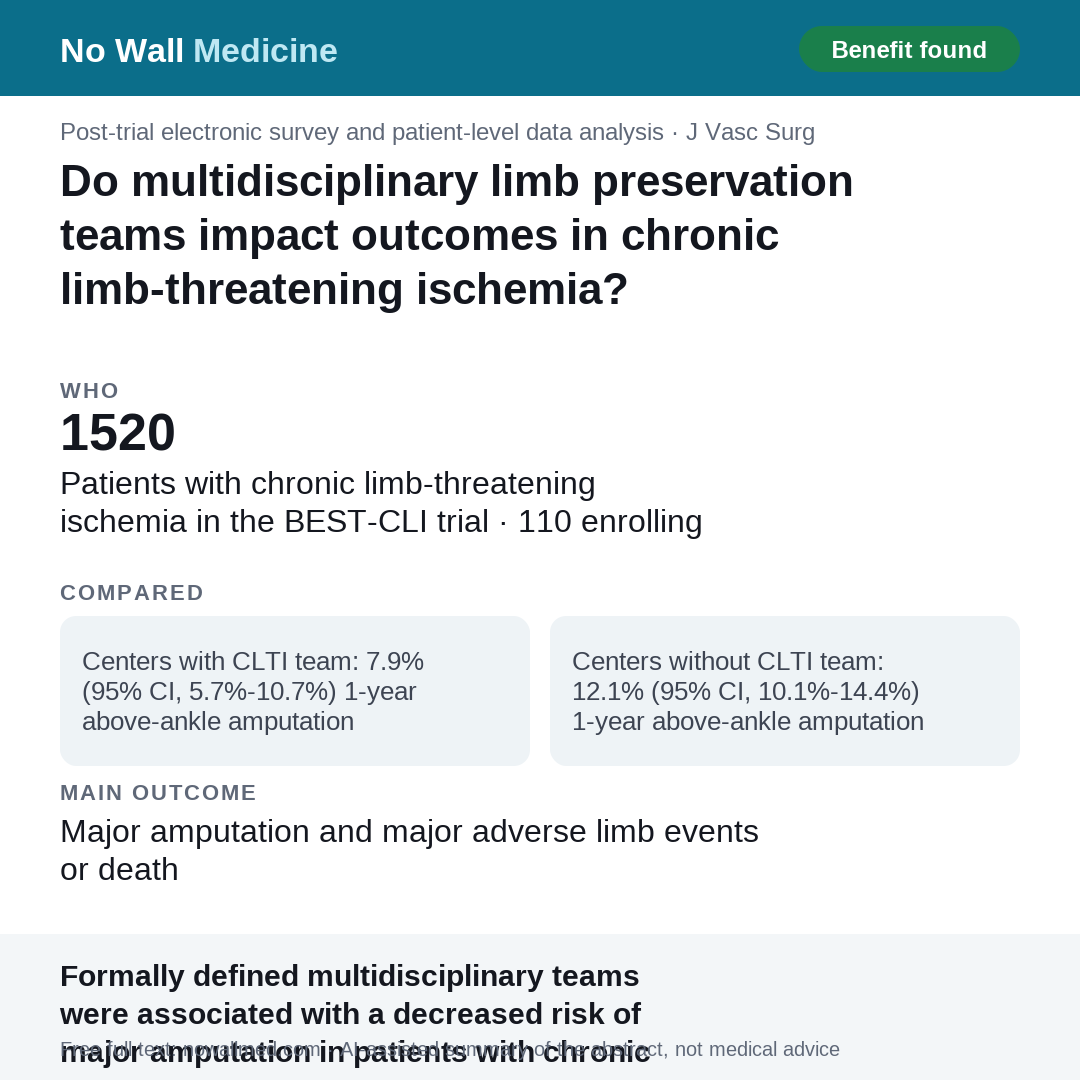
Clinical question: Do multidisciplinary limb preservation teams impact outcomes in chronic limb-threatening ischemia?
Key points
- Researchers analyzed 1520 patients from the BEST-CLI trial to see if specialized teams for chronic limb-threatening ischemia, or severe lack of blood flow to limbs, affected outcomes.
- The presence of a specialized team was independently associated with a decreased risk of major amputation, with a hazard ratio of 0.60.
- There was no significant difference in major adverse limb events or death between patients treated at centers with or without a specialized team.
Headline and key points written with AI from the paper’s abstract, with every number checked against it. Read the paper before relying on them.
Was this summary helpful?
Subject terms
Headline, design, result, key points, caveat and citation as plain text.
Cite this article
Jones DW, Farber A, Armstrong DG, et al. Characteristics of multidisciplinary limb preservation teams and their impact on outcomes in the BEST-CLI trial. J Vasc Surg. 2025. doi:10.1016/j.jvs.2025.08.028
Spotted a mistake? Suggest a correction