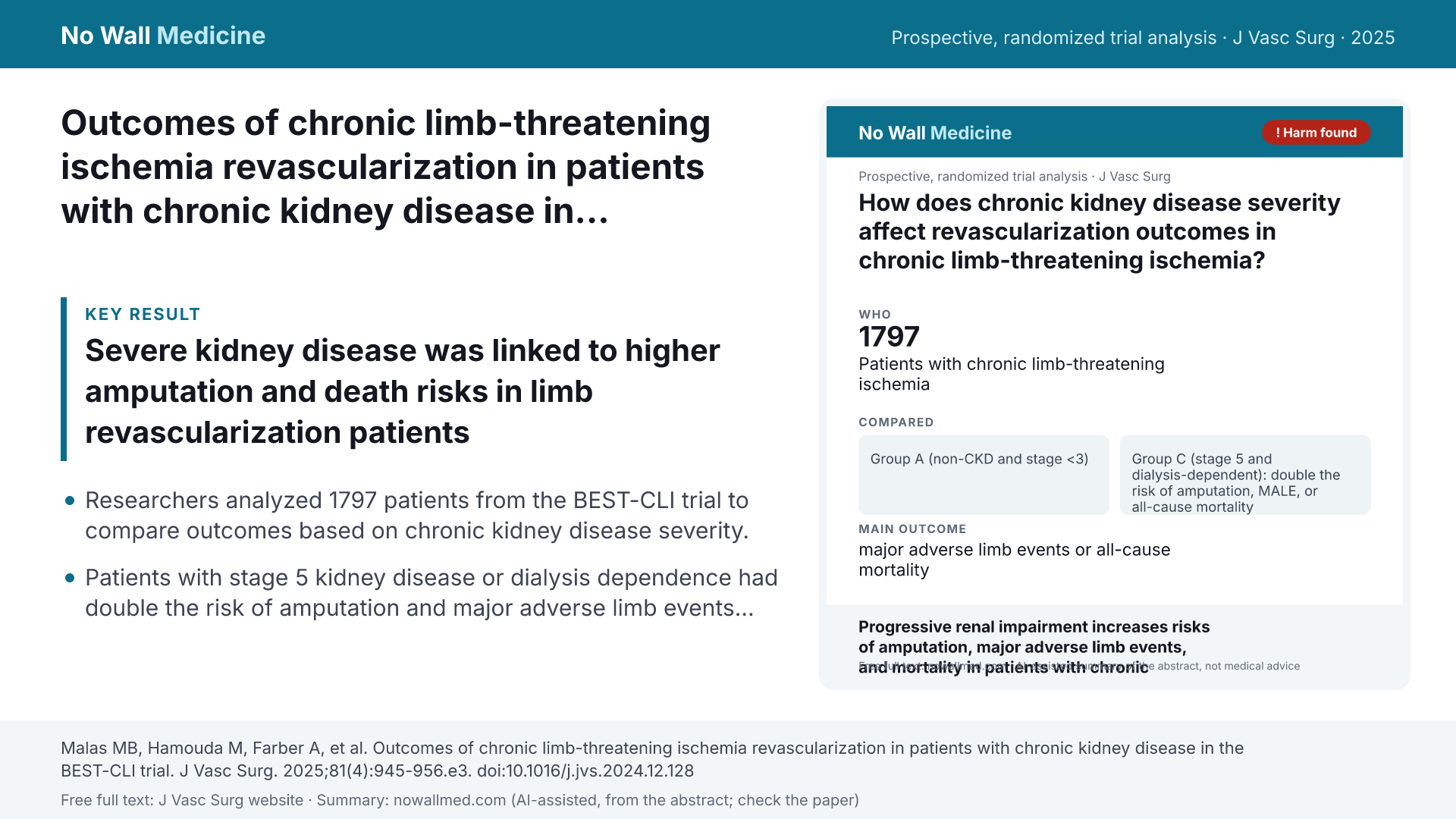
Severe kidney disease was linked to higher amputation and death risks in limb revascularization patients
Outcomes of chronic limb-threatening ischemia revascularization in patients with chronic kidney disease in the BEST-CLI trial
Prospective, randomized trial analysisHarm found
How does chronic kidney disease severity affect revascularization outcomes in chronic limb-threatening ischemia?
Who
1797
Patients with chronic limb-threatening ischemia
Compared
Group A (non-CKD and stage <3)
Group C (stage 5 and dialysis-dependent): double the risk of amputation, MALE, or all-cause mortality
Main outcome
major adverse limb events or all-cause mortality
Result: hazard ratio 2.03 (95% CI 1.68-2.43) for MALE at eGFR <30
Bottom line: Progressive renal impairment increases risks of amputation, major adverse limb events, and mortality in patients with chronic limb-threatening ischemia.
J Vasc Surg · 2025-01-23Download image
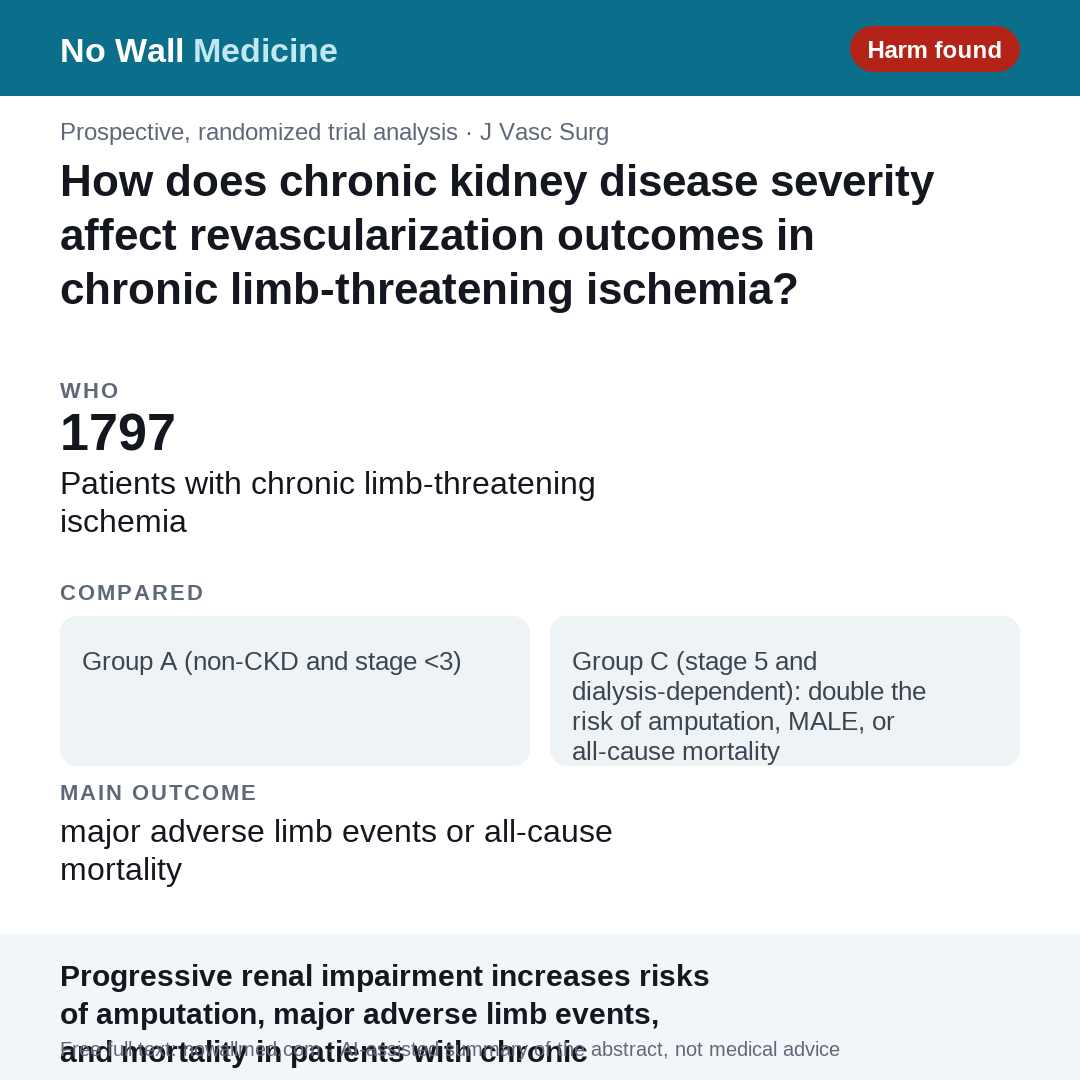
Clinical question: How does chronic kidney disease severity affect revascularization outcomes in chronic limb-threatening ischemia?
Why it matters: It was unknown how different stages of kidney disease affect outcomes for patients undergoing procedures to restore blood flow to limbs threatened by ischemia.
Key points
- Researchers analyzed 1797 patients from the BEST-CLI trial to compare outcomes based on chronic kidney disease severity.
- Patients with stage 5 kidney disease or dialysis dependence had double the risk of amputation and major adverse limb events and more than triple the risk of death compared to those with less severe disease.
- In dialysis-dependent patients, endovascular therapy, or minimally invasive vessel repair, was associated with better survival but twice the risk of reintervention compared to surgical revascularization.
Headline and key points written with AI from the paper’s abstract, with every number checked against it. Read the paper before relying on them.
Was this summary helpful?
Subject terms
Cite this article
Malas MB, Hamouda M, Farber A, et al. Outcomes of chronic limb-threatening ischemia revascularization in patients with chronic kidney disease in the BEST-CLI trial. J Vasc Surg. 2025. doi:10.1016/j.jvs.2024.12.128
Spotted a mistake? Suggest a correction