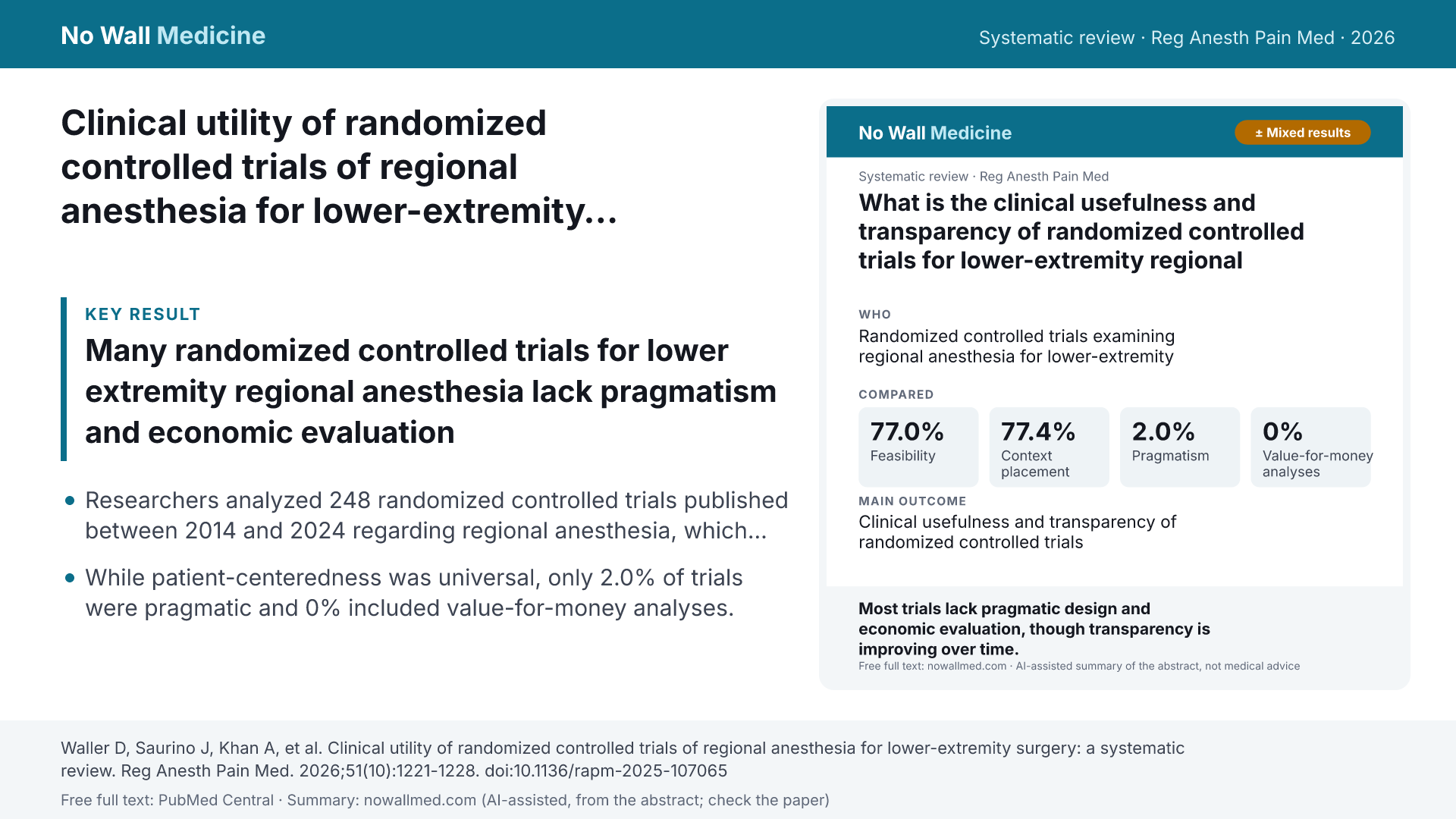
Many randomized controlled trials for lower extremity regional anesthesia lack pragmatism and economic evaluation
Clinical utility of randomized controlled trials of regional anesthesia for lower-extremity surgery: a systematic review
Systematic reviewMixed results
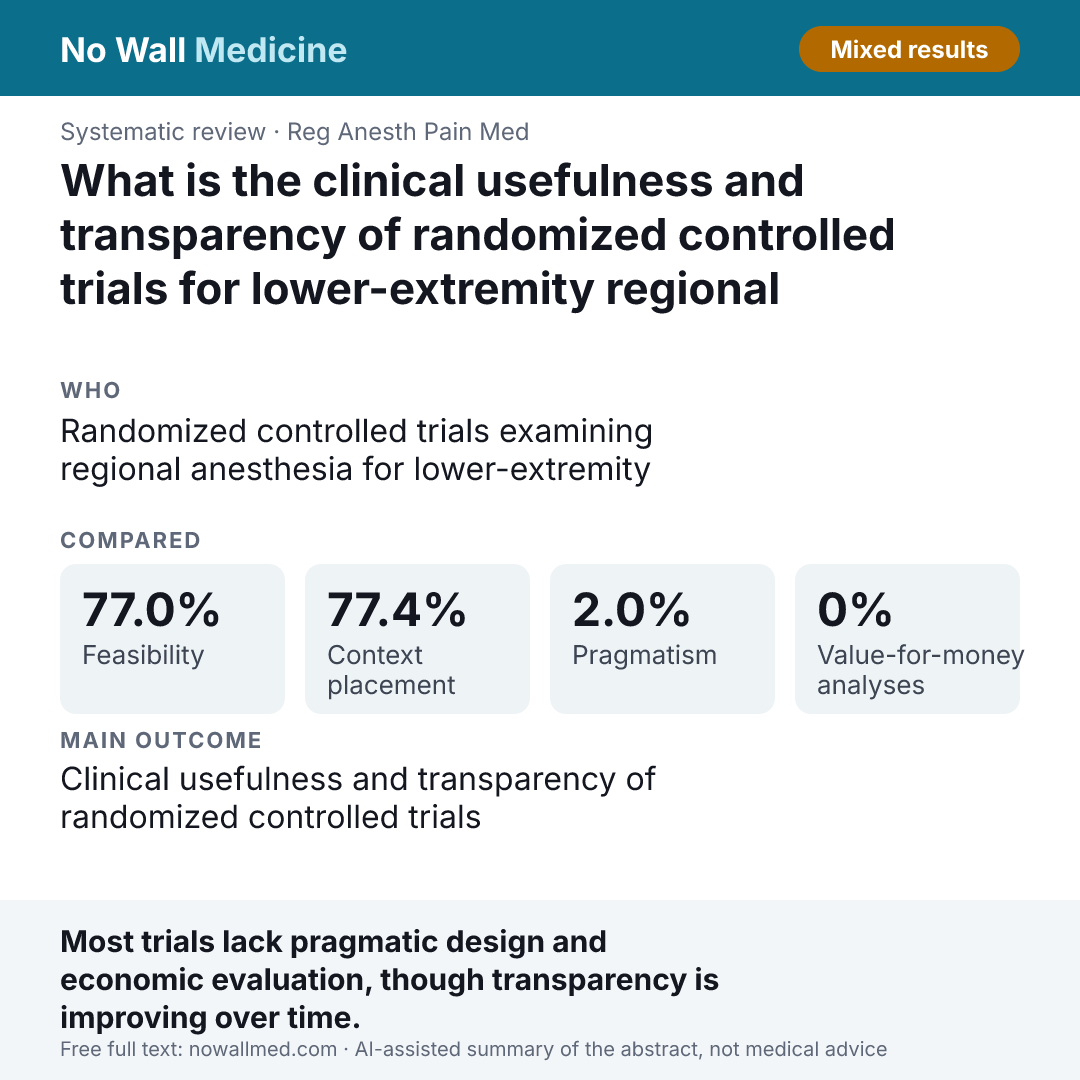
What is the clinical usefulness and transparency of randomized controlled trials for lower-extremity regional anesthesia?
Who
Randomized controlled trials examining regional anesthesia for lower-extremity surgery · Embase and MEDLINE databases
Compared
77.0%Feasibility
77.4%Context placement
2.0%Pragmatism
0%Value-for-money analyses
Main outcome
Clinical usefulness and transparency of randomized controlled trials
Bottom line: Most trials lack pragmatic design and economic evaluation, though transparency is improving over time.
Limitation: Usefulness scoring involves subjective judgment and non-English trials were excluded.
Reg Anesth Pain Med · 2026-10-05 · Save PNG
Clinical question: What is the clinical usefulness and transparency of randomized controlled trials for lower-extremity regional anesthesia?
Why it matters: Many randomized controlled trials for regional anesthesia may lack the rigor and pragmatic design needed to assist in evidence-based selection of nerve blocks.
Key points
- Researchers analyzed 248 randomized controlled trials published between 2014 and 2024 regarding regional anesthesia, which is the use of numbing medication to block pain in specific areas.
- While patient-centeredness was universal, only 2.0% of trials were pragmatic and 0% included value-for-money analyses.
- Transparency varied, with 88.7% disclosing conflicts of interest, 39.9% pre-registering, 10.1% publishing protocols, and 1.2% sharing raw data.
Limitation the authors note: The authors state that usefulness scoring involves subjective judgment, non-English trials were excluded, and the absence of formal risk of bias analysis limits interpretability.
Headline and key points written with AI from the paper’s abstract, with every number checked against it. Read the paper before relying on them.
Was this summary helpful?
Abstract
Background
Regional anesthesia (RA) is central to multimodal analgesia, yet many supporting randomized controlled trials (RCTs) may lack the rigor needed for evidence-based block selection. Objectives
To evaluate the clinical usefulness and transparency of RCTs investigating RA interventions for lower extremity surgeries, using the van 't Hooft et al framework. Methods
Embase/MEDLINE were searched for RCTs (2014-2024) examining RA interventions for lower-extremity surgery. Data were extracted in duplicate using clinical-utility and transparency criteria. Analyses included descriptive statistics, linear regression for temporal trends, Pearson correlation, and multivariable regression to identify predictors of usefulness. Results
Among 248 RCTs, patient-centeredness was universal, while feasibility (77.0%) and context placement (77.4%) were common. Pragmatism (2.0%) and value-for-money analyses (0%) were rare. Transparency varied: conflicts of interest were disclosed in 88.7%, pre-registration occurred in 39.9%, public protocols in 10.1%, and raw-data sharing in 1.2%. Transparency improved over time, correlated with clinical-utility scores (r=0.32, p<0.001) and was greater in hospital-funded, self-funded, and higher-impact journals. Limitations
Usefulness scoring involves subjective judgment; non-English trials were excluded; the absence of formal risk of bias analysis limits interpretability of trial quality. Discussions/conclusions
Although transparency is improving, most trials remain insufficiently pragmatic, lack economic evaluation, and rarely share data, limiting real-world applicability. The results of this study suggest that aligning funder, journal, and collaborative expectations around open science and pragmatic design could accelerate the generation of high-utility evidence for perioperative block selection.
Abstract reproduced under the article’s CC BY NC licence.
Subject terms
Headline, design, result, key points, caveat and citation as plain text.
Cite this article
Waller D, Saurino J, Khan A, et al. Clinical utility of randomized controlled trials of regional anesthesia for lower-extremity surgery: a systematic review. Reg Anesth Pain Med. 2026;51(10):1221-1228. doi:10.1136/rapm-2025-107065
Spotted a mistake? Suggest a correction