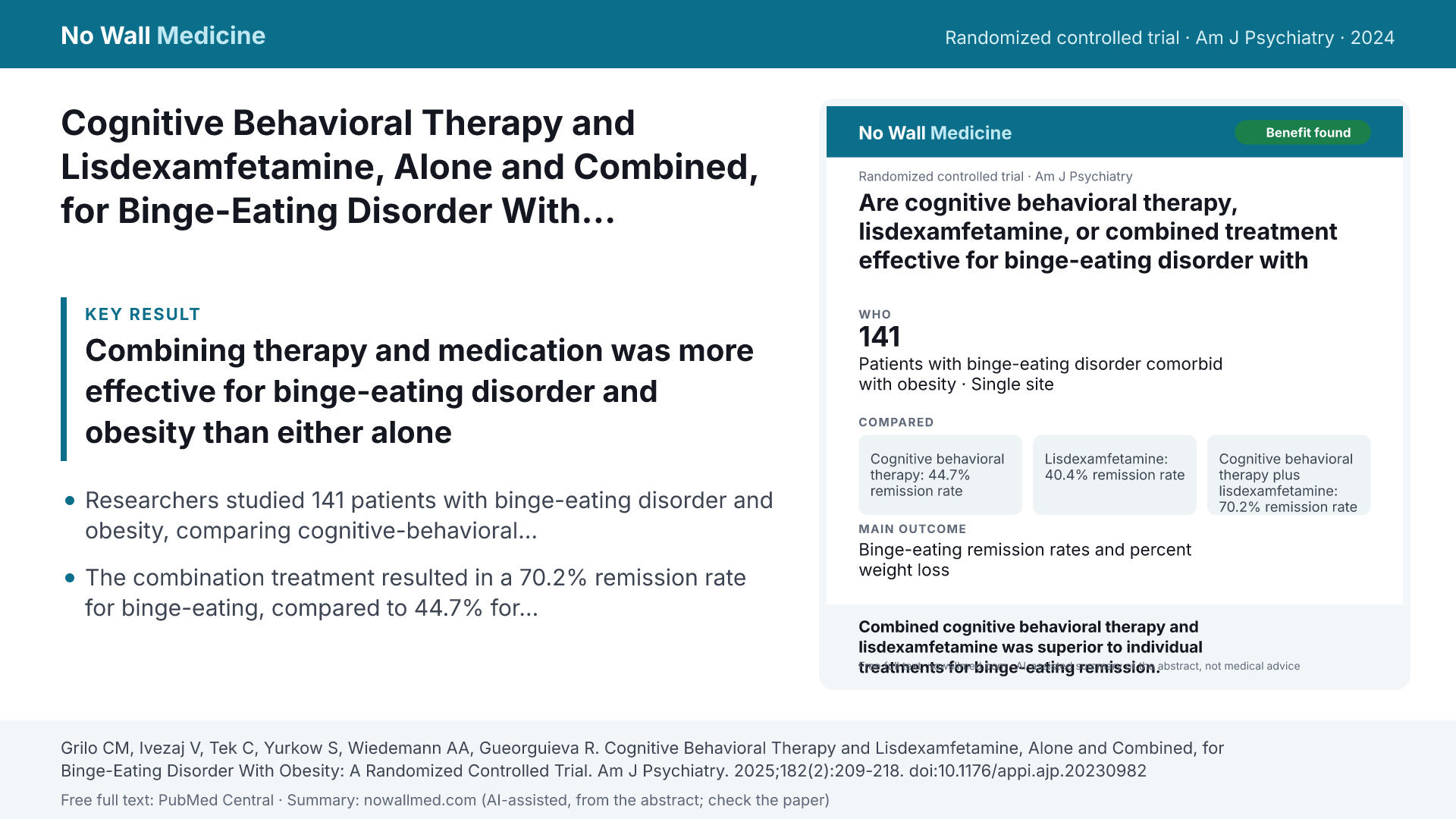
Combining therapy and medication was more effective for binge-eating disorder and obesity than either alone
Cognitive Behavioral Therapy and Lisdexamfetamine, Alone and Combined, for Binge-Eating Disorder With Obesity: A Randomized Controlled Trial
Randomized controlled trialBenefit found
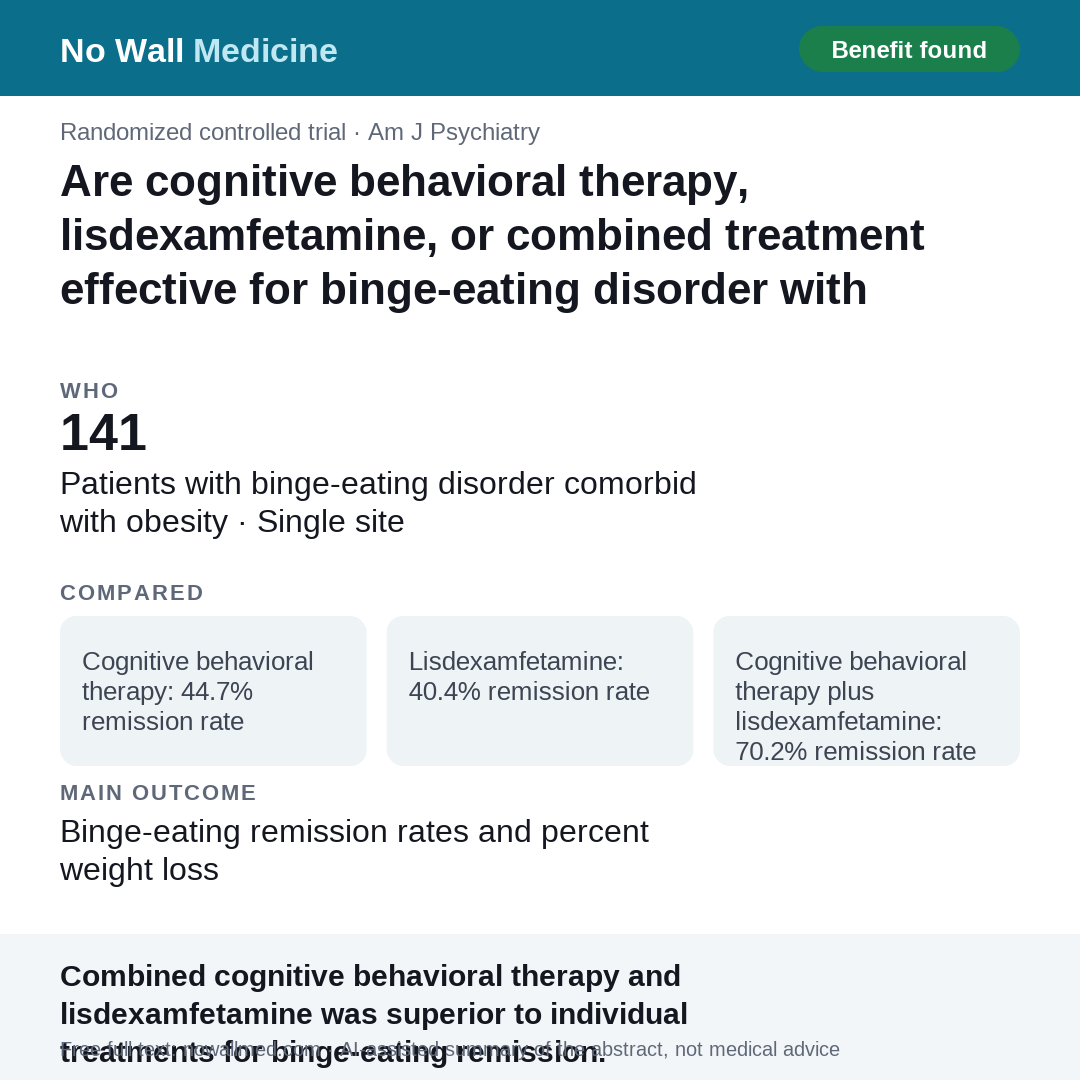
Are cognitive behavioral therapy, lisdexamfetamine, or combined treatment effective for binge-eating disorder with obesity?
Who
141
Patients with binge-eating disorder comorbid with obesity · Single site
Compared
Cognitive behavioral therapy: 44.7% remission rate
Lisdexamfetamine: 40.4% remission rate
Cognitive behavioral therapy plus lisdexamfetamine: 70.2% remission rate
Main outcome
Binge-eating remission rates and percent weight loss
Bottom line: Combined cognitive behavioral therapy and lisdexamfetamine was superior to individual treatments for binge-eating remission.
Am J Psychiatry · 2024-12-11Download image
Clinical question: Are cognitive behavioral therapy, lisdexamfetamine, or combined treatment effective for binge-eating disorder with obesity?
Why it matters: Few evidence-based treatments are currently available for binge-eating disorder that is comorbid with obesity.
Key points
- Researchers studied 141 patients with binge-eating disorder and obesity, comparing cognitive-behavioral therapy, lisdexamfetamine, or a combination of both over 12 weeks.
- The combination treatment resulted in a 70.2% remission rate for binge-eating, compared to 44.7% for cognitive-behavioral therapy and 40.4% for lisdexamfetamine.
- While lisdexamfetamine and the combination therapy were associated with increased weight loss, lisdexamfetamine had the highest rate of achieving at least 5% weight loss at 53.2%.
Headline and key points written with AI from the paper’s abstract, with every number checked against it. Read the paper before relying on them.
Was this summary helpful?
Subject terms
Cite this article
Grilo CM, Ivezaj V, Tek C, Yurkow S, Wiedemann AA, Gueorguieva R. Cognitive Behavioral Therapy and Lisdexamfetamine, Alone and Combined, for Binge-Eating Disorder With Obesity: A Randomized Controlled Trial. Am J Psychiatry. 2024. doi:10.1176/appi.ajp.20230982
Spotted a mistake? Suggest a correction