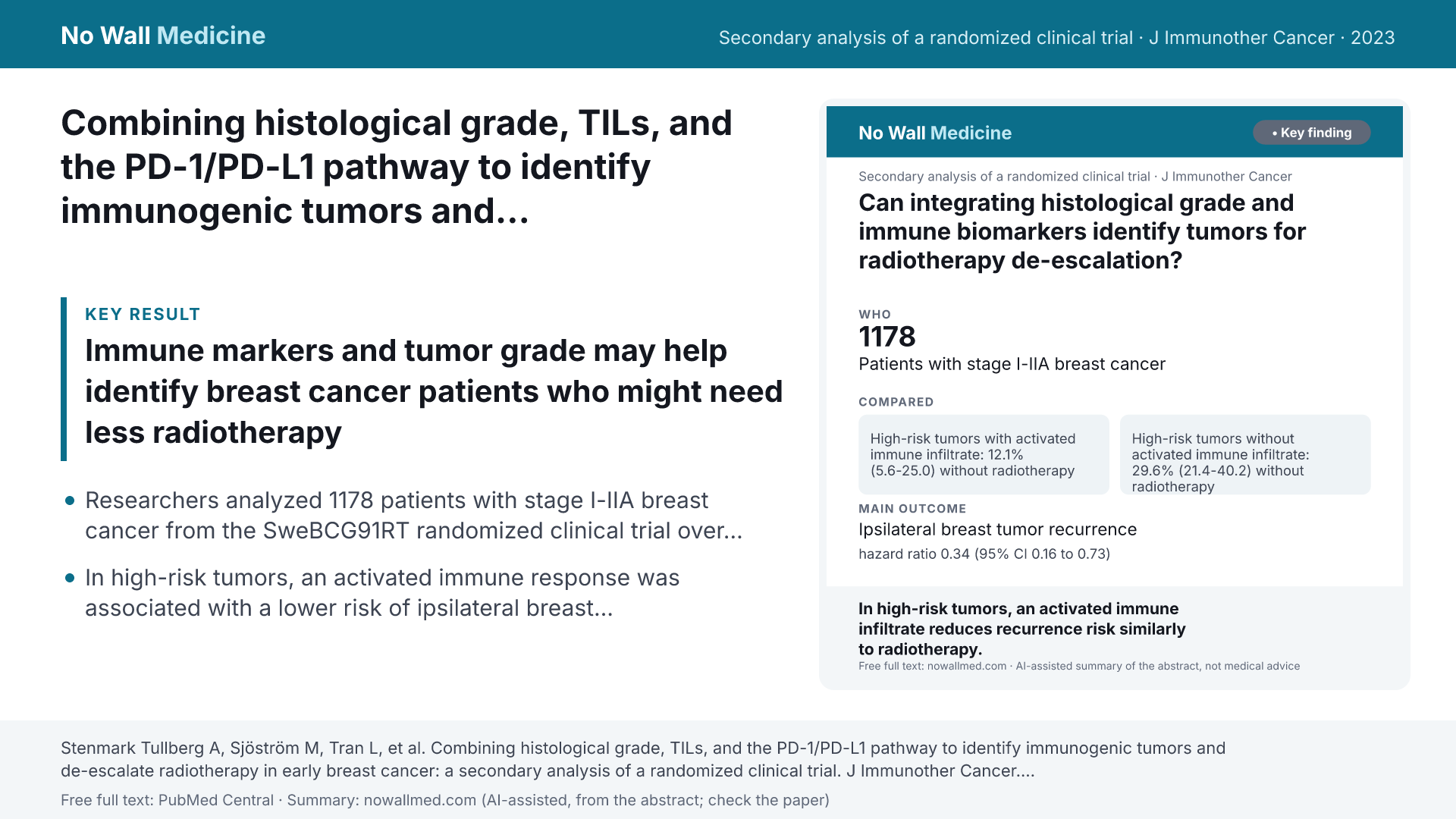
Immune markers and tumor grade may help identify breast cancer patients who might need less radiotherapy
Combining histological grade, TILs, and the PD-1/PD-L1 pathway to identify immunogenic tumors and de-escalate radiotherapy in early breast cancer: a secondary analysis of a randomized clinical trial
Secondary analysis of a randomized clinical trialKey finding
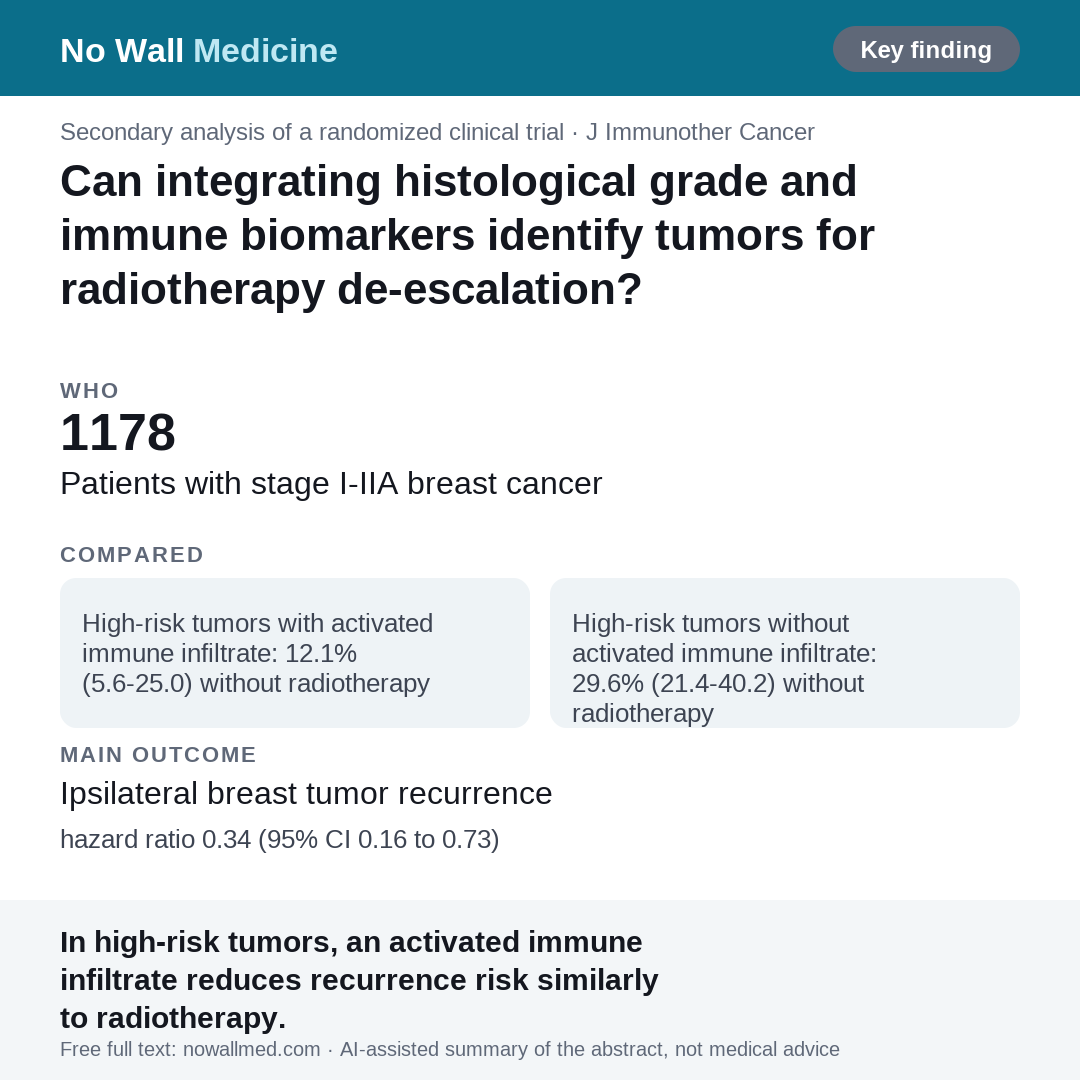
Can integrating histological grade and immune biomarkers identify tumors for radiotherapy de-escalation?
Who
1178
Patients with stage I-IIA breast cancer
Compared
High-risk tumors with activated immune infiltrate: 12.1% (5.6-25.0) without radiotherapy
High-risk tumors without activated immune infiltrate: 29.6% (21.4-40.2) without radiotherapy
Main outcome
Ipsilateral breast tumor recurrence
Result: hazard ratio 0.34 (95% CI 0.16 to 0.73)
Bottom line: In high-risk tumors, an activated immune infiltrate reduces recurrence risk similarly to radiotherapy.
J Immunother Cancer · 2023-05-20Download image
Clinical question: Can integrating histological grade and immune biomarkers identify tumors for radiotherapy de-escalation?
Key points
- Researchers analyzed 1178 patients with stage I-IIA breast cancer from the SweBCG91RT randomized clinical trial over a median of 15.2 years.
- In high-risk tumors, an activated immune response was associated with a lower risk of ipsilateral breast tumor recurrence, with an incidence of 12.1% without radiotherapy and 4.4% with radiotherapy.
- Among low-risk tumors, an activated immune response was not associated with a favorable prognostic effect (HR 2.0, 95% CI 0.87 to 4.6, p=0.100).
Headline and key points written with AI from the paper’s abstract, with every number checked against it. Read the paper before relying on them.
Was this summary helpful?
Abstract
Background
The implementation of immunological biomarkers for radiotherapy (RT) individualization in breast cancer requires consideration of tumor-intrinsic factors. This study aimed to investigate whether the integration of histological grade, tumor-infiltrating lymphocytes (TILs), programmed cell death protein-1 (PD-1), and programmed death ligand-1 (PD-L1) can identify tumors with aggressive characteristics that can be downgraded regarding the need for RT. Methods
The SweBCG91RT trial included 1178 patients with stage I-IIA breast cancer, randomized to breast-conserving surgery with or without adjuvant RT, and followed for a median time of 15.2 years. Immunohistochemical analyses of TILs, PD-1, and PD-L1 were performed. An activated immune response was defined as stromal TILs ≥10% and PD-1 and/or PD-L1 expression in ≥1% of lymphocytes. Tumors were categorized as high-risk or low-risk using assessments of histological grade and proliferation as measured by gene expression. The risk of ipsilateral breast tumor recurrence (IBTR) and benefit of RT were then analyzed with 10 years follow-up based on the integration of immune activation and tumor-intrinsic risk group. Results
Among high-risk tumors, an activated immune infiltrate was associated with a reduced risk of IBTR (HR 0.34, 95% CI 0.16 to 0.73, p=0.006). The incidence of IBTR in this group was 12.1% (5.6-25.0) without RT and 4.4% (1.1-16.3) with RT. In contrast, the incidence of IBTR in the high-risk group without an activated immune infiltrate was 29.6% (21.4-40.2) without RT and 12.8% (6.6-23.9) with RT. Among low-risk tumors, no evidence of a favorable prognostic effect of an activated immune infiltrate was seen (HR 2.0, 95% CI 0.87 to 4.6, p=0.100). Conclusions
Integrating histological grade and immunological biomarkers can identify tumors with aggressive characteristics but a low risk of IBTR despite a lack of RT boost and systemic therapy. Among high-risk tumors, the risk reduction of IBTR conferred by an activated immune infiltrate is comparable to treatment with RT. These findings may apply to cohorts dominated by estrogen receptor-positive tumors.
Abstract reproduced under the article’s CC BY NC licence.
Subject terms
Cite this article
Stenmark Tullberg A, Sjöström M, Tran L, et al. Combining histological grade, TILs, and the PD-1/PD-L1 pathway to identify immunogenic tumors and de-escalate radiotherapy in early breast cancer: a secondary analysis of a randomized clinical trial. J Immunother Cancer. 2023. doi:10.1136/jitc-2022-006618
Spotted a mistake? Suggest a correction