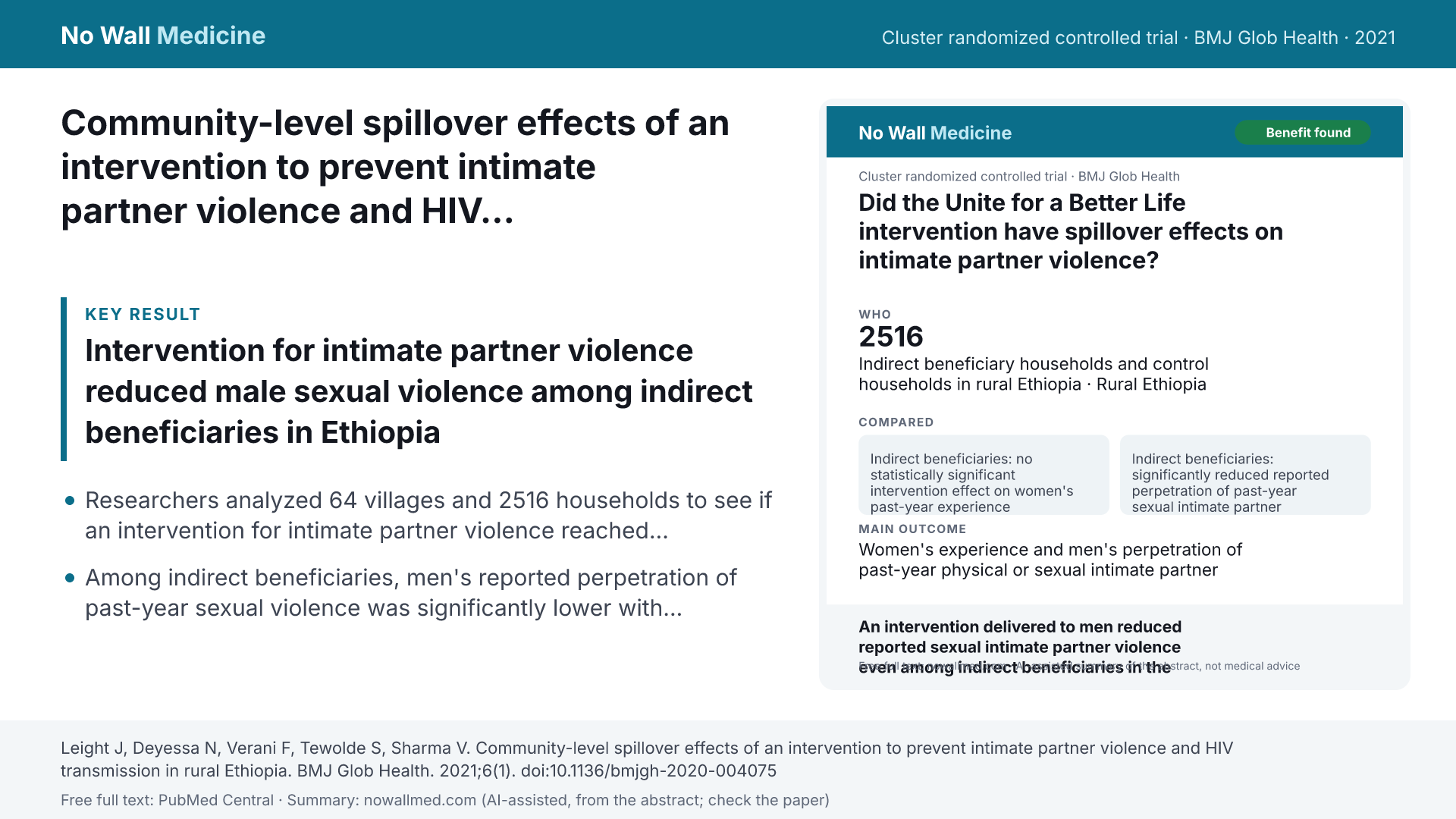
Intervention for intimate partner violence reduced male sexual violence among indirect beneficiaries in Ethiopia
Community-level spillover effects of an intervention to prevent intimate partner violence and HIV transmission in rural Ethiopia
Cluster randomized controlled trialBenefit found
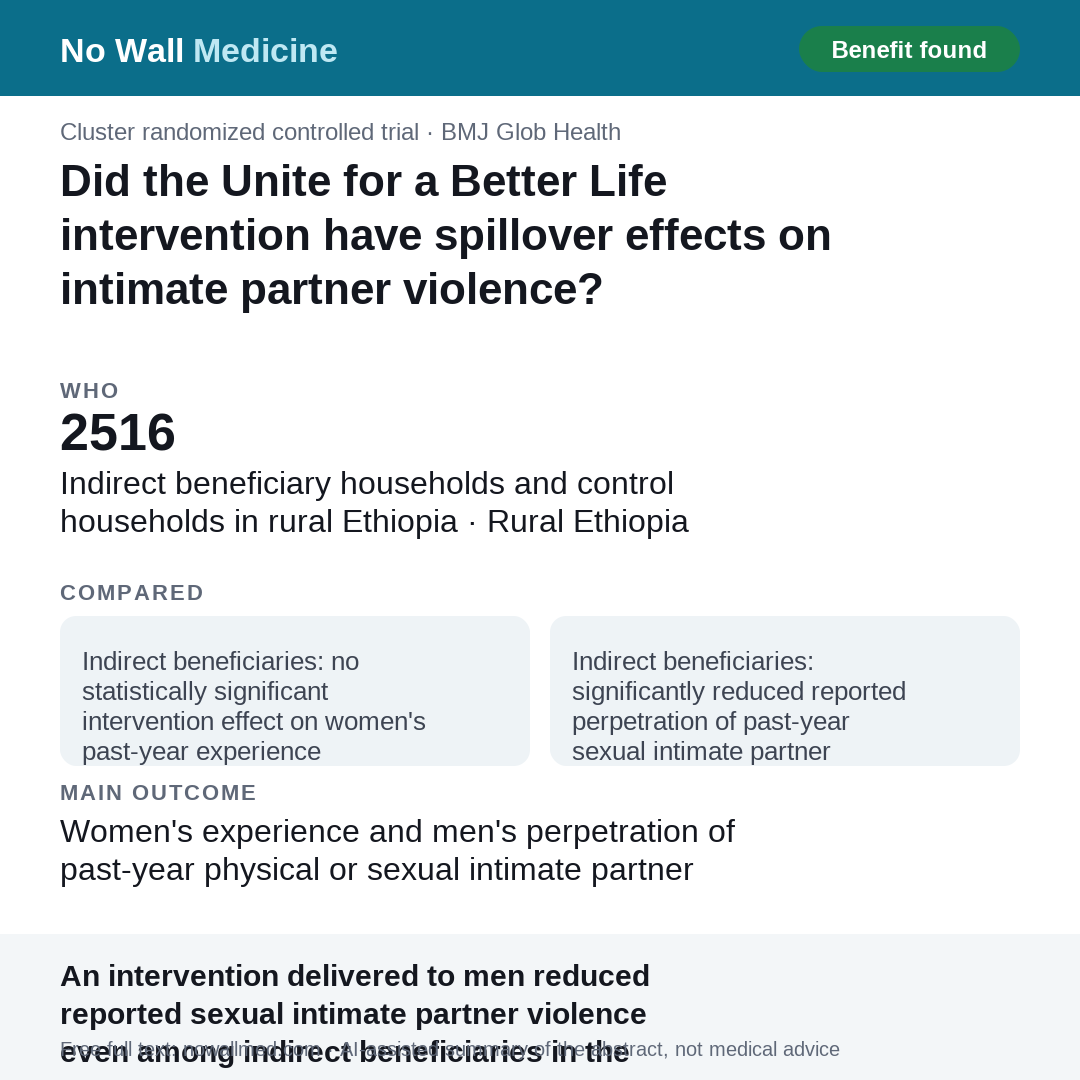
Did the Unite for a Better Life intervention have spillover effects on intimate partner violence?
Who
2516
Indirect beneficiary households and control households in rural Ethiopia · Rural Ethiopia
Compared
Indirect beneficiaries: no statistically significant intervention effect on women's past-year experience
Indirect beneficiaries: significantly reduced reported perpetration of past-year sexual intimate partner violence
Main outcome
Women's experience and men's perpetration of past-year physical or sexual intimate partner violence
Result: Adjusted Odds Ratio: 0.55 (95% CI 0.38 to 0.80)
Bottom line: An intervention delivered to men reduced reported sexual intimate partner violence even among indirect beneficiaries in the community.
BMJ Glob Health · 2021-01-29Download image
Clinical question: Did the Unite for a Better Life intervention have spillover effects on intimate partner violence?
Why it matters: It was unknown whether an intervention targeting intimate partner violence and HIV transmission would have spillover effects on community members who did not directly participate.
Key points
- Researchers analyzed 64 villages and 2516 households to see if an intervention for intimate partner violence reached people not directly participating in the program.
- Among indirect beneficiaries, men's reported perpetration of past-year sexual violence was significantly lower with an adjusted odds ratio of 0.55 (95% CI 0.38 to 0.80, p=0.002).
- There was no statistically significant effect on women's past-year experience of physical or sexual intimate partner violence among indirect beneficiaries.
Headline and key points written with AI from the paper’s abstract, with every number checked against it. Read the paper before relying on them.
Was this summary helpful?
Abstract
Background
Intimate partner violence (IPV) is associated with adverse health and psychosocial outcomes. We analysed the spillover effects of Unite for a Better Life (UBL), an intervention evaluated in a cluster randomised controlled trial using a double-randomised design; previous evidence suggests UBL reduced IPV in rural Ethiopia among direct beneficiaries. Methods
Villages (n=64) were randomly allocated to control, or to receive UBL delivered to men, women or couples. Each cluster comprised 106 surveyed households, including 21 randomly selected indirect beneficiary households who were not included in the intervention. Primary and secondary IPV outcomes included women's experience and men's perpetration of past-year physical or sexual IPV 24 months postintervention. An intention-to-treat analysis was conducted comparing indirect beneficiaries to sampled households in control communities. The analysis includes 2516 households surveyed at baseline in 2014-2015 (1680 households in the control arm, 258 indirect beneficiary households in the couples' arm, 287 indirect beneficiary households in the women's arm and 291 indirect beneficiary households in the men's arm). Follow-up data were available from 88% of baseline respondents and 86% of baseline spouses surveyed in 2017-2018, a total of 4379 individuals. Results
Among indirect beneficiaries, there was no statistically significant intervention effect on women's past-year experience of physical or sexual IPV, while men's UBL significantly reduced reported perpetration of past-year sexual IPV (Adjusted Odds Ratio: 0.55; 95% CI 0.38 to 0.80, p=0.002). The intervention effects among indirect beneficiaries were statistically similar to those reported for the direct beneficiaries. In general, the hypothesis of equal effects cannot be rejected. Conclusion
A gender-transformative intervention delivered to men was effective in reducing reported IPV even among indirect beneficiaries, suggesting that the programme had positive spillover effects in diffusing information and changing behaviours within the broader community. Trial registration numbers
NCT02311699 and American Economic Association Registry (AEARCTR-0000211).
Abstract reproduced under the article’s CC BY NC licence.
Subject terms
Cite this article
Leight J, Deyessa N, Verani F, Tewolde S, Sharma V. Community-level spillover effects of an intervention to prevent intimate partner violence and HIV transmission in rural Ethiopia. BMJ Glob Health. 2021. doi:10.1136/bmjgh-2020-004075
Spotted a mistake? Suggest a correction