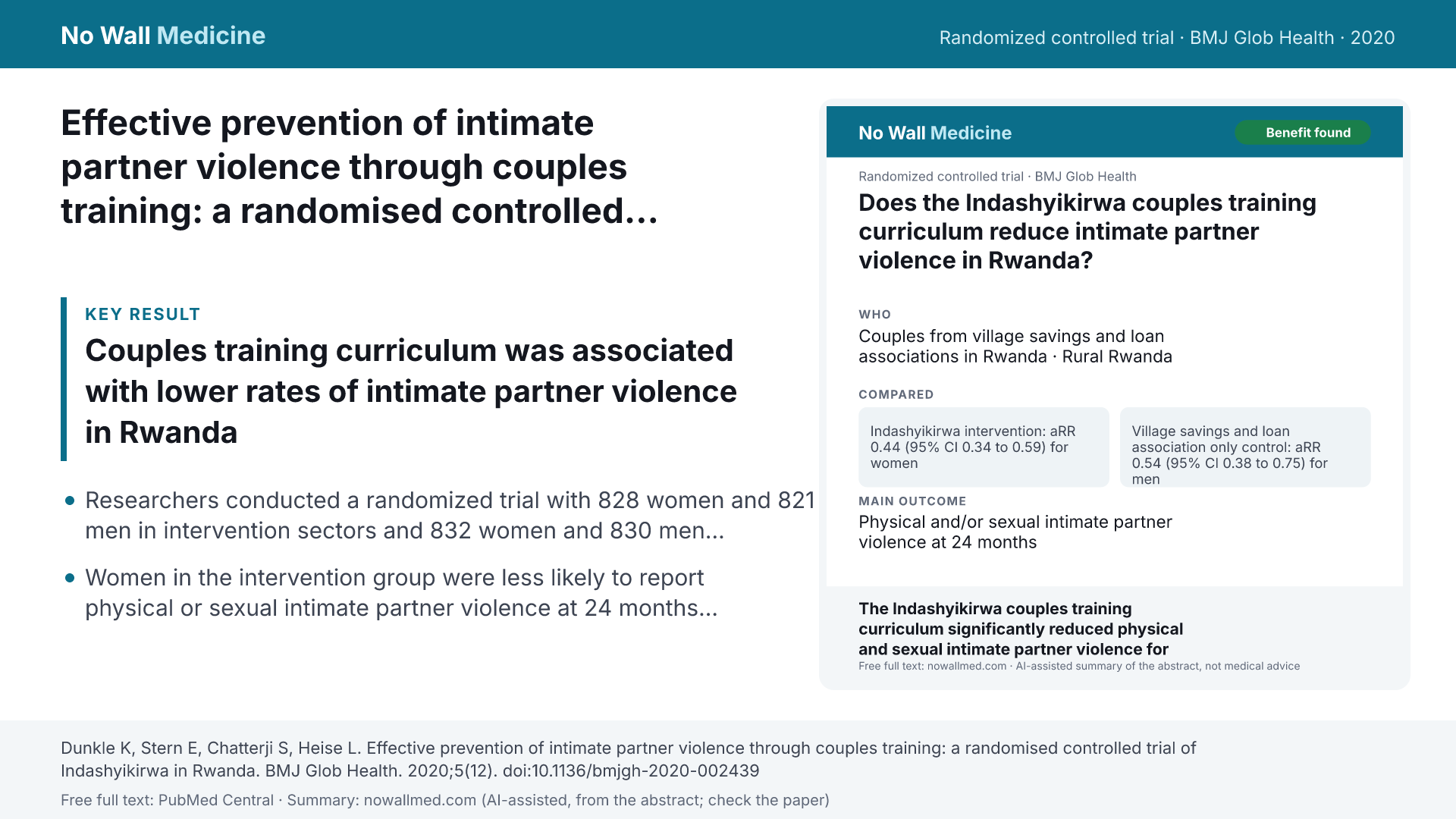
Couples training curriculum was associated with lower rates of intimate partner violence in Rwanda
Effective prevention of intimate partner violence through couples training: a randomised controlled trial of Indashyikirwa in Rwanda
Public & Global HealthAdult and pediatric
Randomized controlled trialBenefit found
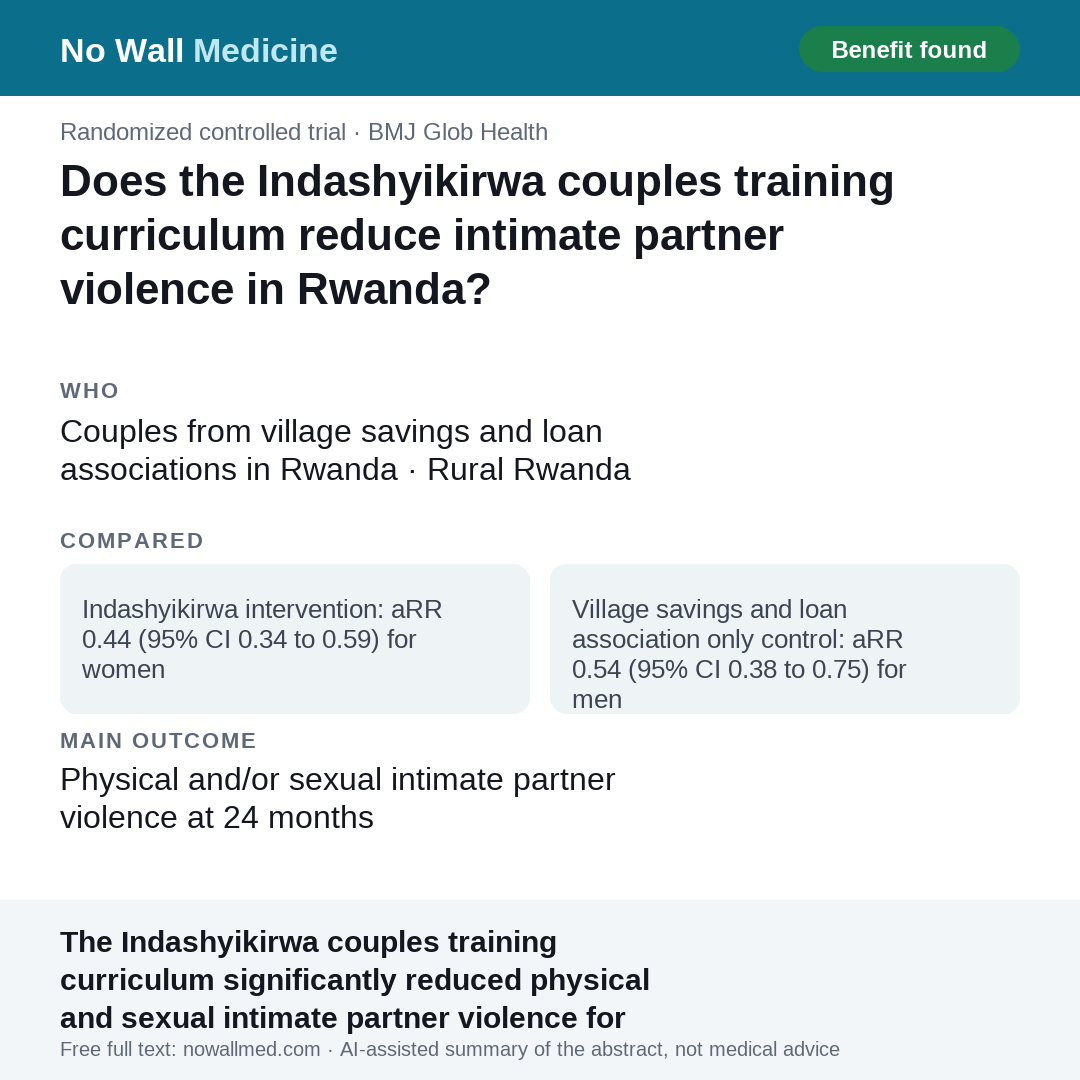
Does the Indashyikirwa couples training curriculum reduce intimate partner violence in Rwanda?
Who
Couples from village savings and loan associations in Rwanda · Rural Rwanda
Compared
Indashyikirwa intervention: aRR 0.44 (95% CI 0.34 to 0.59) for women
Village savings and loan association only control: aRR 0.54 (95% CI 0.38 to 0.75) for men
Main outcome
Physical and/or sexual intimate partner violence at 24 months
Result: aRR 0.44 (95% CI 0.34 to 0.59) for women; aRR 0.54 (95% CI 0.38 to 0.75) for men
Bottom line: The Indashyikirwa couples training curriculum significantly reduced physical and sexual intimate partner violence for both women and men.
BMJ Glob Health · 2020-12-23Download image
Clinical question: Does the Indashyikirwa couples training curriculum reduce intimate partner violence in Rwanda?
Why it matters: It was unknown if a gender transformative curriculum for couples could effectively reduce intimate partner violence in rural Rwandan communities.
Key points
- Researchers conducted a randomized trial with 828 women and 821 men in intervention sectors and 832 women and 830 men in control sectors.
- Women in the intervention group were less likely to report physical or sexual intimate partner violence at 24 months with an adjusted relative risk of 0.44.
- Men in the intervention group were also less likely to report perpetrating physical or sexual intimate partner violence with an adjusted relative risk of 0.54.
Headline and key points written with AI from the paper’s abstract, with every number checked against it. Read the paper before relying on them.
Was this summary helpful?
Abstract
Background
Between 2015 and 2018, three civil society organisations in Rwanda implemented Indashyikirwa, a four-part intervention designed to reduce intimate partner violence (IPV) among couples and within communities. We assessed the impact of the programme's gender transformative curriculum for couples. Methods
Sectors (n=28) were purposively selected based on density of village savings and loan association (VLSA) groups and randomised (with stratification by district) to either the full community-level Indashyikirwa programme (n=14) or VSLA-only control (n=14). Within each sector, 60 couples recruited from VSLAs received either a 21-session curriculum or VSLA as usual. No blinding was attempted. Primary outcomes were perpetration (for men) or experience (for women) of past-year physical/sexual IPV at 24 months post-baseline, hypothesised to be reduced in intervention versus control (ClinicalTrials.gov: NCT03477877). Results
We enrolled 828 women and 821 men in the intervention sectors and 832 women and 830 men in the control sectors; at endline, 815 women (98.4%) and 763 men (92.9%) in the intervention and 802 women (96.4%) and 773 men (93.1%) were available for intention-to-treat analysis. Women in the intervention compared with control were less likely to report physical and/or sexual IPV at 24 months (adjusted relative risk (aRR)=0.44, 95% CI 0.34 to 0.59). Men in the intervention compared with control were also significantly less likely to report perpetration of physical and/or sexual IPV at 24 months (aRR=0.54, 95% CI 0.38 to 0.75). Additional intervention benefits included reductions in acceptability of wife beating, conflict with partner, depression, and corporal punishment against children and improved conflict management, communication, trust, self-efficacy, self-rated health, household earnings, food security and actions to prevent IPV. There were no study-related harms. Conclusions
The Indashyikirwa couples' training curriculum was highly effective in reducing IPV among male/female couples in rural Rwanda. Scale-up and adaptation to similar settings should be considered.
Abstract reproduced under the article’s CC BY NC licence.
Subject terms
Cite this article
Dunkle K, Stern E, Chatterji S, Heise L. Effective prevention of intimate partner violence through couples training: a randomised controlled trial of Indashyikirwa in Rwanda. BMJ Glob Health. 2020. doi:10.1136/bmjgh-2020-002439
Spotted a mistake? Suggest a correction