Gender transformative intervention did not change rates of physical or sexual intimate partner violence
A cluster randomised controlled trial to evaluate the impact of a gender transformative intervention on intimate partner violence against women in newly formed neighbourhood groups in Tanzania
Cluster randomised controlled trialMixed results
Does a gender transformative intervention reduce intimate partner violence against women?
Who
1265
Women in newly formed neighbourhood groups · Mwanza city, Tanzania
Compared
Intervention: 21% reported physical IPV
Control: 20% reported physical IPV
Main outcome
Past-year physical and sexual intimate partner violence
Result: adjusted OR 0.98 (95% CI 0.72 to 1.33)
Bottom line: The intervention reduced emotional abuse and improved attitudes but did not reduce physical or sexual intimate partner violence.
BMJ Glob Health · 2021-07-24Download image
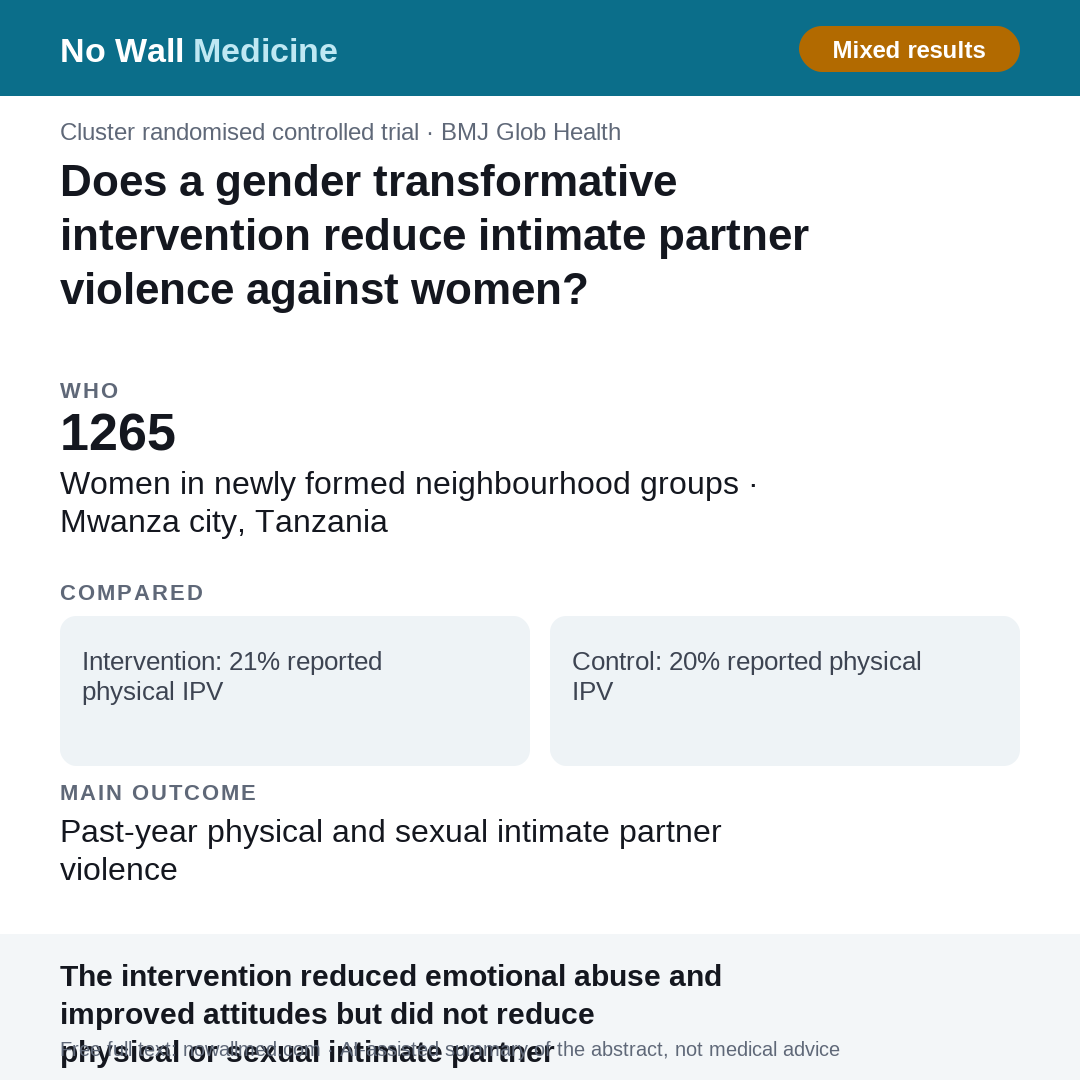
Clinical question: Does a gender transformative intervention reduce intimate partner violence against women?
Why it matters: It is unknown if a gender transformative intervention designed to empower women can prevent physical and sexual intimate partner violence.
Key points
- Researchers conducted a cluster randomized controlled trial with 1265 women in 66 Tanzanian neighbourhoods to test a 10-session empowerment program.
- The intervention did not significantly change physical intimate partner violence, reported by 21% of intervention women versus 20% of control women, or sexual violence, reported by 20% versus 21%.
- Intervention women reported less emotional abuse and were less likely to hold attitudes accepting of intimate partner violence or beliefs that it is a private matter.
Headline and key points written with AI from the paper’s abstract, with every number checked against it. Read the paper before relying on them.
Was this summary helpful?
Abstract
Introduction
Violence against women is a global public health concern; around a quarter of women will experience intimate partner physical or sexual violence during their lifetime. We assessed the impact of a gender transformative intervention for women designed to prevent intimate partner violence (IPV). Methods
We conducted a cluster randomised controlled trial in Mwanza city, Tanzania, among women in newly formed neighbourhood groups to evaluate a 10-session participatory intervention that aims to empower women, prevent IPV and promote healthy relationships. Following a baseline interview, groups were randomly assigned (1:1 ratio) to the intervention or control arm. An intention-to-treat analysis was conducted to assess the impact of the intervention on the main outcomes, assessed 24 months postintervention. These included past-year physical IPV and sexual IPV (primary); past-year emotional abuse; and acceptability and tolerance of IPV. Results
Between September 2015 and February 2017, 1265 women were recruited in 66 neighbourhoods and randomly allocated to intervention (n=627 women in 33 neighbourhoods) or control (n=638 women in 33 neighbourhoods). Assessment of outcomes was completed for 551 (88%) intervention and 575 (90%) control women. Among intervention women, 113 (21%) reported physical IPV compared with 117 (20%) control women (adjusted OR (aOR) 0.98, 95% CI 0.72 to 1.33, p=0.892), and 109 (20%) intervention women reported sexual IPV compared with 121 (21%) control women (aOR 0.98, 95% CI 0.72 to 1.32, p=0.881). Intervention women reported less emotional abuse (aOR 0.74, 95% CI 0.56 to 0.98, p=0.035), and were less likely to express attitudes accepting of IPV (aOR 0.49, 95% CI 0.36 to 0.66, p<0.001), and beliefs that IPV is a private matter (aOR 0.54, 95% CI 0.38 to 0.78, p=0.001), or should be tolerated (aOR 0.48, 95% CI 0.34 to 0.66, p<0.001). Conclusion
These results indicate that the intervention was effective in reducing emotional abuse and positively impacting attitudes and beliefs condoning IPV, but was not sufficient to reduce physical or sexual IPV. Trial registration number
NCT02592252.
Abstract reproduced under the article’s CC BY NC licence.
Subject terms
Cite this article
Harvey S, Abramsky T, Mshana G, Hansen CH, Mtolela GJ, Madaha F. A cluster randomised controlled trial to evaluate the impact of a gender transformative intervention on intimate partner violence against women in newly formed neighbourhood groups in Tanzania. BMJ Glob Health. 2021. doi:10.1136/bmjgh-2020-004555
Spotted a mistake? Suggest a correction
Top studies every Monday
The week’s key trials and guidelines in your specialties, plus any topics you follow. By email, free.
Get the weekly digest