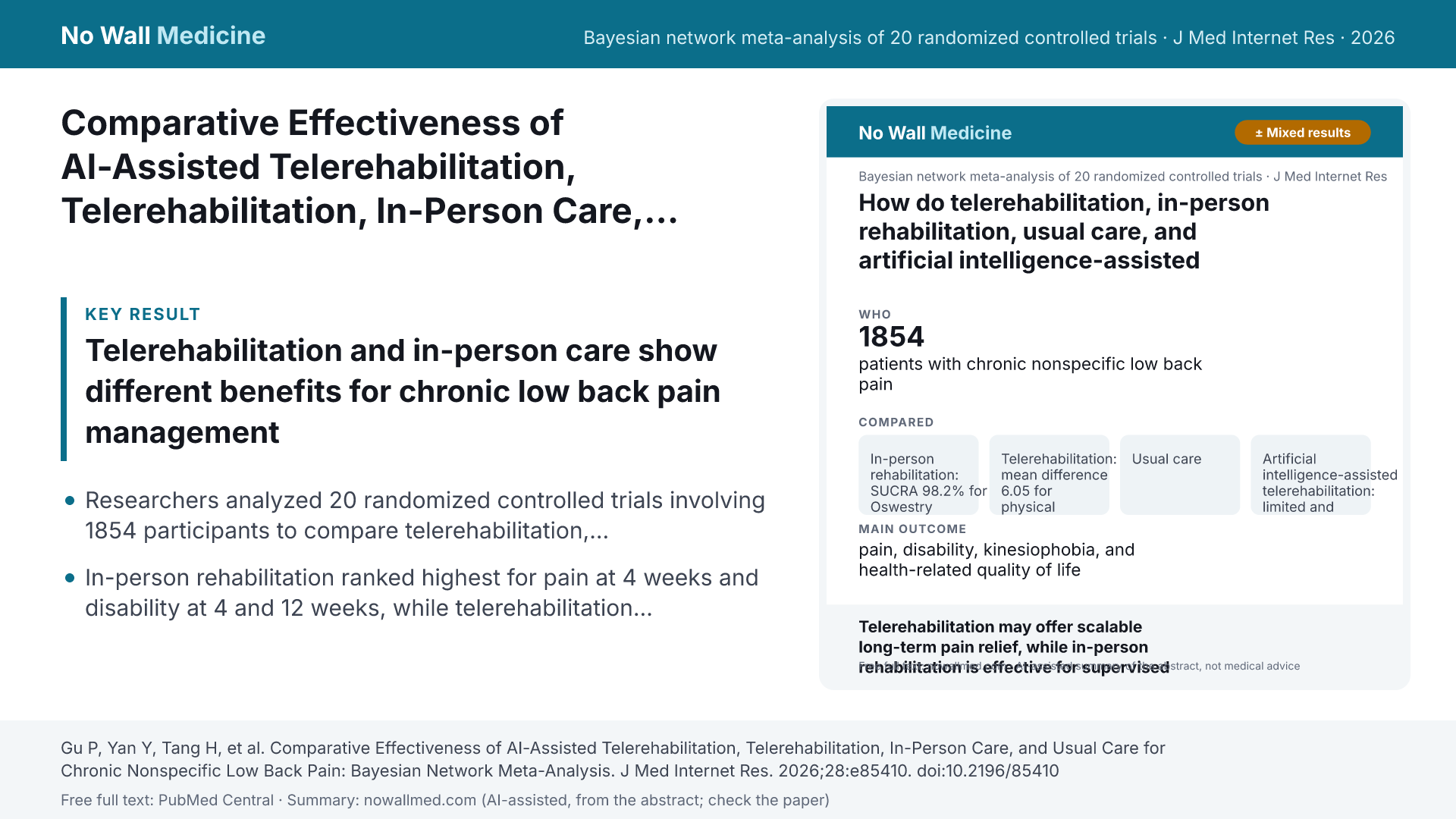
Telerehabilitation and in-person care show different benefits for chronic low back pain management
Comparative Effectiveness of AI-Assisted Telerehabilitation, Telerehabilitation, In-Person Care, and Usual Care for Chronic Nonspecific Low Back Pain: Bayesian Network Meta-Analysis
Bayesian network meta-analysis of 20 randomized controlled trialsMixed results
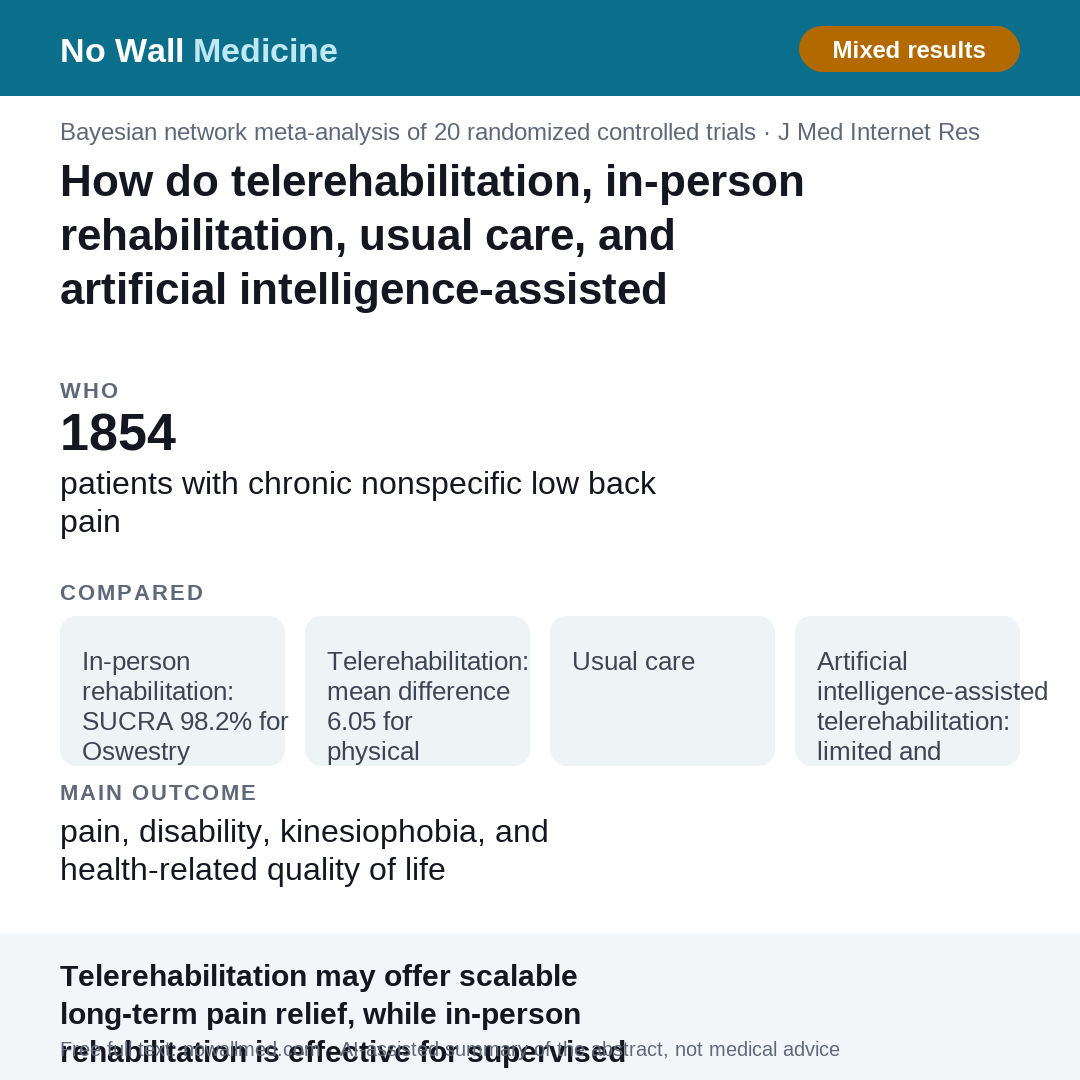
How do telerehabilitation, in-person rehabilitation, usual care, and artificial intelligence-assisted telerehabilitation compare for chronic nonspecific low back pain?
Who
1854
patients with chronic nonspecific low back pain
Compared
In-person rehabilitation: SUCRA 98.2% for Oswestry Disability Index at 4 weeks
Telerehabilitation: mean difference 6.05 for physical component summary score
Usual care
Artificial intelligence-assisted telerehabilitation: limited and descriptive
Main outcome
pain, disability, kinesiophobia, and health-related quality of life
Result: mean difference 6.05, 95% credible interval 2.89-9.22
Bottom line: Telerehabilitation may offer scalable long-term pain relief, while in-person rehabilitation is effective for supervised functional recovery.
Limitation: Evidence for artificial intelligence-assisted telerehabilitation remains limited and descriptive with low to very low certainty.
J Med Internet Res · 2026-07-03Download image
Clinical question: How do telerehabilitation, in-person rehabilitation, usual care, and artificial intelligence-assisted telerehabilitation compare for chronic nonspecific low back pain?
Key points
- Researchers analyzed 20 randomized controlled trials involving 1854 participants to compare telerehabilitation, in-person rehabilitation, usual care, and artificial intelligence-assisted telerehabilitation.
- In-person rehabilitation ranked highest for pain at 4 weeks and disability at 4 and 12 weeks, while telerehabilitation ranked highest for pain at 12 weeks.
- Telerehabilitation significantly improved physical health-related quality of life with a mean difference of 6.05, but in-person mental health-related quality of life improvements were not significant.
Limitation the authors note: Evidence for artificial intelligence-assisted telerehabilitation remained limited and descriptive, suggesting possible short-term benefits with low to very low certainty.
Headline and key points written with AI from the paper’s abstract, with every number checked against it. Read the paper before relying on them.
Was this summary helpful?
Subject terms
Cite this article
Gu P, Yan Y, Tang H, et al. Comparative Effectiveness of AI-Assisted Telerehabilitation, Telerehabilitation, In-Person Care, and Usual Care for Chronic Nonspecific Low Back Pain: Bayesian Network Meta-Analysis. J Med Internet Res. 2026. doi:10.2196/85410
Spotted a mistake? Suggest a correction