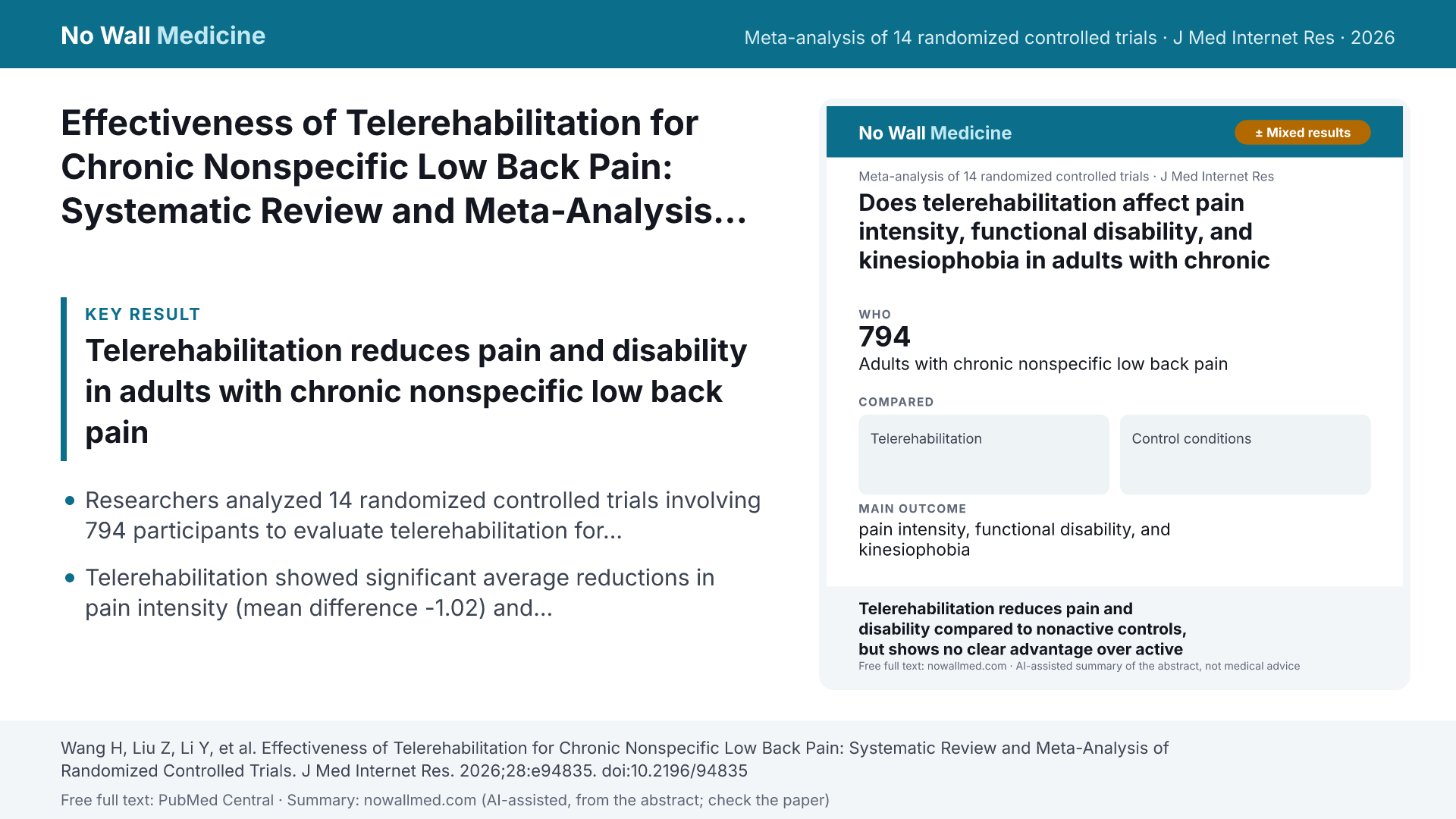
Telerehabilitation reduces pain and disability in adults with chronic nonspecific low back pain
Effectiveness of Telerehabilitation for Chronic Nonspecific Low Back Pain: Systematic Review and Meta-Analysis of Randomized Controlled Trials
Meta-analysis of 14 randomized controlled trialsMixed results
Does telerehabilitation affect pain intensity, functional disability, and kinesiophobia in adults with chronic nonspecific low back pain?
Who
794
Adults with chronic nonspecific low back pain
Compared
Telerehabilitation
Control conditions
Main outcome
pain intensity, functional disability, and kinesiophobia
Result: pain intensity MD -1.02 (95% CI -1.78 to -0.26); functional disability MD -7.04 (95% CI -13.43 to -0.65); kinesiophobia MD -3.14 (95% CI -7.88 to 1.59)
Bottom line: Telerehabilitation reduces pain and disability compared to nonactive controls, but shows no clear advantage over active rehabilitation.
Limitation: Substantial heterogeneity, prediction intervals crossing the null, and low or very low certainty of evidence.
J Med Internet Res · 2026-08-10 · Save PNG
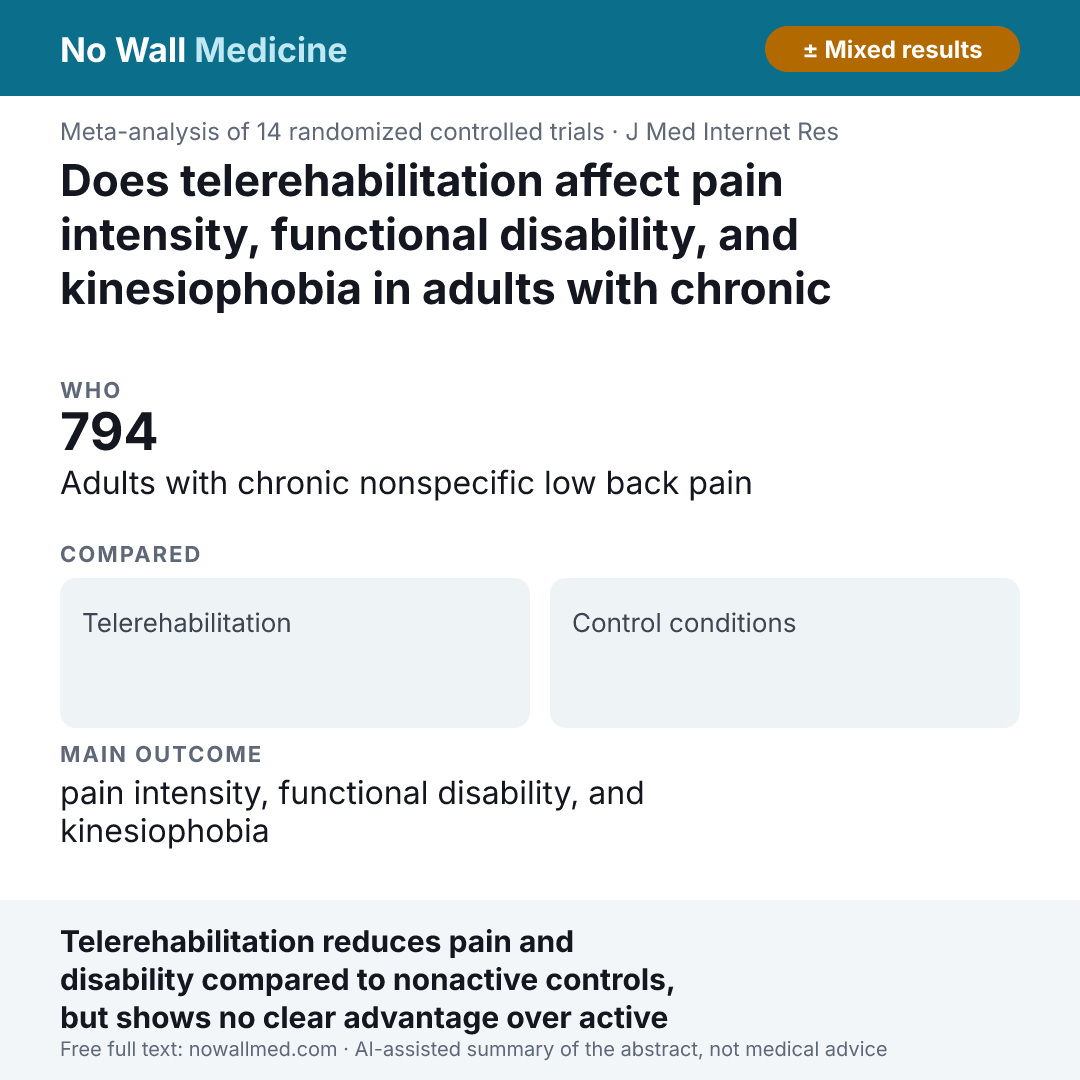
Clinical question: Does telerehabilitation affect pain intensity, functional disability, and kinesiophobia in adults with chronic nonspecific low back pain?
Why it matters: Evidence regarding the effects of telerehabilitation on chronic nonspecific low back pain has remained inconsistent.
Key points
- Researchers analyzed 14 randomized controlled trials involving 794 participants to evaluate telerehabilitation for chronic nonspecific low back pain.
- Telerehabilitation showed significant average reductions in pain intensity (mean difference -1.02) and functional disability (mean difference -7.04) compared to control conditions.
- The effect on kinesiophobia, or fear of movement, was not statistically significant with a mean difference of -3.14.
Limitation the authors note: The review noted substantial heterogeneity, risk of bias, and low or very low certainty of evidence.
Headline and key points written with AI from the paper’s abstract, with every number checked against it. Read the paper before relying on them.
Was this summary helpful?
Subject terms
Headline, design, result, key points, caveat and citation as plain text.
Cite this article
Wang H, Liu Z, Li Y, et al. Effectiveness of Telerehabilitation for Chronic Nonspecific Low Back Pain: Systematic Review and Meta-Analysis of Randomized Controlled Trials. J Med Internet Res. 2026;28:e94835. doi:10.2196/94835
Spotted a mistake? Suggest a correction