High intensity rosuvastatin, simvastatin, and atorvastatin most effective at reducing non-HDL cholesterol in diabetes
Comparative effectiveness of statins on non-high density lipoprotein cholesterol in people with diabetes and at risk of cardiovascular disease: systematic review and network meta-analysis
Systematic review and network meta-analysisBenefit found
How do different statin intensities compare for non-high density lipoprotein cholesterol reduction in diabetes?
Who
11698
Adults with type 1 or type 2 diabetes mellitus
Compared
Rosuvastatin high intensity: -2.31 mmol/L
Rosuvastatin moderate intensity: -2.27 mmol/L
Simvastatin high intensity: -2.26 mmol/L
Atorvastatin high intensity: -2.20 mmol/L
Main outcome
Changes in non-high density lipoprotein cholesterol levels
Bottom line: Rosuvastatin at moderate or high intensity and atorvastatin or simvastatin at high intensity most effectively reduce non-high density lipoprotein cholesterol.
BMJ · 2022-03-24Download image
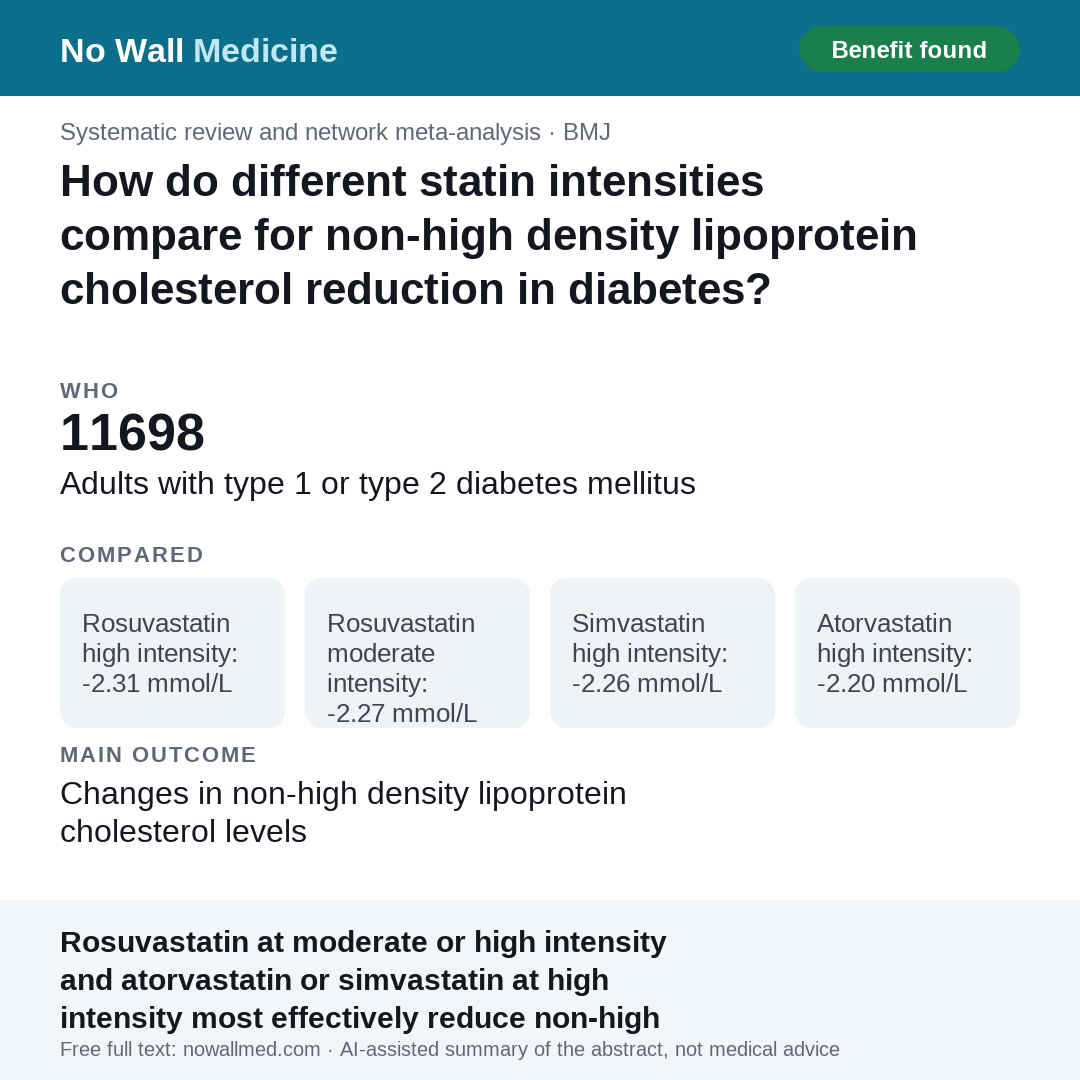
Clinical question: How do different statin intensities compare for non-high density lipoprotein cholesterol reduction in diabetes?
Why it matters: It is unknown which specific types and intensities of statins are most effective at reducing non-high density lipoprotein cholesterol in people with diabetes.
Key points
- Researchers analyzed 42 randomized controlled trials involving 20,193 adults, with 11,698 included in the meta-analysis comparing different statin types and intensities.
- Compared to placebo, high-intensity rosuvastatin showed the largest reduction in non-high density lipoprotein cholesterol (non-HDL-C) at -2.31 mmol/L.
- Moderate-intensity atorvastatin was associated with a lower risk of non-fatal heart attack compared to placebo, with a relative risk of 0.57.
Headline and key points written with AI from the paper’s abstract, with every number checked against it. Read the paper before relying on them.
Abstract
Objective
To compare the efficacy of different statin treatments by intensity on levels of non-high density lipoprotein cholesterol (non-HDL-C) for the prevention of cardiovascular disease in people with diabetes. Design
Systematic review and network meta-analysis. Data sources
Medline, Cochrane Central Register of Controlled Trials, and Embase from inception to 1 December 2021. Review methods
Randomised controlled trials comparing different types and intensities of statins, including placebo, in adults with type 1 or type 2 diabetes mellitus were included. The primary outcome was changes in levels of non-HDL-C, calculated from measures of total cholesterol and HDL-C. Secondary outcomes were changes in levels of low density lipoprotein cholesterol (LDL-C) and total cholesterol, three point major cardiovascular events (non-fatal stroke, non-fatal myocardial infarction, and death related to cardiovascular disease), and discontinuations because of adverse events. A bayesian network meta-analysis of statin intensity (low, moderate, or high) with random effects evaluated the treatment effect on non-HDL-C by mean differences and 95% credible intervals. Subgroup analysis of patients at greater risk of major cardiovascular events was compared with patients at low or moderate risk. The confidence in network meta-analysis (CINeMA) framework was applied to determine the certainty of evidence. Results
In 42 randomised controlled trials involving 20 193 adults, 11 698 were included in the meta-analysis. Compared with placebo, the greatest reductions in levels of non-HDL-C were seen with rosuvastatin at high (-2.31 mmol/L, 95% credible interval -3.39 to -1.21) and moderate (-2.27, -3.00 to -1.49) intensities, and simvastatin (-2.26, -2.99 to -1.51) and atorvastatin (-2.20, -2.69 to -1.70) at high intensity. Atorvastatin and simvastatin at any intensity and pravastatin at low intensity were also effective in reducing levels of non-HDL-C. In 4670 patients at greater risk of a major cardiovascular events, atorvastatin at high intensity showed the largest reduction in levels of non-HDL-C (-1.98, -4.16 to 0.26, surface under the cumulative ranking curve 64%). Simvastatin (-1.93, -2.63 to -1.21) and rosuvastatin (-1.76, -2.37 to -1.15) at high intensity were the most effective treatment options for reducing LDL-C. Significant reductions in non-fatal myocardial infarction were found for atorvastatin at moderate intensity compared with placebo (relative risk=0.57, confidence interval 0.43 to 0.76, n=4 studies). No significant differences were found for discontinuations, non-fatal stroke, and cardiovascular deaths. Conclusions
This network meta-analysis indicated that rosuvastatin, at moderate and high intensity doses, and simvastatin and atorvastatin, at high intensity doses, were most effective at moderately reducing levels of non-HDL-C in patients with diabetes. Given the potential improvement in accuracy in predicting cardiovascular disease when reduction in levels of non-HDL-C is used as the primary target, these findings provide guidance on which statin types and intensities are most effective by reducing non-HDL-C in patients with diabetes. Systematic review registration
PROSPERO CRD42021258819.
Abstract reproduced under the article’s CC BY licence.
Topics
Cite this article
Hodkinson A, Tsimpida D, Kontopantelis E, Rutter MK, Mamas MA, Panagioti M. Comparative effectiveness of statins on non-high density lipoprotein cholesterol in people with diabetes and at risk of cardiovascular disease: systematic review and network meta-analysis. BMJ. 2022. doi:10.1136/bmj-2021-067731
Spotted a mistake? Suggest a correction
Top studies every Monday
The week’s key trials and guidelines in your specialties, plus any topics you follow. By email, free.
Get the weekly digest