Motor imagery with low-frequency rTMS improved upper limb function post-stroke
Comparative efficacy of motor imagery augmented with central non-invasive brain stimulation versus peripheral electrical stimulation for upper extremity rehabilitation post-stroke: a systematic review and network meta-analysis
Systematic review and network meta-analysisBenefit found
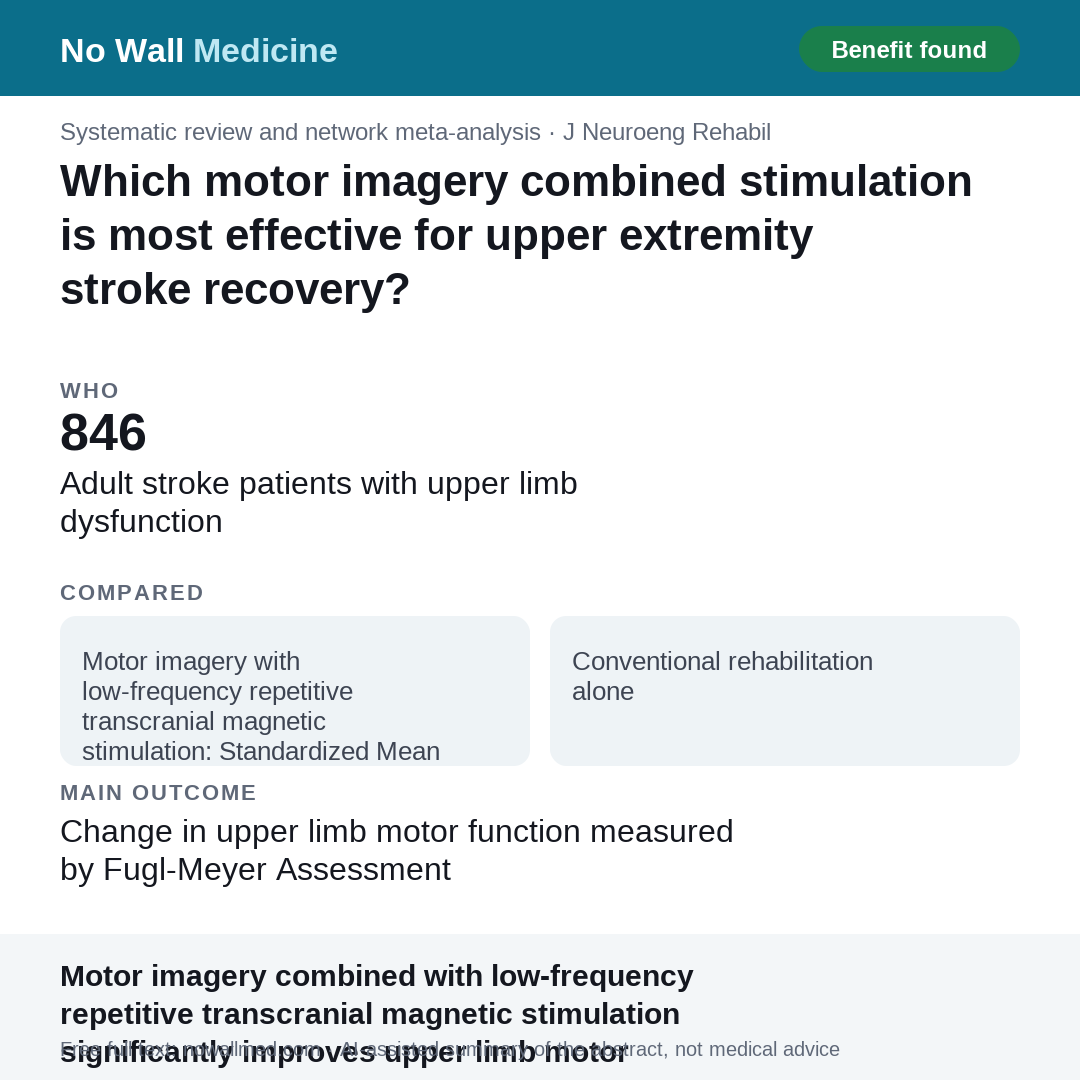
Which motor imagery combined stimulation is most effective for upper extremity stroke recovery?
Who
846
Adult stroke patients with upper limb dysfunction
Compared
Motor imagery with low-frequency repetitive transcranial magnetic stimulation: Standardized Mean Difference 1.755
Conventional rehabilitation alone
Main outcome
Change in upper limb motor function measured by Fugl-Meyer Assessment
Result: Standardized Mean Difference 1.755 (95% CI 0.631 to 2.879)
Bottom line: Motor imagery combined with low-frequency repetitive transcranial magnetic stimulation significantly improves upper limb motor function compared to conventional rehabilitation.
Limitation: Heterogeneity was influenced by brain-computer interface use, publication year, and patient mean age.
J Neuroeng Rehabil · 2026-04-25Download image
Clinical question: Which motor imagery combined stimulation is most effective for upper extremity stroke recovery?
Why it matters: Doctors have had little evidence on the best way to combine motor imagery with other therapies for upper limb rehabilitation post-stroke
Key points
- Seventeen trials with 846 participants compared nine rehabilitation strategies.
- Motor imagery with low-frequency rTMS showed a significant difference in upper limb function.
- No other intervention showed a significant difference compared to conventional rehabilitation.
Limitation the authors note: Future research should focus on larger, more diverse populations to validate the findings
Headline and key points written with AI from the paper’s abstract, with every number checked against it. Read the paper before relying on them.
Topics
Cite this article
Xi L, Liu Q, Li H, Li W, He D, Yao L. Comparative efficacy of motor imagery augmented with central non-invasive brain stimulation versus peripheral electrical stimulation for upper extremity rehabilitation post-stroke: a systematic review and network meta-analysis. J Neuroeng Rehabil. 2026. doi:10.1186/s12984-026-02002-w
Spotted a mistake? Suggest a correction