Comparative efficacy of nonpharmacological interventions for preventing postoperative delirium in hospitalized older adults: a systematic review and network meta-analysis
Network meta-analysis of randomized controlled trialsBenefit found
Which nonpharmacological interventions are most effective for preventing postoperative delirium in older adults?
Who
4340
Hospitalized older adults undergoing surgery
Compared
Multicomponent interventions: OR 0.48 (95% CI 0.35-0.66)
Usual care
Main outcome
Postoperative delirium incidence
Result: odds ratio 0.48 (95% CI 0.35-0.66)
Bottom line: Multicomponent nonpharmacological interventions are the most effective strategies for reducing postoperative delirium incidence in hospitalized older adults.
Age Ageing · 2025-09-26Download image
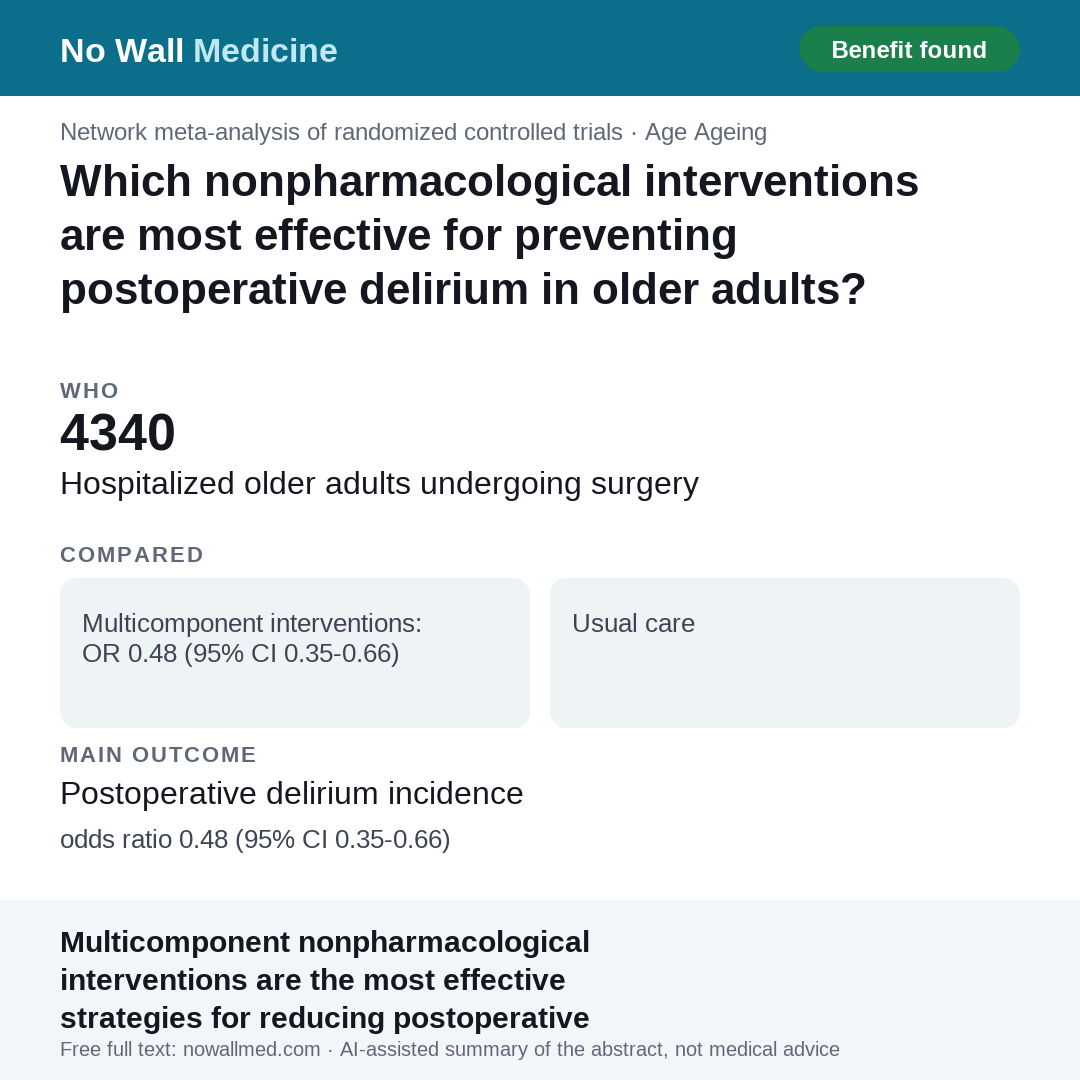
Clinical question: Which nonpharmacological interventions are most effective for preventing postoperative delirium in older adults?
Abstract
Background
Postoperative delirium (POD) is the most common surgical complication. Although numerous studies have demonstrated the effectiveness of multicomponent interventions in preventing delirium among medical patients, the most effective nonpharmacological strategies for reducing the incidence of POD remains unclear. This study aimed to compare the effects of component-based and treatment-based nonpharmacological interventions on POD prevention in hospitalized older adults. Methods
A network meta-analysis was conducted using three databases from inception to February 1, 2024. Only randomized controlled trials evaluating nonpharmacological interventions versus usual care or other interventions for POD prevention in surgical older adults were included. A random-effects network meta-analysis assessed the comparative effectiveness of interventions. Results
Nineteen studies involving 4340 hospitalized older adults were included. Component-based analysis showed that multicomponent interventions were the most effective for reducing POD compared to usual care (odds ratio [OR] = 0.48, 95% confidence interval [CI] = 0.35-0.66). Treatment-based analysis identified that multicomponent interventions comprising six elements-physical activity, reorientation, clinical adjustment, sensory stimulation, environmental control and relaxation promotion-most effectively reduced POD incidence (OR = 0.11, 95% CI = 0.04-0.33). Conclusions
This network meta-analysis, drawing on both direct and indirect evidence, suggests that multicomponent nonpharmacological interventions are the most effective strategies for reducing POD incidence in hospitalized older adults. Specifically, interventions incorporating physical activity, reorientation, clinical adjustment, sensory stimulation, environmental control and relaxation promotion significantly lowered the risk of POD. These findings support the adoption of comprehensive multicomponent interventions as a first-line approach for POD prevention in surgical older adult populations.
Topics
Cite this article
Hsiao CC, Lin CJ, Hasan F, Romadlon DS, Traynor V, Hulu SRK. Comparative efficacy of nonpharmacological interventions for preventing postoperative delirium in hospitalized older adults: a systematic review and network meta-analysis. Age Ageing. 2025. doi:10.1093/ageing/afaf264
Spotted a mistake? Suggest a correction
Top studies every Monday
The week’s key trials and guidelines in your specialties, plus any topics you follow. By email, free.
Get the weekly digest