Digital rectal examination shows low diagnostic value for prostate cancer screening compared to PSA
Comparing the Performance of Digital Rectal Examination and Prostate-specific Antigen as a Screening Test for Prostate Cancer: A Systematic Review and Meta-analysis
Systematic review and meta-analysisNo clear difference
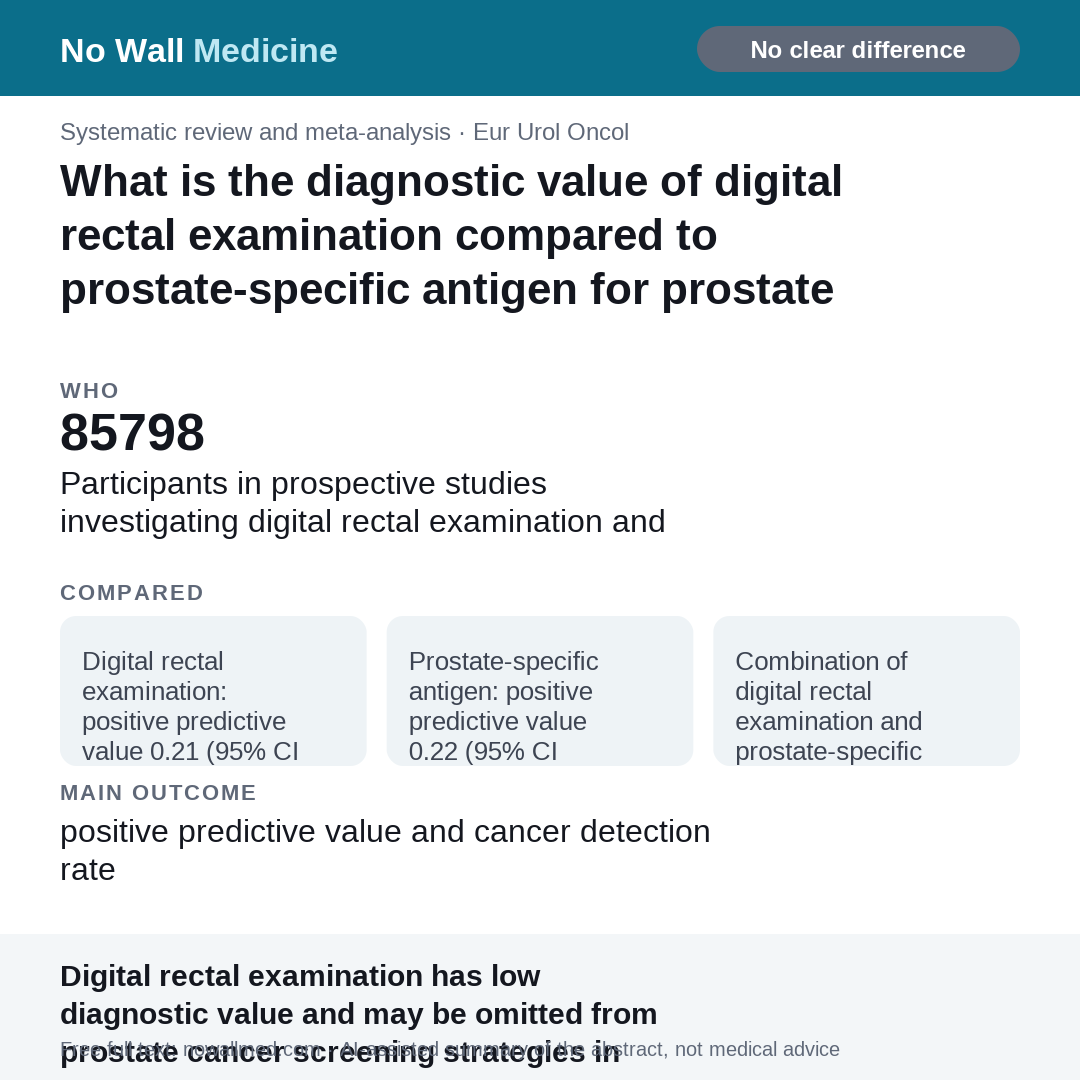
What is the diagnostic value of digital rectal examination compared to prostate-specific antigen for prostate cancer screening?
Who
85798
Participants in prospective studies investigating digital rectal examination and prostate-specific antigen
Compared
Digital rectal examination: positive predictive value 0.21 (95% CI 0.13-0.33)
Prostate-specific antigen: positive predictive value 0.22 (95% CI 0.15-0.30)
Combination of digital rectal examination and prostate-specific antigen: positive predictive value 0.19 (95% CI 0.13-0.26)
Main outcome
positive predictive value and cancer detection rate
Result: cancer detection rate of digital rectal examination 0.01 (95% CI: 0.01-0.02)
Bottom line: Digital rectal examination has low diagnostic value and may be omitted from prostate cancer screening strategies in asymptomatic patients.
Eur Urol Oncol · 2024-01-04Download image
Clinical question: What is the diagnostic value of digital rectal examination compared to prostate-specific antigen for prostate cancer screening?
Why it matters: It is unclear if digital rectal examination provides additional diagnostic benefit when used alongside prostate-specific antigen for early prostate cancer detection.
Key points
- Researchers analyzed eight studies involving 85,798 participants to compare digital rectal examination and prostate-specific antigen for prostate cancer detection.
- The positive predictive value for digital rectal examination was 0.21, which was similar to the 0.22 value for prostate-specific antigen.
- The cancer detection rate for digital rectal examination was 0.01, which was significantly lower than the 0.03 rate for prostate-specific antigen alone.
Headline and key points written with AI from the paper’s abstract, with every number checked against it. Read the paper before relying on them.
Was this summary helpful?
Subject terms
Cite this article
Matsukawa A, Yanagisawa T, Bekku K, Kardoust Parizi M, Laukhtina E, Klemm J. Comparing the Performance of Digital Rectal Examination and Prostate-specific Antigen as a Screening Test for Prostate Cancer: A Systematic Review and Meta-analysis. Eur Urol Oncol. 2024. doi:10.1016/j.euo.2023.12.005
Spotted a mistake? Suggest a correction
Top studies every Monday
The week’s key trials and guidelines in your specialties, plus any topics you follow. By email, free.
Get the weekly digest