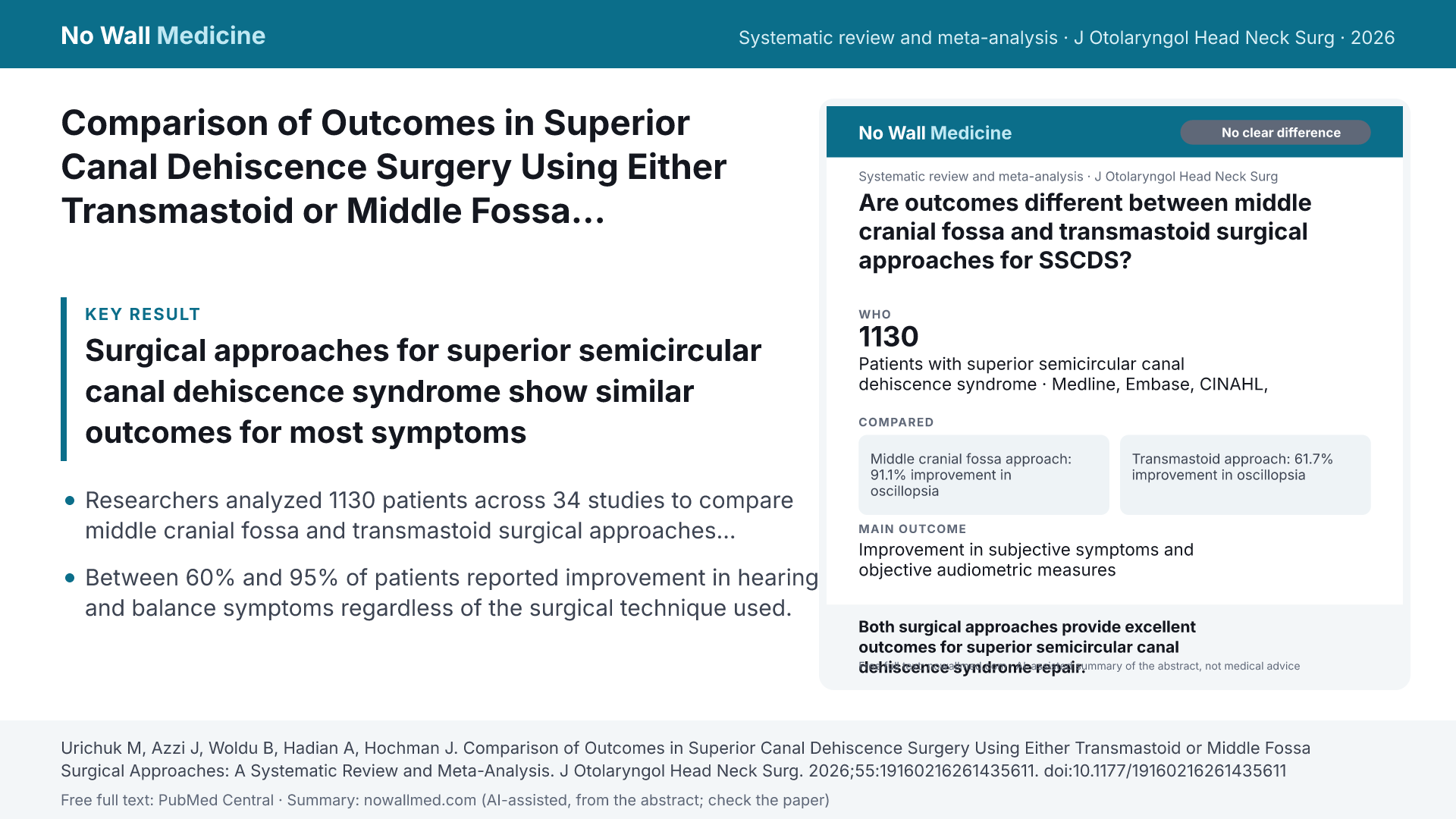
Surgical approaches for superior semicircular canal dehiscence syndrome show similar outcomes for most symptoms
Comparison of Outcomes in Superior Canal Dehiscence Surgery Using Either Transmastoid or Middle Fossa Surgical Approaches: A Systematic Review and Meta-Analysis
Systematic review and meta-analysisNo clear difference
Are outcomes different between middle cranial fossa and transmastoid surgical approaches for SSCDS?
Who
1130
Patients with superior semicircular canal dehiscence syndrome · Medline, Embase, CINAHL, Scopus, and Web of Science databases
Compared
Middle cranial fossa approach: 91.1% improvement in oscillopsia
Transmastoid approach: 61.7% improvement in oscillopsia
Main outcome
Improvement in subjective symptoms and objective audiometric measures
Result: aOR 6.40 (95% CI 1.66-24.66) for oscillopsia improvement
Bottom line: Both surgical approaches provide excellent outcomes for superior semicircular canal dehiscence syndrome repair.
J Otolaryngol Head Neck Surg · 2026-03-30Download image
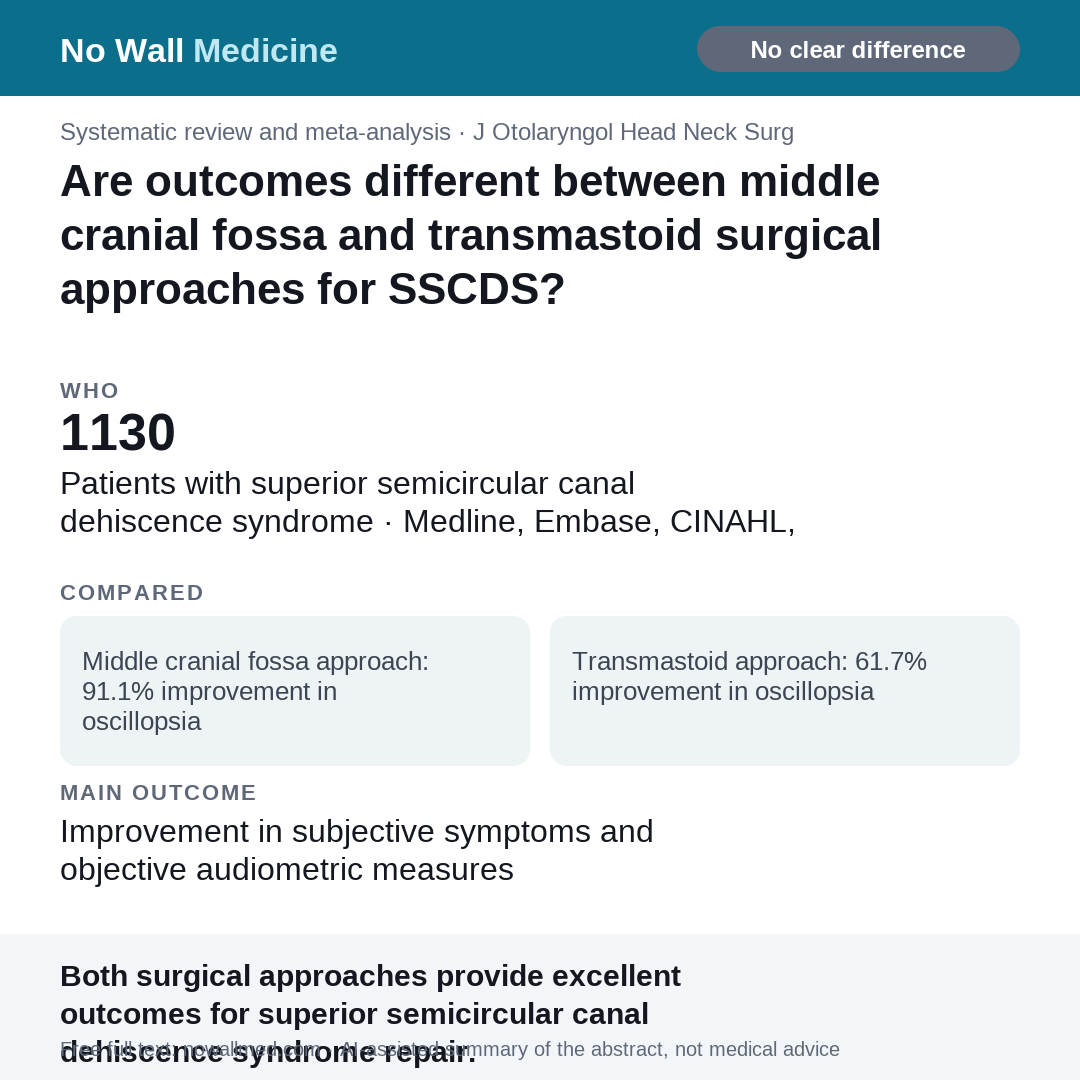
Clinical question: Are outcomes different between middle cranial fossa and transmastoid surgical approaches for SSCDS?
Why it matters: It is unclear how different surgical approaches for repairing superior semicircular canal dehiscence syndrome compare regarding patient outcomes.
Key points
- Researchers analyzed 1130 patients across 34 studies to compare middle cranial fossa and transmastoid surgical approaches for superior semicircular canal dehiscence syndrome.
- Between 60% and 95% of patients reported improvement in hearing and balance symptoms regardless of the surgical technique used.
- The transmastoid approach was associated with a higher rate of oscillopsia resolution compared to the middle cranial fossa approach at 91.1% versus 61.7%.
Headline and key points written with AI from the paper’s abstract, with every number checked against it. Read the paper before relying on them.
Was this summary helpful?
Subject terms
Cite this article
Urichuk M, Azzi J, Woldu B, Hadian A, Hochman J. Comparison of Outcomes in Superior Canal Dehiscence Surgery Using Either Transmastoid or Middle Fossa Surgical Approaches: A Systematic Review and Meta-Analysis. J Otolaryngol Head Neck Surg. 2026. doi:10.1177/19160216261435611
Spotted a mistake? Suggest a correction