Three weeks of escitalopram was associated with reduced learning from punishment in healthy volunteers
Computational modelling and neural correlates of reinforcement learning following three-week escitalopram: a double-blind, placebo-controlled semi-randomised study
Double-blind, placebo-controlled semi-randomised studyMixed results
How does three-week escitalopram administration affect reinforcement learning and neural mechanisms?
Who
64
Healthy volunteers
Compared
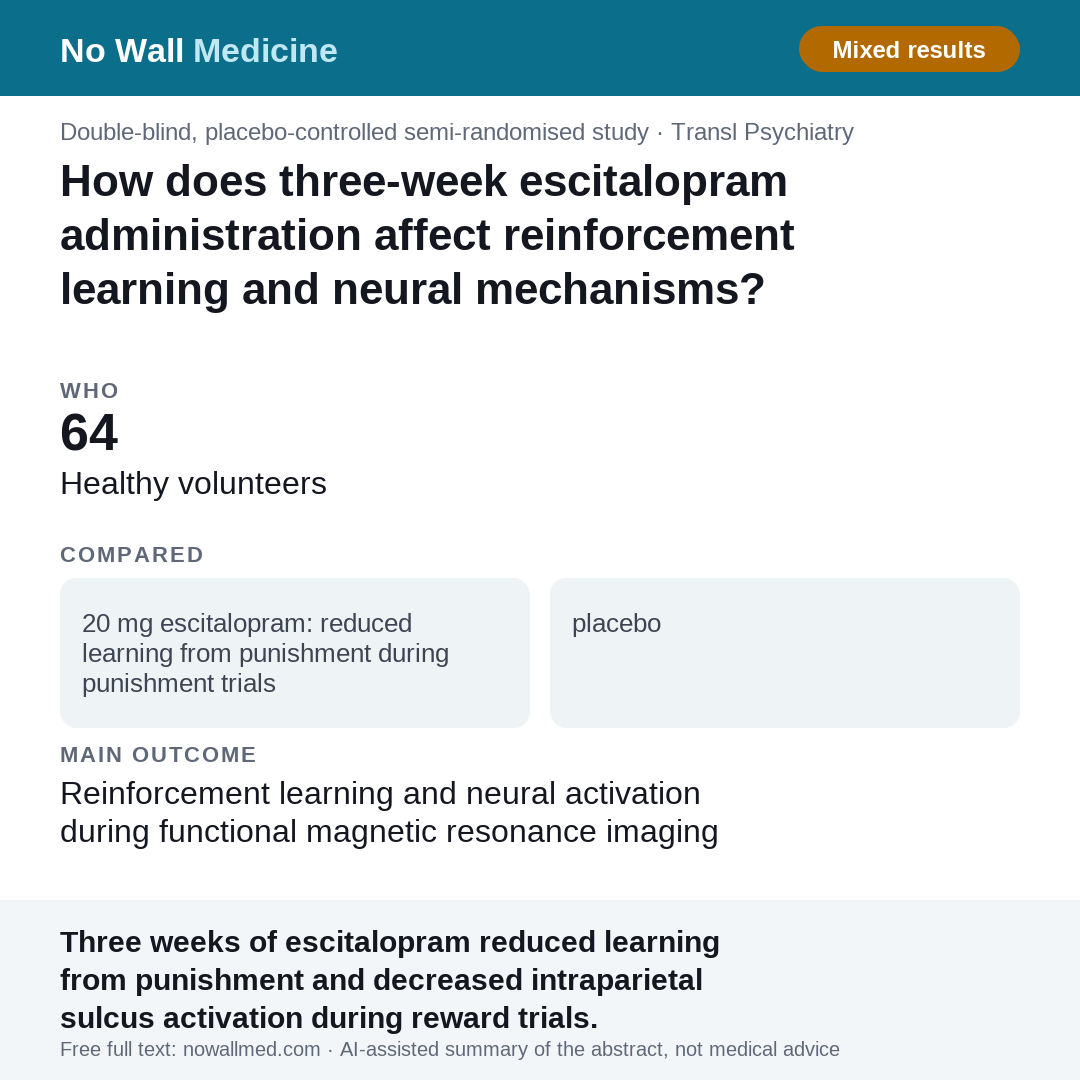
20 mg escitalopram: reduced learning from punishment during punishment trials
placebo
Main outcome
Reinforcement learning and neural activation during functional magnetic resonance imaging
Bottom line: Three weeks of escitalopram reduced learning from punishment and decreased intraparietal sulcus activation during reward trials.
Transl Psychiatry · 2025-05-21Download image
Clinical question: How does three-week escitalopram administration affect reinforcement learning and neural mechanisms?
Why it matters: It is unknown how chronic manipulation of serotonin, which is more clinically relevant than acute manipulation, affects reinforcement learning and the underlying neural mechanisms.
Key points
- The study involved 64 healthy volunteers who were semi-randomised to receive either 20 mg of escitalopram or a placebo for at least 21 days.
- Escitalopram was associated with reduced learning from punishment during punishment trials compared to the placebo group.
- The escitalopram group showed decreased activation of the intraparietal sulcus, a brain region, during reward trials compared to the placebo group.
Headline and key points written with AI from the paper’s abstract, with every number checked against it. Read the paper before relying on them.
Was this summary helpful?
Subject terms
Cite this article
Langley C, Murray GK, Armand S, Knolle F, Cardinal RN, Johansen A. Computational modelling and neural correlates of reinforcement learning following three-week escitalopram: a double-blind, placebo-controlled semi-randomised study. Transl Psychiatry. 2025. doi:10.1038/s41398-025-03392-6
Spotted a mistake? Suggest a correction
Top studies every Monday
The week’s key trials and guidelines in your specialties, plus any topics you follow. By email, free.
Get the weekly digest