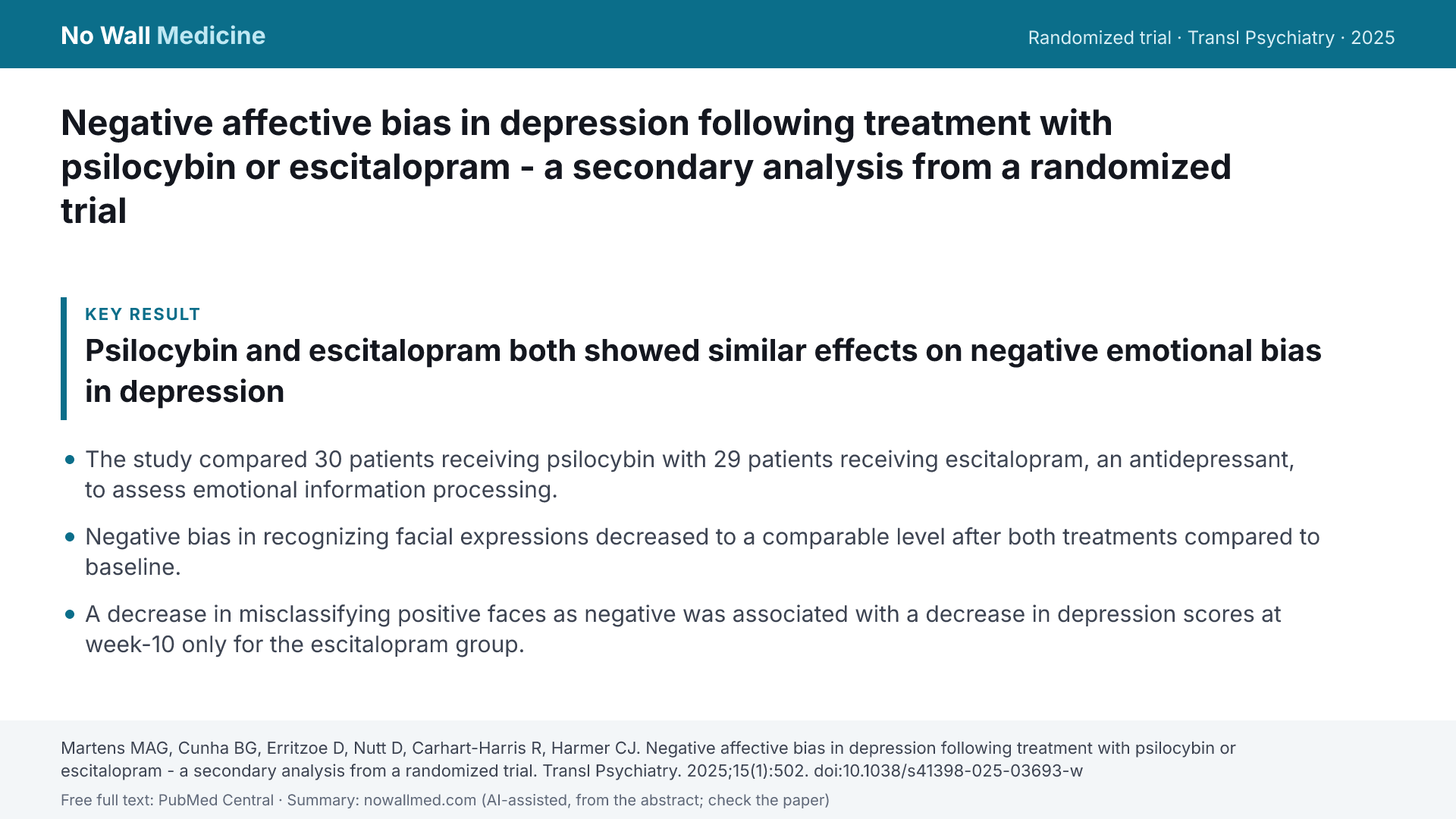
Psilocybin and escitalopram both showed similar effects on negative emotional bias in depression
Negative affective bias in depression following treatment with psilocybin or escitalopram - a secondary analysis from a randomized trial
Why it matters: It is unclear what neuropsychological mechanisms, such as how the brain processes emotional information, underpin the effects of psilocybin therapy on depression.
Key points
- The study compared 30 patients receiving psilocybin with 29 patients receiving escitalopram, an antidepressant, to assess emotional information processing.
- Negative bias in recognizing facial expressions decreased to a comparable level after both treatments compared to baseline.
- A decrease in misclassifying positive faces as negative was associated with a decrease in depression scores at week-10 only for the escitalopram group.
Headline and key points written with AI from the paper’s abstract, with every number checked against it. Read the paper before relying on them.
Was this summary helpful?
Subject terms
Cite this article
Martens MAG, Cunha BG, Erritzoe D, Nutt D, Carhart-Harris R, Harmer CJ. Negative affective bias in depression following treatment with psilocybin or escitalopram - a secondary analysis from a randomized trial. Transl Psychiatry. 2025. doi:10.1038/s41398-025-03693-w
Spotted a mistake? Suggest a correction
Top studies every Monday
The week’s key trials and guidelines in your specialties, plus any topics you follow. By email, free.
Get the weekly digest