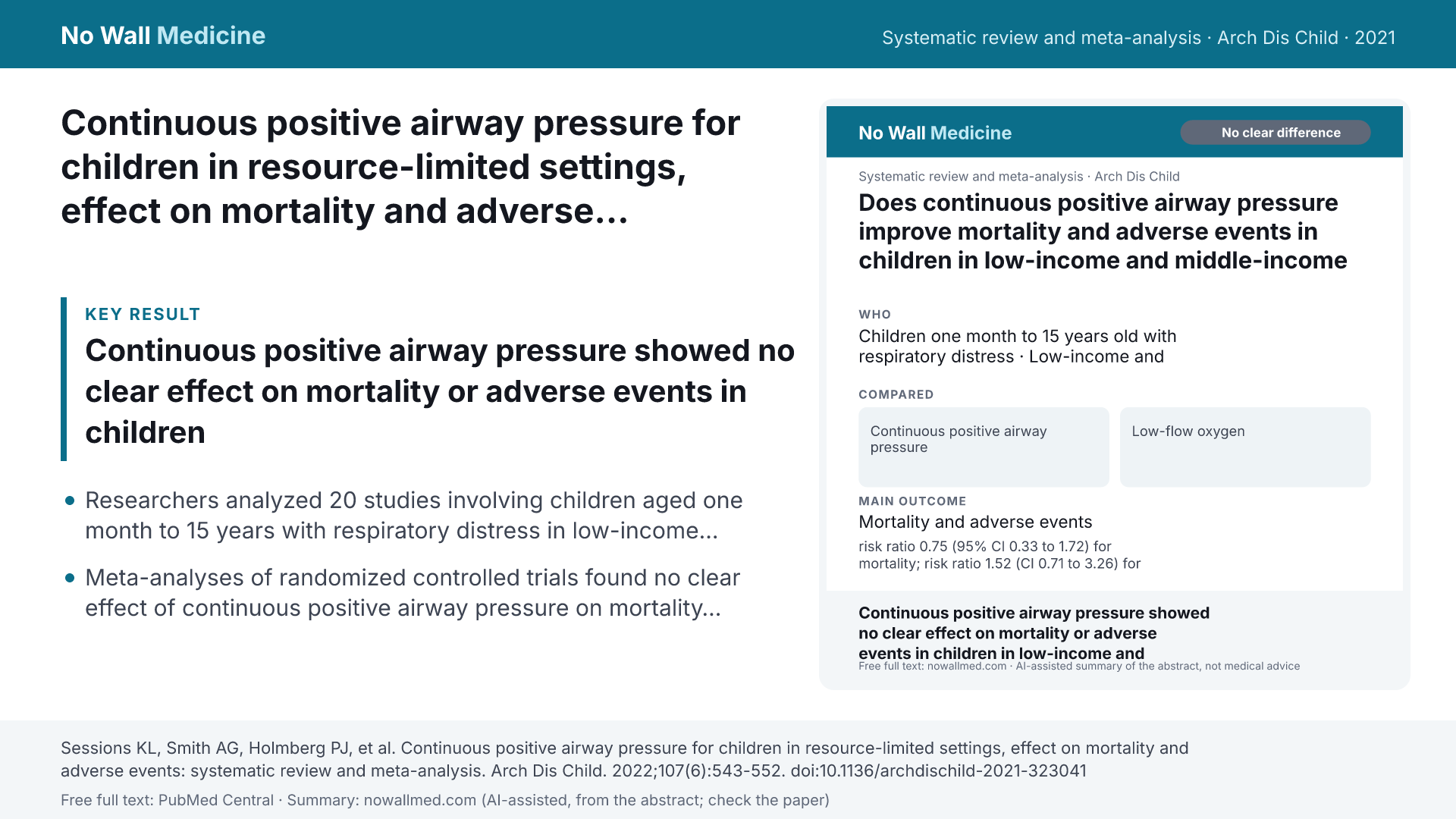
Continuous positive airway pressure showed no clear effect on mortality or adverse events in children
Continuous positive airway pressure for children in resource-limited settings, effect on mortality and adverse events: systematic review and meta-analysis
Systematic review and meta-analysisNo clear difference
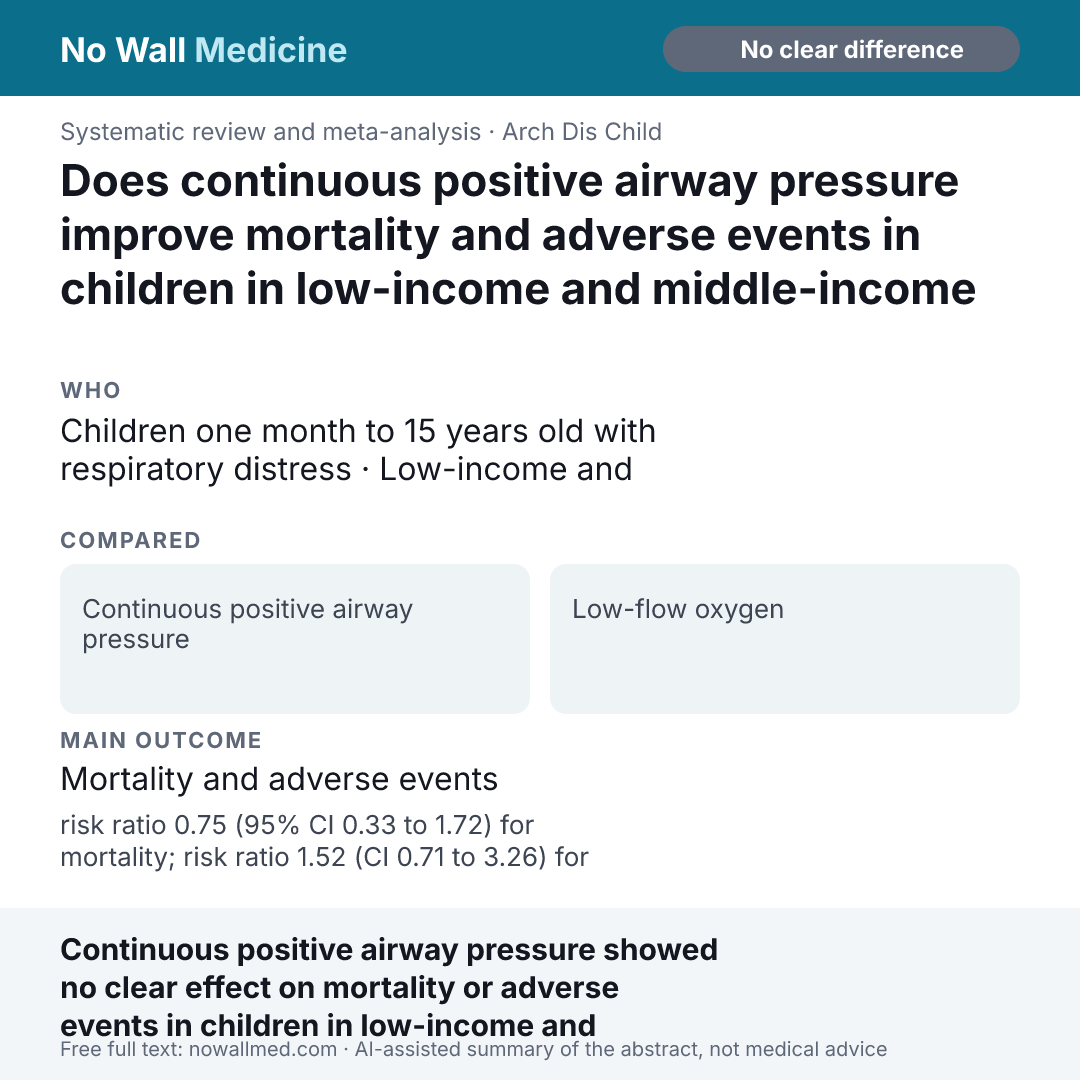
Does continuous positive airway pressure improve mortality and adverse events in children in low-income and middle-income countries?
Who
Children one month to 15 years old with respiratory distress · Low-income and middle-income country hospitals
Compared
Continuous positive airway pressure
Low-flow oxygen
Main outcome
Mortality and adverse events
Result: risk ratio 0.75 (95% CI 0.33 to 1.72) for mortality; risk ratio 1.52 (CI 0.71 to 3.26) for adverse events
Bottom line: Continuous positive airway pressure showed no clear effect on mortality or adverse events in children in low-income and middle-income countries.
Limitation: Low certainty of evidence due to design issues and results discrepancies across randomized controlled trials.
Arch Dis Child · 2021-12-08 · Save PNG
Clinical question: Does continuous positive airway pressure improve mortality and adverse events in children in low-income and middle-income countries?
Key points
- Researchers analyzed 20 studies involving children aged one month to 15 years with respiratory distress in low-income and middle-income countries.
- Meta-analyses of randomized controlled trials found no clear effect of continuous positive airway pressure on mortality (RR 0.75, 95% CI 0.33 to 1.72).
- The use of continuous positive airway pressure was also not clearly linked to a difference in adverse events (RR 1.52, CI 0.71 to 3.26).
Limitation the authors note: The certainty of evidence for both death and adverse events outcomes was downgraded to low due to design issues and results discrepancies across randomized controlled trials.
Headline and key points written with AI from the paper’s abstract, with every number checked against it. Read the paper before relying on them.
Was this summary helpful?
Abstract
Objective
Determine non-invasive ventilation with continuous positive airway pressure (CPAP) outcomes for paediatric respiratory distress in low-income and middle-income countries (LMICs). Design
Systematic review and meta-analysis. Setting
LMIC hospitals. Patients
One month to 15 year olds with respiratory distress. Interventions
We searched Medline, Embase, LILACS, Web of Science and Scopus on 7 April 2020. Included studies assessed CPAP safety, efficacy or effectiveness. All study types were included; neonatal only studies were excluded. Data were extracted by two reviewers and bias was assessed. Certainty of evidence was evaluated, and risk ratios (RR) were produced for meta-analyses. (PROSPERO protocol CRD42018084278). Results
2174 papers were screened, 20 were included in the systematic review and 3 were included in two separate meta-analyses of mortality and adverse events. Studies suitable for meta-analysis were randomised controlled trials (RCTs) from Bangladesh, Ghana and Malawi. For meta-analyses comparing death or adverse events between CPAP and low-flow oxygen recipients, we found no clear CPAP effect on mortality (RR 0.75, 95% CI 0.33 to 1.72) or adverse events (RR 1.52, CI 0.71 to 3.26). We downgraded the certainty of evidence for both death and adverse events outcomes to 'low' due to design issues and results discrepancies across RCTs. Conclusions
Evidence for CPAP efficacy against mortality and adverse events has low certainty and is context dependent. Hospitals introducing CPAP need to have mechanisms in place to optimise safety in the context it is being used; this includes the location (a high dependency or intensive care area), adequate numbers of staff trained in CPAP use, close monitoring and mechanisms for escalation, daily direct physician supervision, equipment that is age appropriate and user-friendly and continuous monitoring of outcomes and quality of care.
Abstract reproduced under the article’s CC BY NC licence.
Subject terms
Headline, design, result, key points, caveat and citation as plain text.
Cite this article
Sessions KL, Smith AG, Holmberg PJ, et al. Continuous positive airway pressure for children in resource-limited settings, effect on mortality and adverse events: systematic review and meta-analysis. Arch Dis Child. 2022;107(6):543-552. doi:10.1136/archdischild-2021-323041
Spotted a mistake? Suggest a correction