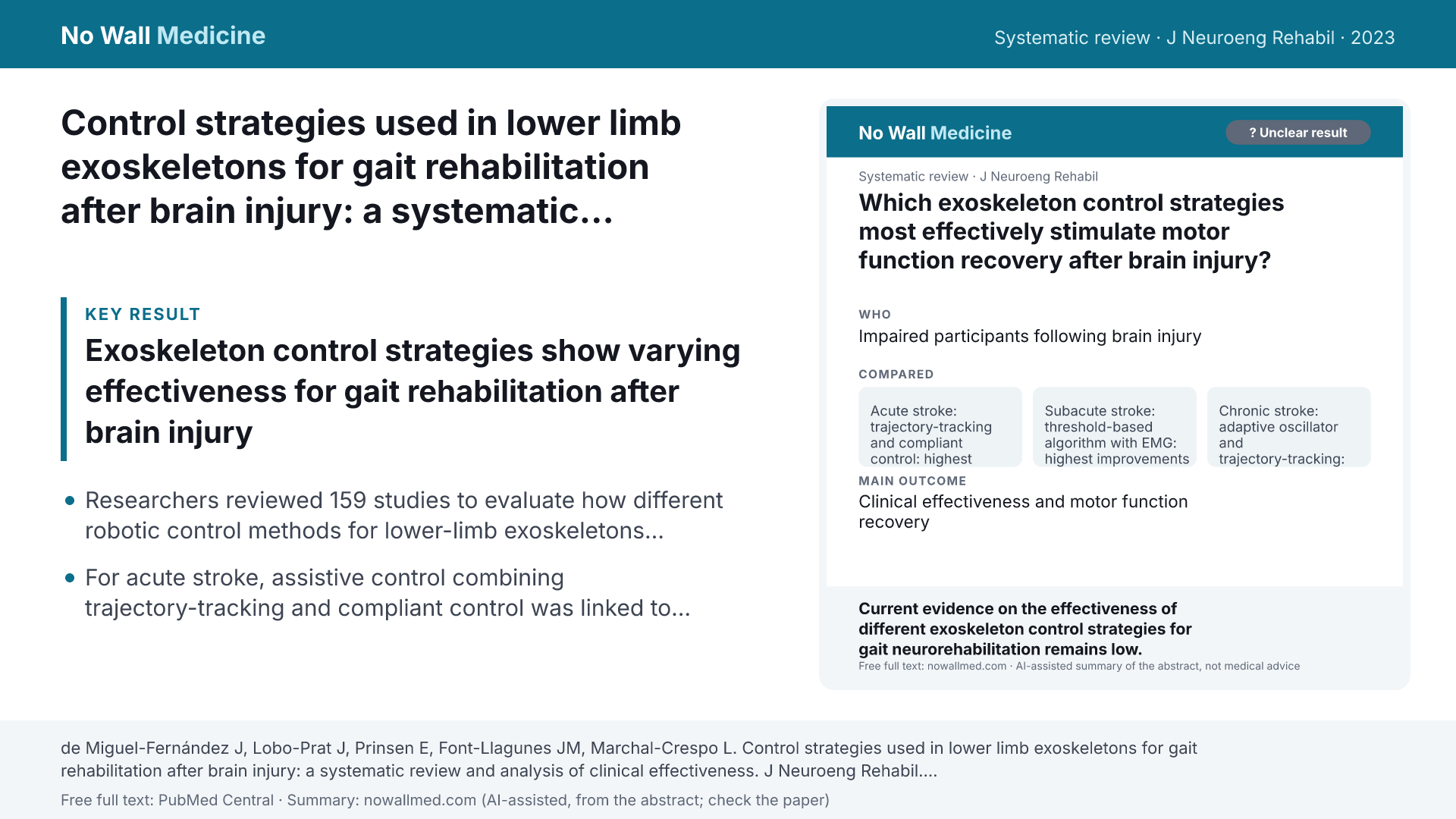
Exoskeleton control strategies show varying effectiveness for gait rehabilitation after brain injury
Control strategies used in lower limb exoskeletons for gait rehabilitation after brain injury: a systematic review and analysis of clinical effectiveness
Systematic reviewUnclear result
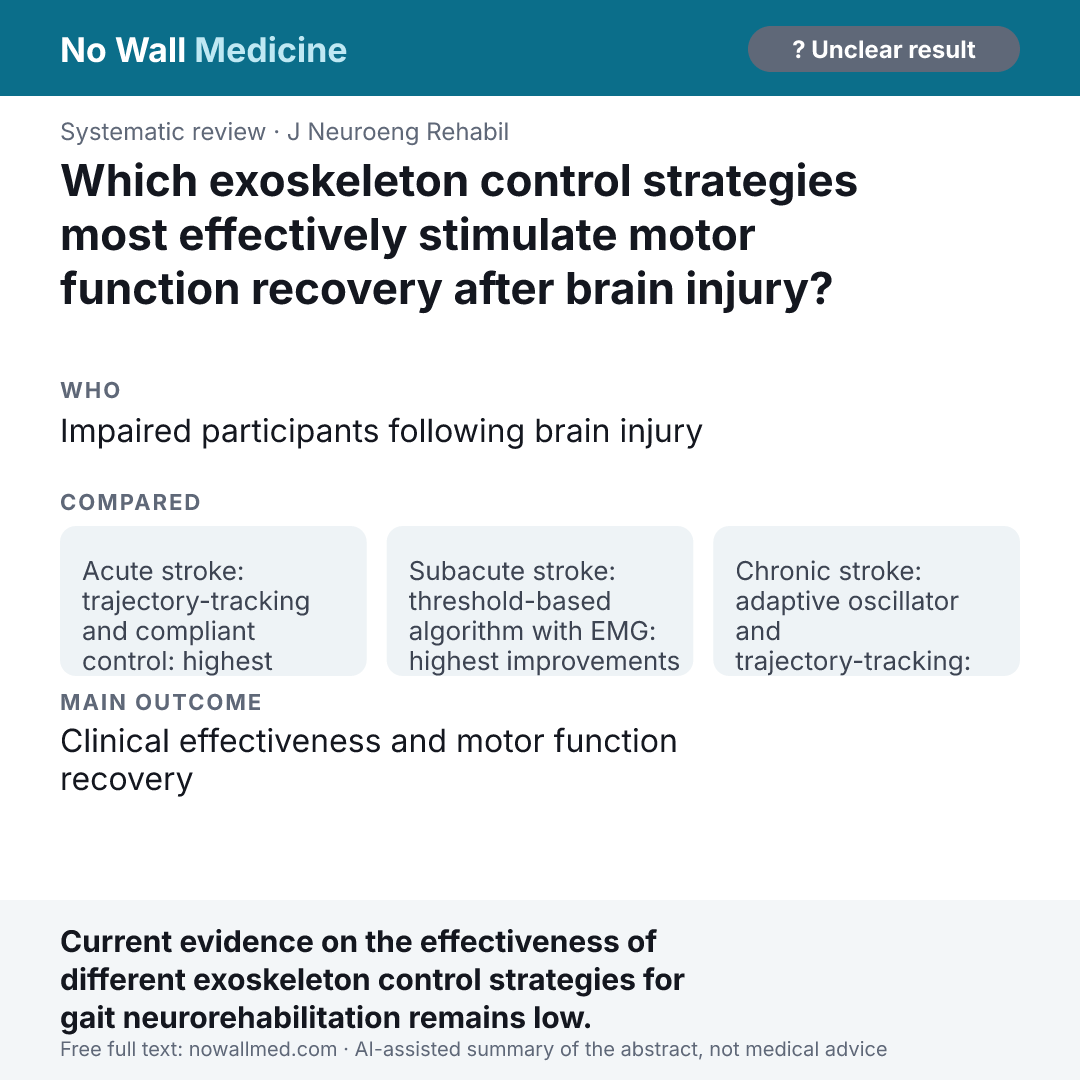
Which exoskeleton control strategies most effectively stimulate motor function recovery after brain injury?
Who
Impaired participants following brain injury
Compared
Acute stroke: trajectory-tracking and compliant control: highest clinical effectiveness
Subacute stroke: threshold-based algorithm with EMG: highest improvements with the lowest training intensities
Chronic stroke: adaptive oscillator and trajectory-tracking: highest improvements with reduced training intensities
Main outcome
Clinical effectiveness and motor function recovery
Bottom line: Current evidence on the effectiveness of different exoskeleton control strategies for gait neurorehabilitation remains low.
Limitation: High variability in experimental protocols and outcome metrics leading to high levels of heterogeneity.
J Neuroeng Rehabil · 2023-02-19 · Save PNG
Clinical question: Which exoskeleton control strategies most effectively stimulate motor function recovery after brain injury?
Key points
- Researchers reviewed 159 studies to evaluate how different robotic control methods for lower-limb exoskeletons affect motor recovery in patients with brain injuries.
- For acute stroke, assistive control combining trajectory-tracking and compliant control was linked to the highest clinical effectiveness but required the longest training time.
- In chronic stroke, assistive control using adaptive oscillator algorithms and trajectory-tracking was associated with the highest improvements and reduced training intensities.
Headline and key points written with AI from the paper’s abstract, with every number checked against it. Read the paper before relying on them.
Was this summary helpful?
Subject terms
Headline, design, result, key points, caveat and citation as plain text.
Cite this article
de Miguel-Fernández J, Lobo-Prat J, Prinsen E, Font-Llagunes JM, Marchal-Crespo L. Control strategies used in lower limb exoskeletons for gait rehabilitation after brain injury: a systematic review and analysis of clinical effectiveness. J Neuroeng Rehabil. 2023;20(1):23. doi:10.1186/s12984-023-01144-5
Spotted a mistake? Suggest a correction