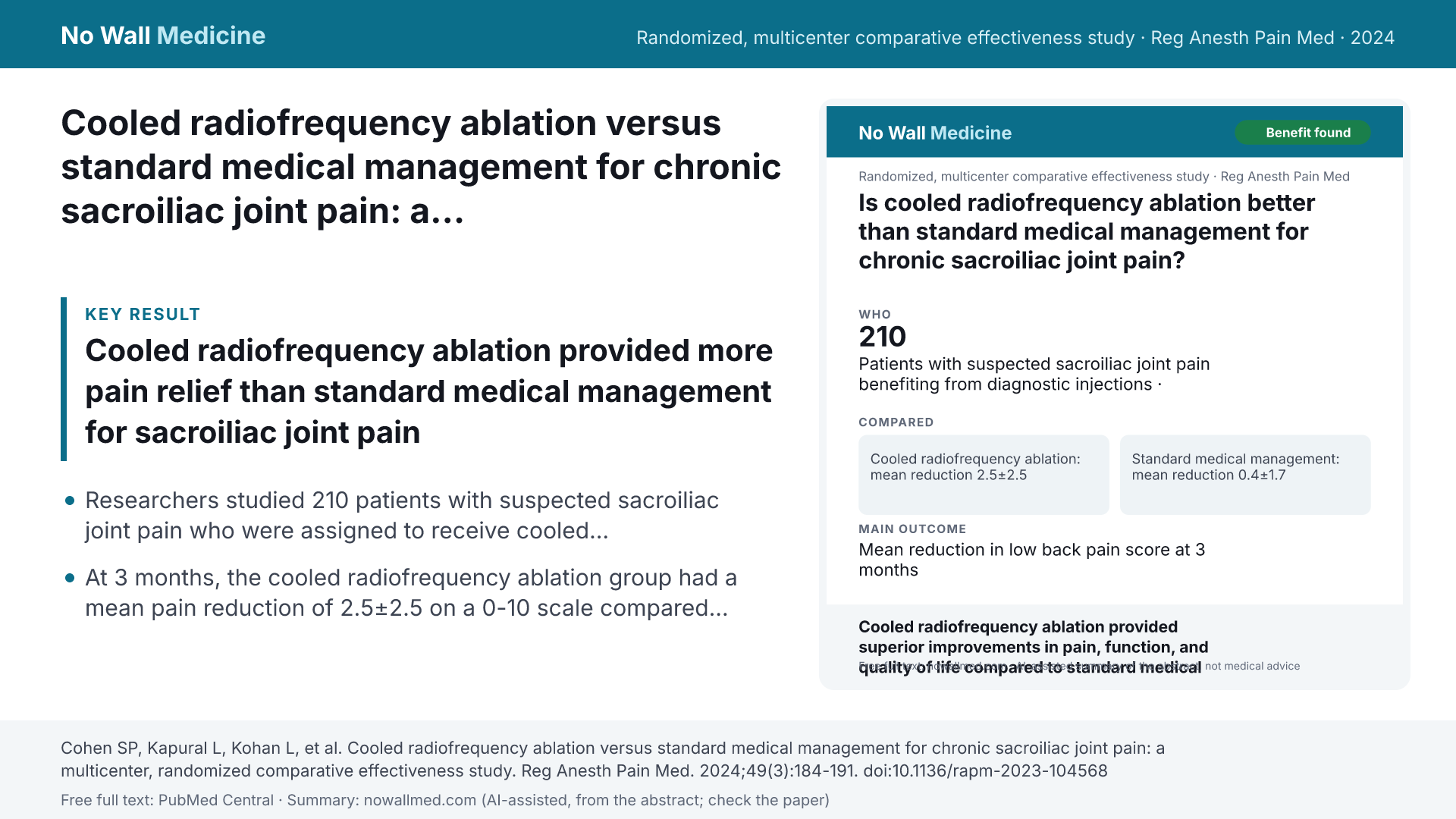
Cooled radiofrequency ablation provided more pain relief than standard medical management for sacroiliac joint pain
Cooled radiofrequency ablation versus standard medical management for chronic sacroiliac joint pain: a multicenter, randomized comparative effectiveness study
Randomized, multicenter comparative effectiveness studyBenefit found
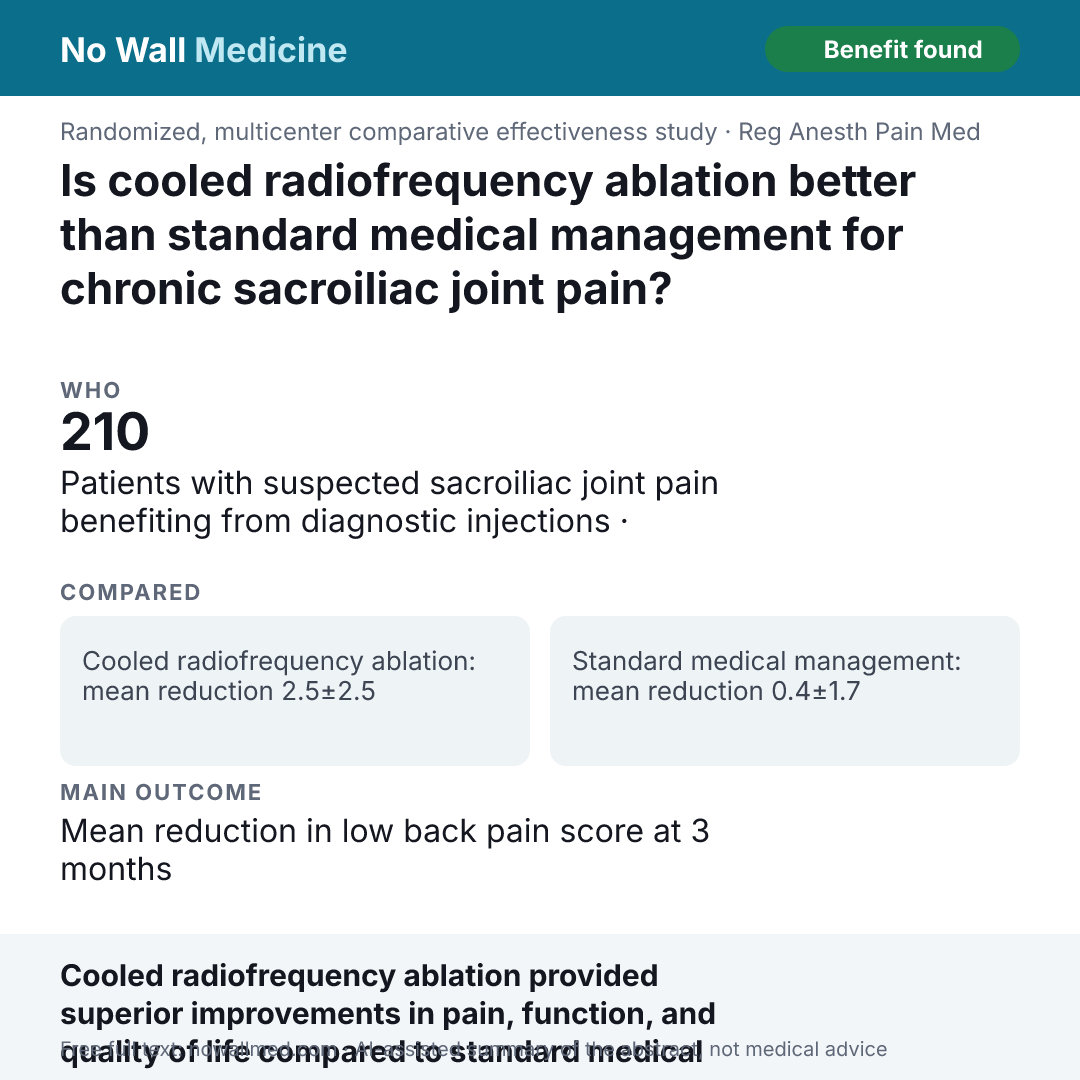
Is cooled radiofrequency ablation better than standard medical management for chronic sacroiliac joint pain?
Who
210
Patients with suspected sacroiliac joint pain benefiting from diagnostic injections · Multicenter
Compared
Cooled radiofrequency ablation: mean reduction 2.5±2.5
Standard medical management: mean reduction 0.4±1.7
Main outcome
Mean reduction in low back pain score at 3 months
Bottom line: Cooled radiofrequency ablation provided superior improvements in pain, function, and quality of life compared to standard medical management.
Reg Anesth Pain Med · 2024-03-04 · Save PNG
Same trial (NCT03601949)
Papers we list that report this registered trial, oldest first. Read a secondary analysis alongside the main results.
- Main results Benefit found
This paper Reg Anesth Pain Med 2024-03 - Longer follow-up Key finding
Cooled radiofrequency ablation provided sustained pain relief for 12 months in patients with sacroiliac joint pain Reg Anesth Pain Med 2026-06
Clinical question: Is cooled radiofrequency ablation better than standard medical management for chronic sacroiliac joint pain?
Key points
- Researchers studied 210 patients with suspected sacroiliac joint pain who were assigned to receive cooled radiofrequency ablation or standard medical management including drugs and injections.
- At 3 months, the cooled radiofrequency ablation group had a mean pain reduction of 2.5±2.5 on a 0-10 scale compared to 0.4±1.7 in the medical management group.
- The cooled radiofrequency ablation group had a 52.3% responder rate for pain relief compared to 4.3% in the standard medical management group.
Headline and key points written with AI from the paper’s abstract, with every number checked against it. Read the paper before relying on them.
Was this summary helpful?
Abstract
Introduction
Low back pain is the leading cause of disability worldwide, with sacroiliac joint pain comprising up to 30% of cases of axial lower back pain. Conservative therapies provide only modest relief. Although placebo-controlled trials show efficacy for sacral lateral branch cooled radiofrequency ablation, there are no comparative effectiveness studies. Methods
In this randomized, multicenter comparative effectiveness study, 210 patients with clinically suspected sacroiliac joint pain who obtained short-term benefit from diagnostic sacroiliac joint injections and prognostic lateral branch blocks were randomly assigned to receive cooled radiofrequency ablation of the L5 dorsal ramus and S1-S3 lateral branches or standard medical management consisting of pharmacotherapy, injections and integrative therapies. The primary outcome measure was mean reduction in low back pain score on a 0-10 Numeric Rating Scale at 3 months. Secondary outcomes included measures of quality of life and function. Results
3 months post-treatment, the mean Numeric Rating Scale pain score for the cooled radiofrequency ablation group was 3.8±2.4 (mean reduction 2.5±2.5) compared with 5.9±1.7 (mean reduction 0.4±1.7) in the standard medical management group (p<0.0001). 52.3% of subjects in the cooled radiofrequency ablation group experienced >2 points or 30% pain relief and were deemed responders versus 4.3% of standard medical management patients (p<0.0001). Comparable improvements favoring cooled radiofrequency ablation were noted in Oswestry Disability Index score (mean 29.7±15.2 vs 41.5+13.6; p<0.0001) and quality of life (mean EuroQoL-5 score 0.68±0.22 vs 0.47±0.29; p<0.0001). Conclusions
In patients with sacroiliac joint pain, cooled radiofrequency ablation provided statistically superior improvements across the spectrum of patient outcomes compared with standard medical management. Trial registration number
NCT03601949.
Abstract reproduced under the article’s CC BY NC licence.
Subject terms
Headline, design, result, key points, caveat and citation as plain text.
Cite this article
Cohen SP, Kapural L, Kohan L, et al. Cooled radiofrequency ablation versus standard medical management for chronic sacroiliac joint pain: a multicenter, randomized comparative effectiveness study. Reg Anesth Pain Med. 2024;49(3):184-191. doi:10.1136/rapm-2023-104568
Spotted a mistake? Suggest a correction