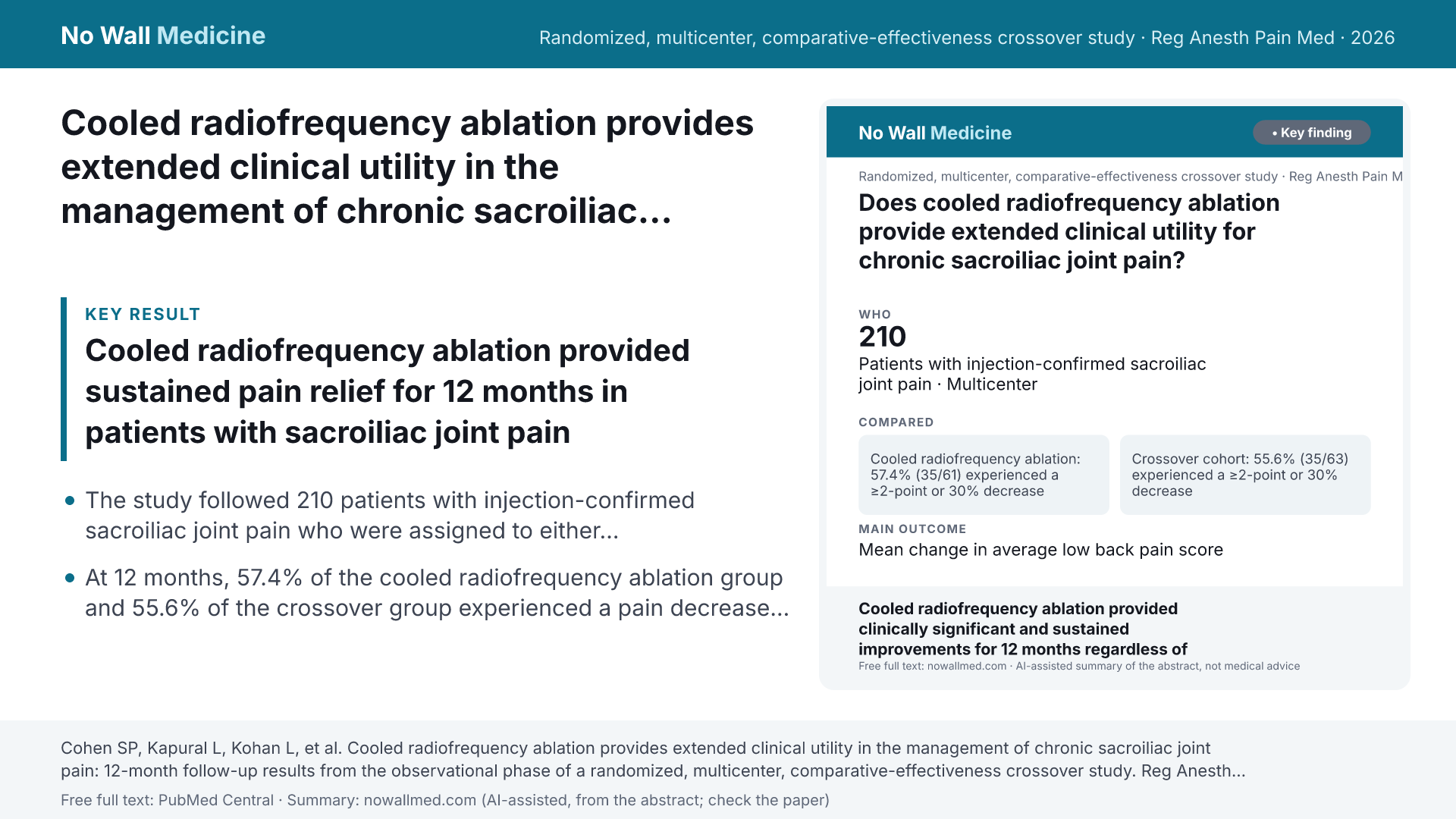
Cooled radiofrequency ablation provided sustained pain relief for 12 months in patients with sacroiliac joint pain
Cooled radiofrequency ablation provides extended clinical utility in the management of chronic sacroiliac joint pain: 12-month follow-up results from the observational phase of a randomized, multicenter, comparative-effectiveness crossover study
Randomized, multicenter, comparative-effectiveness crossover studyKey finding
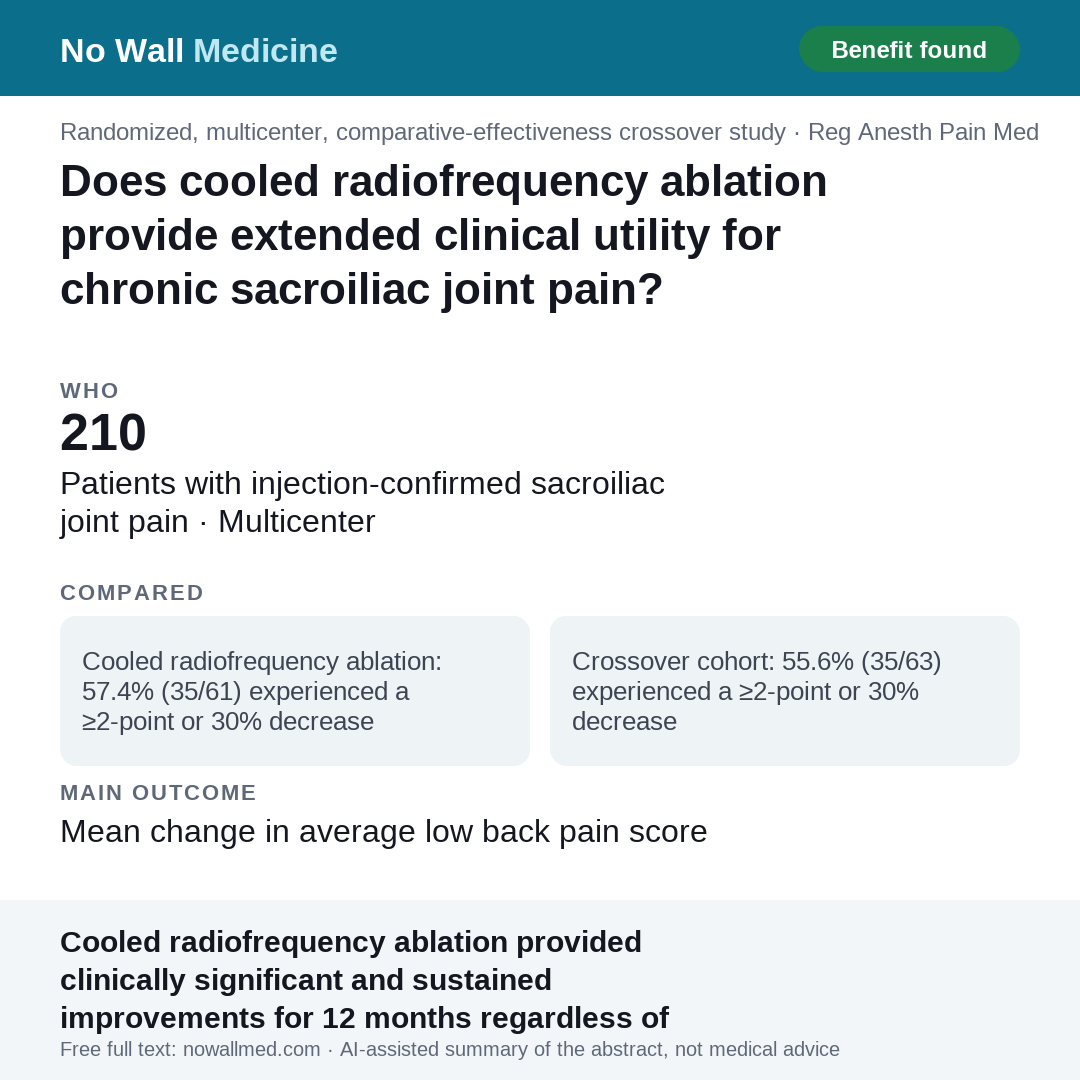
Does cooled radiofrequency ablation provide extended clinical utility for chronic sacroiliac joint pain?
Who
210
Patients with injection-confirmed sacroiliac joint pain · Multicenter
Compared
Cooled radiofrequency ablation: 57.4% (35/61) experienced a ≥2-point or 30% decrease
Crossover cohort: 55.6% (35/63) experienced a ≥2-point or 30% decrease
Main outcome
Mean change in average low back pain score
Bottom line: Cooled radiofrequency ablation provided clinically significant and sustained improvements for 12 months regardless of previous medical management.
Reg Anesth Pain Med · 2026-06-05Download image
Same trial (NCT03601949)
Papers we list that report this registered trial, oldest first. Read a secondary analysis alongside the main results.
- Main results Benefit found
Cooled radiofrequency ablation provided more pain relief than standard medical management for sacroiliac joint pain Reg Anesth Pain Med 2024-03 - Longer follow-up Key finding
This paper Reg Anesth Pain Med 2026-06
Clinical question: Does cooled radiofrequency ablation provide extended clinical utility for chronic sacroiliac joint pain?
Key points
- The study followed 210 patients with injection-confirmed sacroiliac joint pain who were assigned to either cooled radiofrequency ablation or standard medical management.
- At 12 months, 57.4% of the cooled radiofrequency ablation group and 55.6% of the crossover group experienced a pain decrease of at least 2 points or 30%.
- The mean pain score in the cooled radiofrequency ablation group declined from 6.4±1.4 at baseline to 3.5±2.6 at 12 months.
Headline and key points written with AI from the paper’s abstract, with every number checked against it. Read the paper before relying on them.
Was this summary helpful?
Abstract
Introduction
Sacroiliac joint (SIJ) pain comprises up to 30% of cases of mechanical low back pain (LBP), the leading cause of disability worldwide. Despite sacral lateral branch cooled radiofrequency ablation (CRFA) showing efficacy in clinical trials, there is a lack of comparative-effectiveness long-term follow-up. Methods
In this randomized, multicenter, comparative-effectiveness study, 210 patients with injection-confirmed SIJ pain who responded to prognostic lateral branch blocks were randomly assigned to receive CRFA of the L5 dorsal ramus and S1-S3/4 lateral branches or standard medical management (SMM) consisting of pharmacotherapy, physical therapy, injections, and integrative therapies. Patients were followed up at 1, 3, 6, 9, and 12 months, with participants reporting unsatisfactory SMM outcomes being allowed to crossover (XO) and receive CRFA at 3 months. The primary outcome measure was the mean change in average LBP score on a 0-10 Numeric Rating Scale (NRS), with secondary outcomes including measures of quality of life (QoL) and function. A responder was defined as a participant who experienced a ≥30% or ≥2-point decrease in average daily NRS pain score coupled with a score ≥5 out of 7 (moderately better) on the Patient Global Impression of Change scale. Results
At 12 months, the mean NRS pain score declined from a baseline of 6.4±1.4 to 3.5±2.6, with 57.4% (35/61) of participants in the randomized CRFA cohort experiencing a ≥2-point or 30% decrease in average LBP from baseline. In the crossover cohort, 35/63 (55.6%) subjects had the same experience 12 months following the XO procedure; in the XO group, the mean LBP decreased from 6.1±1.5 to 3.4±2.5. Patients also experienced clinically meaningful improvements in QoL via EuroQoL-5D-5L at 12 months (mean change of +0.22±0.27 in the originally-treated CRFA group and +0.21±0.33 in the XO group). Oswestry Disability Index (ODI) scores also improved by 12.4%±14.7 (CRFA) and 13.7%±17.1 (XO) from baseline at study-end. No serious adverse events related to the CRFA procedure were reported. Conclusion
CRFA in patients with SIJ pain provided clinically significant and sustained improvements for 12 months following a single CRFA treatment, regardless of previous SMM treatment. Trial registration number
NCT03601949.
Abstract reproduced under the article’s CC BY NC licence.
Subject terms
Headline, design, result, key points, caveat and citation as plain text.
Cite this article
Cohen SP, Kapural L, Kohan L, et al. Cooled radiofrequency ablation provides extended clinical utility in the management of chronic sacroiliac joint pain: 12-month follow-up results from the observational phase of a randomized, multicenter, comparative-effectiveness crossover study. Reg Anesth Pain Med. 2026;51(6):660-669. doi:10.1136/rapm-2024-106315
Spotted a mistake? Suggest a correction