People with chronic pain show greater interpretation bias than those without pain
Interpretation bias and its relationship with pain: a systematic review and meta-analysis
Systematic review and meta-analysisBenefit found
Does interpretation bias exist in pain and is it associated with pain outcomes?
Who
4842
People with and without pain
Compared
People with chronic pain: moderate effect ( g = 0.602)
People without pain
Main outcome
Presence of interpretation bias and association with pain outcomes
Result: g = 0.602
Bottom line: Interpretation bias is more common in chronic pain and is associated with pain interference and improved by interventions.
Limitation: Longitudinal studies were mixed as to whether interpretation bias predicted subsequent pain.
Pain · 2025-04-17Download image
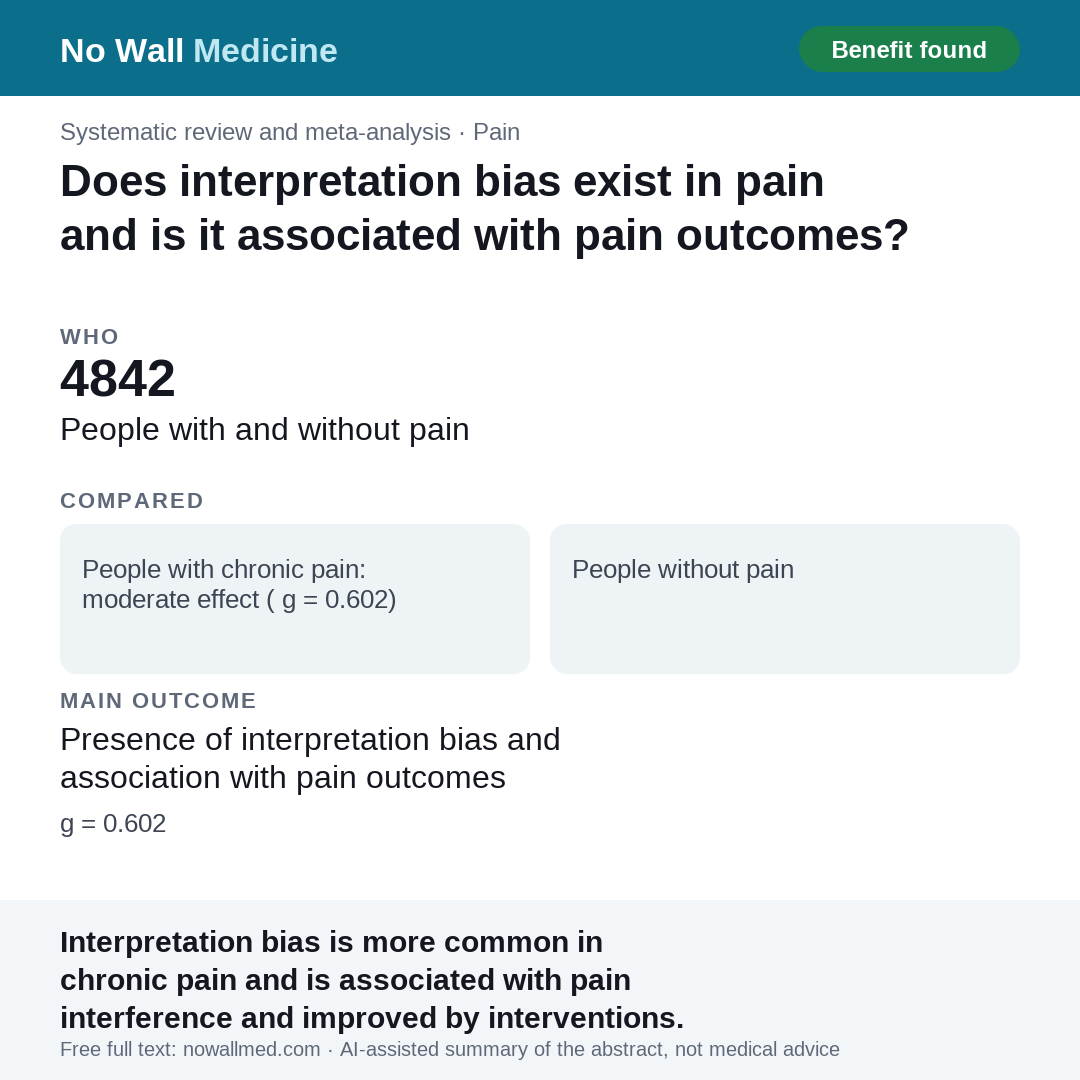
Clinical question: Does interpretation bias exist in pain and is it associated with pain outcomes?
Key points
- Researchers analyzed 33 studies involving 4842 participants to compare interpretation bias between people with and without pain.
- Chronic pain was associated with a moderate interpretation bias (g = 0.602), which reached a large effect size (g = 0.899) when measured with word association tasks.
- Interpretation bias was associated with pain catastrophizing and pain interference, but was not linked to experimental pain outcomes.
Headline and key points written with AI from the paper’s abstract, with every number checked against it. Read the paper before relying on them.
Was this summary helpful?
Subject terms
Cite this article
Todd J, Pickup B, Coutts-Bain D, Duijzings M, Sharpe L. Interpretation bias and its relationship with pain: a systematic review and meta-analysis. Pain. 2025. doi:10.1097/j.pain.0000000000003612
Spotted a mistake? Suggest a correction
Top studies every Monday
The week’s key trials and guidelines in your specialties, plus any topics you follow. By email, free.
Get the weekly digest