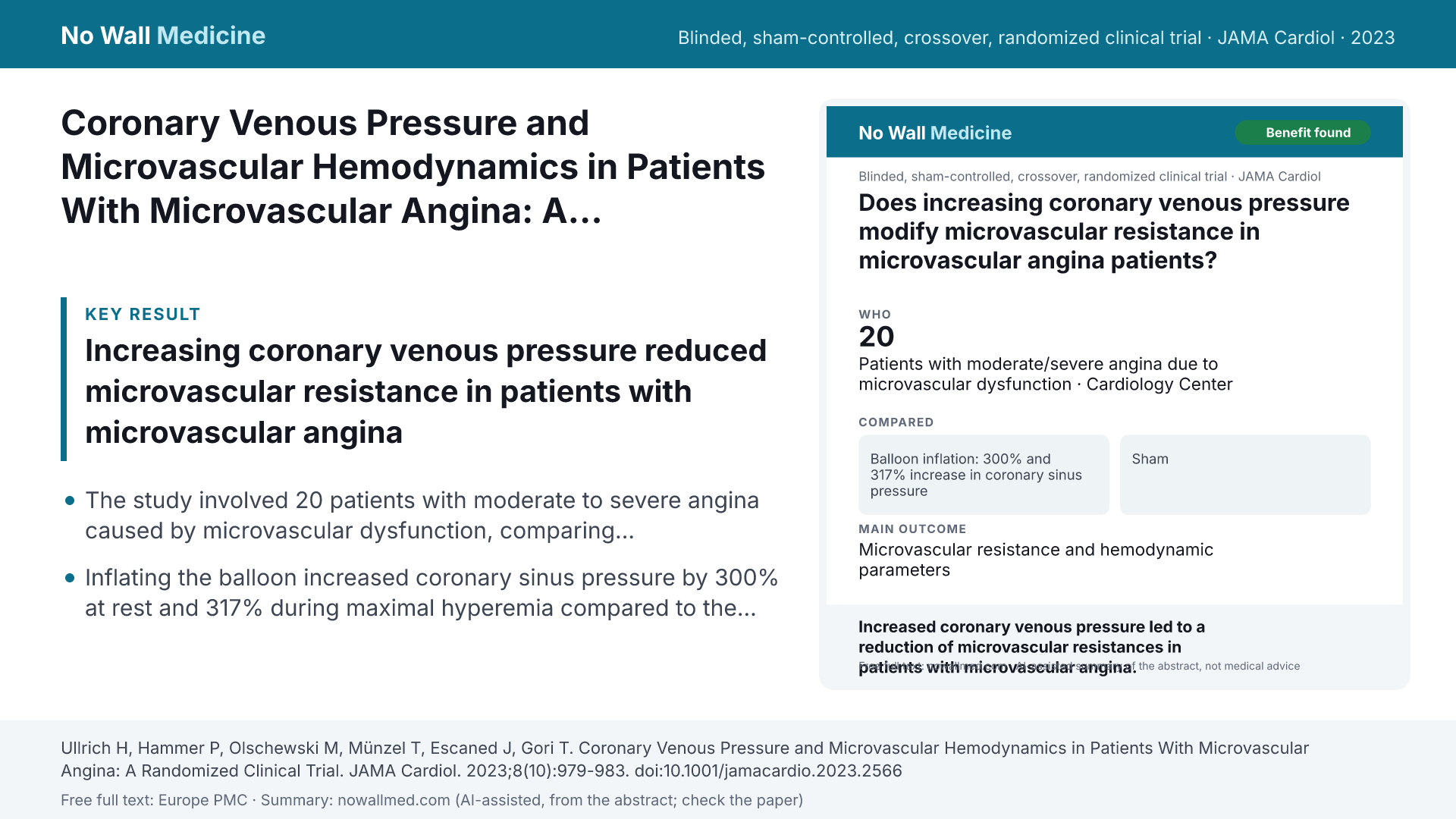
Increasing coronary venous pressure reduced microvascular resistance in patients with microvascular angina
Coronary Venous Pressure and Microvascular Hemodynamics in Patients With Microvascular Angina: A Randomized Clinical Trial
Blinded, sham-controlled, crossover, randomized clinical trialBenefit found
Does increasing coronary venous pressure modify microvascular resistance in microvascular angina patients?
Who
20
Patients with moderate/severe angina due to microvascular dysfunction · Cardiology Center of the University of Medicine in Mainz, Germany
Compared
Balloon inflation: 300% and 317% increase in coronary sinus pressure
Sham
Main outcome
Microvascular resistance and hemodynamic parameters
Bottom line: Increased coronary venous pressure led to a reduction of microvascular resistances in patients with microvascular angina.
JAMA Cardiol · 2023-08-23Download image
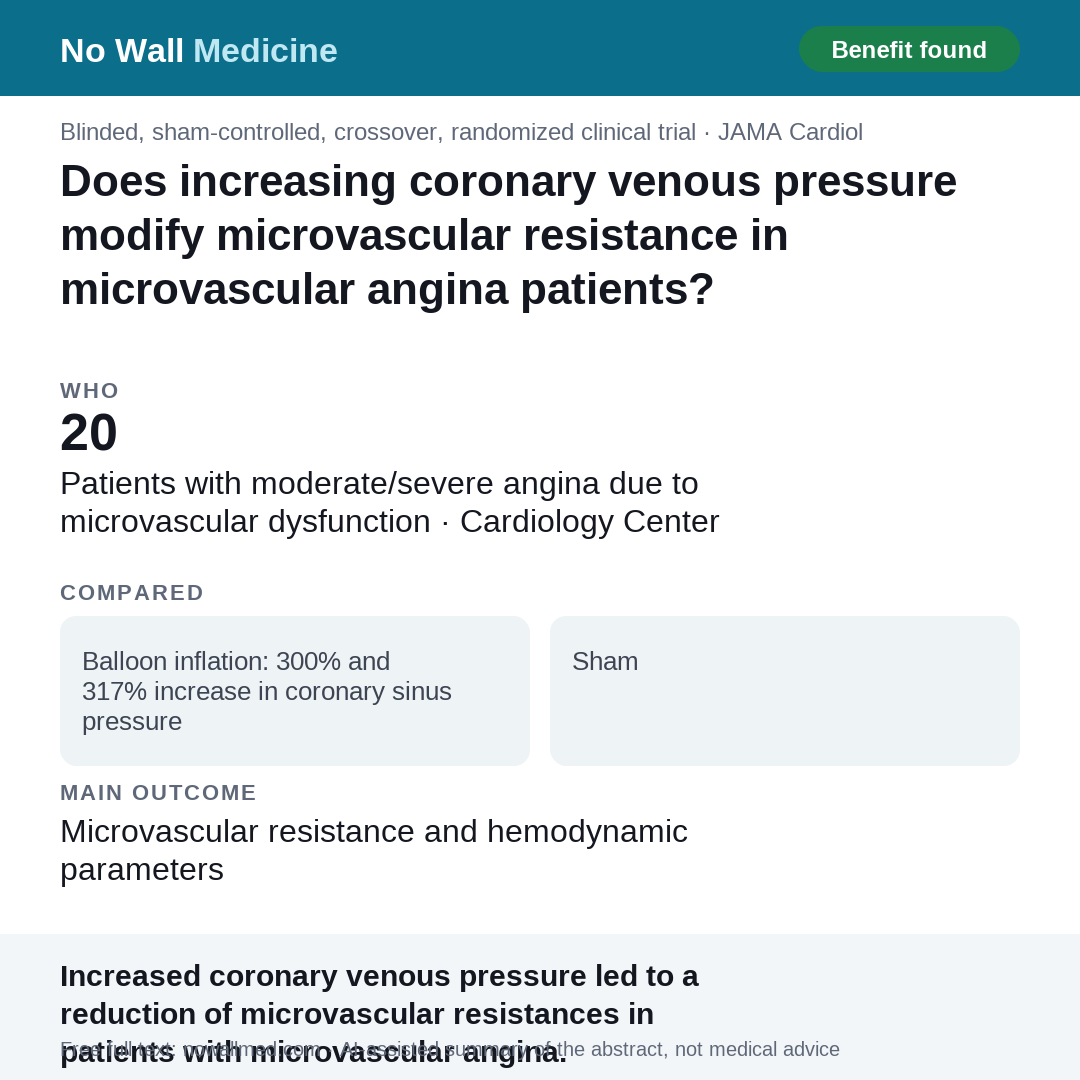
Clinical question: Does increasing coronary venous pressure modify microvascular resistance in microvascular angina patients?
Why it matters: The role of the coronary venous circulation in regulating blood flow to the heart muscle and its potential for treating microvascular angina is unexplored.
Key points
- The study involved 20 patients with moderate to severe angina caused by microvascular dysfunction, comparing balloon inflation in the coronary sinus to a sham procedure.
- Inflating the balloon increased coronary sinus pressure by 300% at rest and 317% during maximal hyperemia compared to the sham group.
- The increase in coronary venous pressure led to a reduction in microvascular resistance, which is the resistance to blood flow in the smallest heart vessels.
Headline and key points written with AI from the paper’s abstract, with every number checked against it. Read the paper before relying on them.
Was this summary helpful?
Abstract
Importance
The role of the coronary venous circulation in regulating myocardial perfusion and its potential in treating microvascular angina is unexplored.Objective
To evaluate whether an increase in coronary venous pressure modifies microvascular resistance in patients with microvascular angina.Design, setting, and participants
This was a blinded, sham-controlled, crossover, randomized clinical trial that enrolled participants between November 2021 and January 2023. Participants for this physiology end point study were recruited from the Cardiology Center of the University of Medicine in Mainz, Germany. Patients with moderate/severe angina pectoris (Canadian Cardiovascular Society class 2-4) due to microvascular dysfunction (as defined by the thermodilution-based index of microvascular resistance >25 mm Hg × s). Exclusion criteria were epicardial coronary disease, second- and third-degree atrioventricular block, severe valvular heart disease, cardiomyopathy, and pulmonary or kidney disease.Intervention
Inflation of an undersized balloon placed in the cardiac coronary sinus (CS), hereafter referred to as balloon and the deflated balloon in the right atrium, referred to as sham. Measurements were performed at rest and during maximal coronary hyperemia. Both patients and final assessors were blinded to the randomization sequence.Main outcomes and measures
Hemodynamic parameters, including aortic (Pa) and distal (Pd) coronary pressure, coronary sinus pressure (Pcs), right atrial pressure (Pra), and the mean transit time (inverse of blood flow [Tmn]), were measured.Results
A total of 20 patients (median [IQR] age, 69 [64-75] years; 11 female [55.0%]) were included in the study. Two patients (10%) had diabetes, 6 (30%) had hypercholesterolemia, 15 (75%) had hypertension, and 3 (15%) were active smokers. The inflation of the CS balloon caused a significant increase in CS pressure at rest and during hyperemia (300% and 317% increase, respectively, compared with sham, both P Conclusion and relevance
Increased coronary venous pressure led to a reduction of microvascular resistances in patients with microvascular angina, a mechanism with potential implications for the therapy of this complex disease.Trial registration
ClinicalTrials.gov Identifier: NCT05034224.
Abstract reproduced under the article’s CC BY licence.
Subject terms
Cite this article
Ullrich H, Hammer P, Olschewski M, Münzel T, Escaned J, Gori T. Coronary Venous Pressure and Microvascular Hemodynamics in Patients With Microvascular Angina: A Randomized Clinical Trial. JAMA Cardiol. 2023. doi:10.1001/jamacardio.2023.2566
Spotted a mistake? Suggest a correction