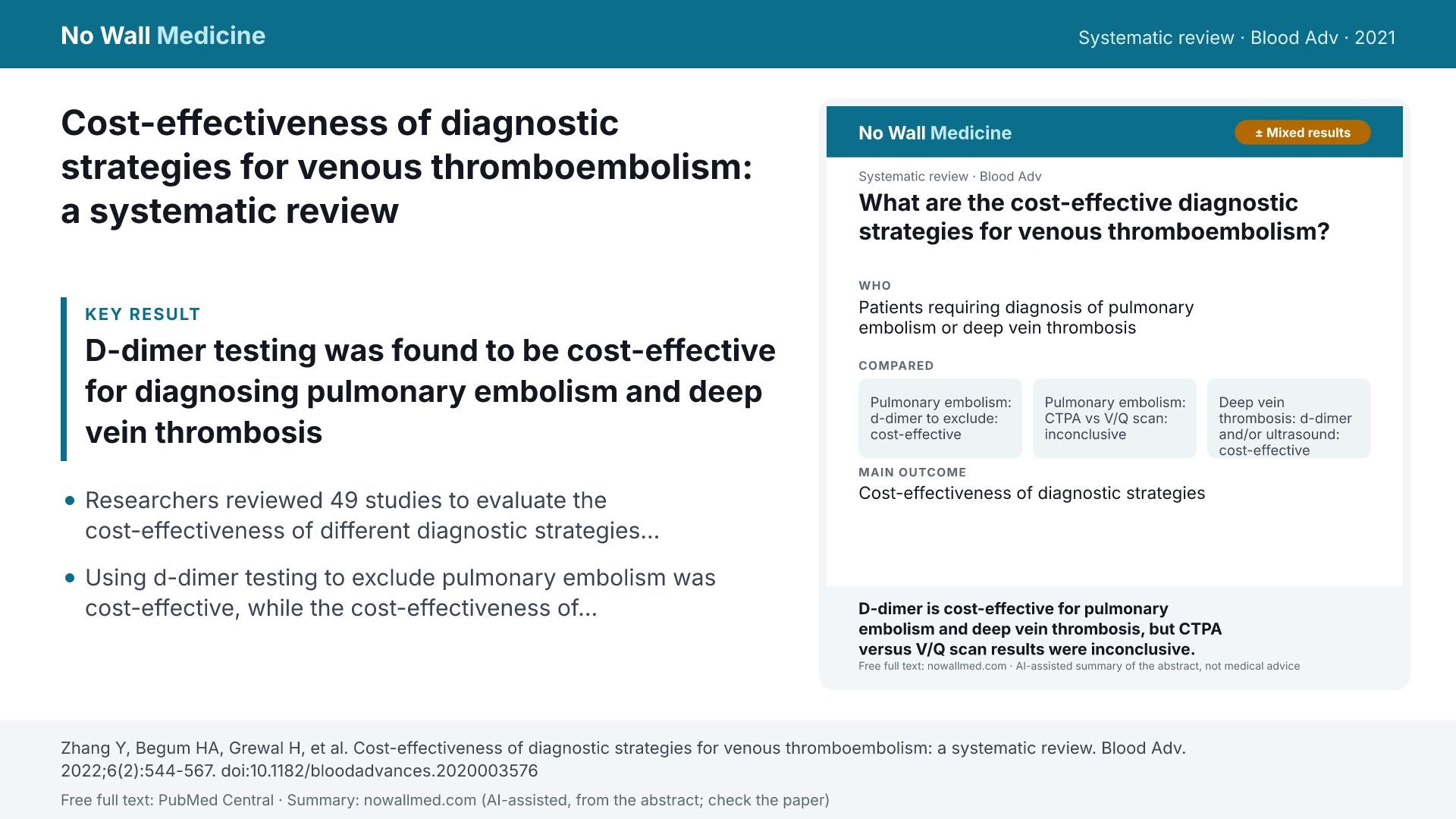
D-dimer testing was found to be cost-effective for diagnosing pulmonary embolism and deep vein thrombosis
Cost-effectiveness of diagnostic strategies for venous thromboembolism: a systematic review
Systematic reviewMixed results
What are the cost-effective diagnostic strategies for venous thromboembolism?
Who
Patients requiring diagnosis of pulmonary embolism or deep vein thrombosis
Compared
Pulmonary embolism: d-dimer to exclude: cost-effective
Pulmonary embolism: CTPA vs V/Q scan: inconclusive
Deep vein thrombosis: d-dimer and/or ultrasound: cost-effective
Main outcome
Cost-effectiveness of diagnostic strategies
Bottom line: D-dimer is cost-effective for pulmonary embolism and deep vein thrombosis, but CTPA versus V/Q scan results were inconclusive.
Blood Adv · 2021-10-05Download image
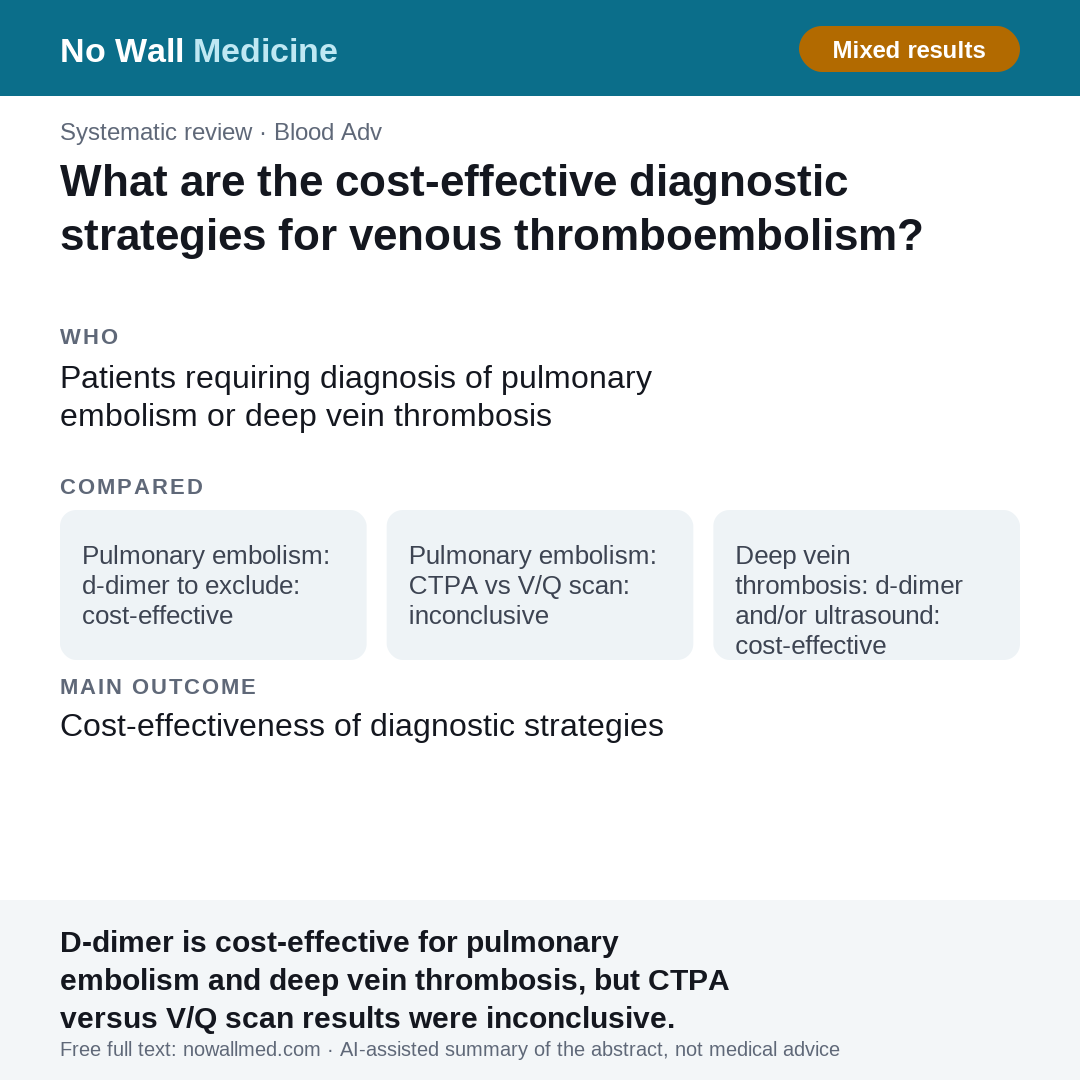
Clinical question: What are the cost-effective diagnostic strategies for venous thromboembolism?
Why it matters: Guideline developers require evidence on whether different diagnostic strategies for venous thromboembolism provide value for money.
Key points
- Researchers reviewed 49 studies to evaluate the cost-effectiveness of different diagnostic strategies for pulmonary embolism (blood clots in the lungs) and deep vein thrombosis (blood clots in the legs).
- Using d-dimer testing to exclude pulmonary embolism was cost-effective, while the cost-effectiveness of computed tomography pulmonary angiogram compared to ventilation-perfusion scans remained inconclusive.
- For deep vein thrombosis, strategies using d-dimer and or ultrasound were cost-effective and associated with a reduced need for diagnostic imaging in low-risk patients.
Headline and key points written with AI from the paper’s abstract, with every number checked against it. Read the paper before relying on them.
Was this summary helpful?
Abstract
Guideline developers consider cost-effectiveness evidence in decision making to determine value for money. This consideration in the guideline development process can be informed either by formal and dedicated economic evaluations or by systematic reviews of existing studies. To inform the American Society of Hematology guideline on the diagnosis of venous thromboembolism (VTE), we conducted a systematic review focused on the cost-effectiveness of diagnostic strategies for VTE within the guideline scope. We systematically searched Medline (Ovid), Embase (Ovid), National Health Service Economic Evaluation Database, and the Cost-effectiveness Analysis Registry; summarized; and critically appraised the economic evidence on diagnostic strategies for VTE. We identified 49 studies that met our inclusion criteria, with 26 on pulmonary embolism (PE) and 24 on deep vein thrombosis (DVT). For the diagnosis of PE, strategies including d-dimer to exclude PE were cost-effective compared with strategies without d-dimer testing. The cost-effectiveness of computed tomography pulmonary angiogram (CTPA) in relation to ventilation-perfusion (V/Q) scan was inconclusive. CTPA or V/Q scan following ultrasound or d-dimer results could be cost-effective or even cost saving. For DVT, studies supporting strategies with d-dimer and/or ultrasound were cost-effective, supporting the recommendation that for patients at low (unlikely) VTE risk, using d-dimer as the initial test reduces the need for diagnostic imaging. Our systematic review informed the American Society of Hematology guideline recommendations about d-dimer, V/Q scan and CTPA for PE diagnosis, and d-dimer and ultrasound for DVT diagnosis.
Abstract reproduced under the article’s CC BY NC ND licence.
Subject terms
Headline, design, result, key points, caveat and citation as plain text.
Cite this article
Zhang Y, Begum HA, Grewal H, et al. Cost-effectiveness of diagnostic strategies for venous thromboembolism: a systematic review. Blood Adv. 2021. doi:10.1182/bloodadvances.2020003576
Spotted a mistake? Suggest a correction