Dual hypothermic oxygenated machine perfusion was cost-effective compared to static cold storage in liver transplants
Cost-effectiveness of Dual Hypothermic Oxygenated Machine Perfusion Versus Static Cold Storage in DCD Liver Transplantation
Economic evaluation based on a randomized controlled trialBenefit found
Is dual hypothermic oxygenated machine perfusion cost-effective compared to static cold storage?
Who
119
Patients receiving liver transplantation after circulatory death · 3 participating centers in the Netherlands
Compared
Dual hypothermic oxygenated machine perfusion: €110 794
Static cold storage: €126 221
Main outcome
Mean total cost per patient up to 1 year posttransplant
Bottom line: Dual hypothermic oxygenated machine perfusion is cost-effective, reducing total medical costs up to 1 year posttransplant.
Transplantation · 2024-10-08Download image
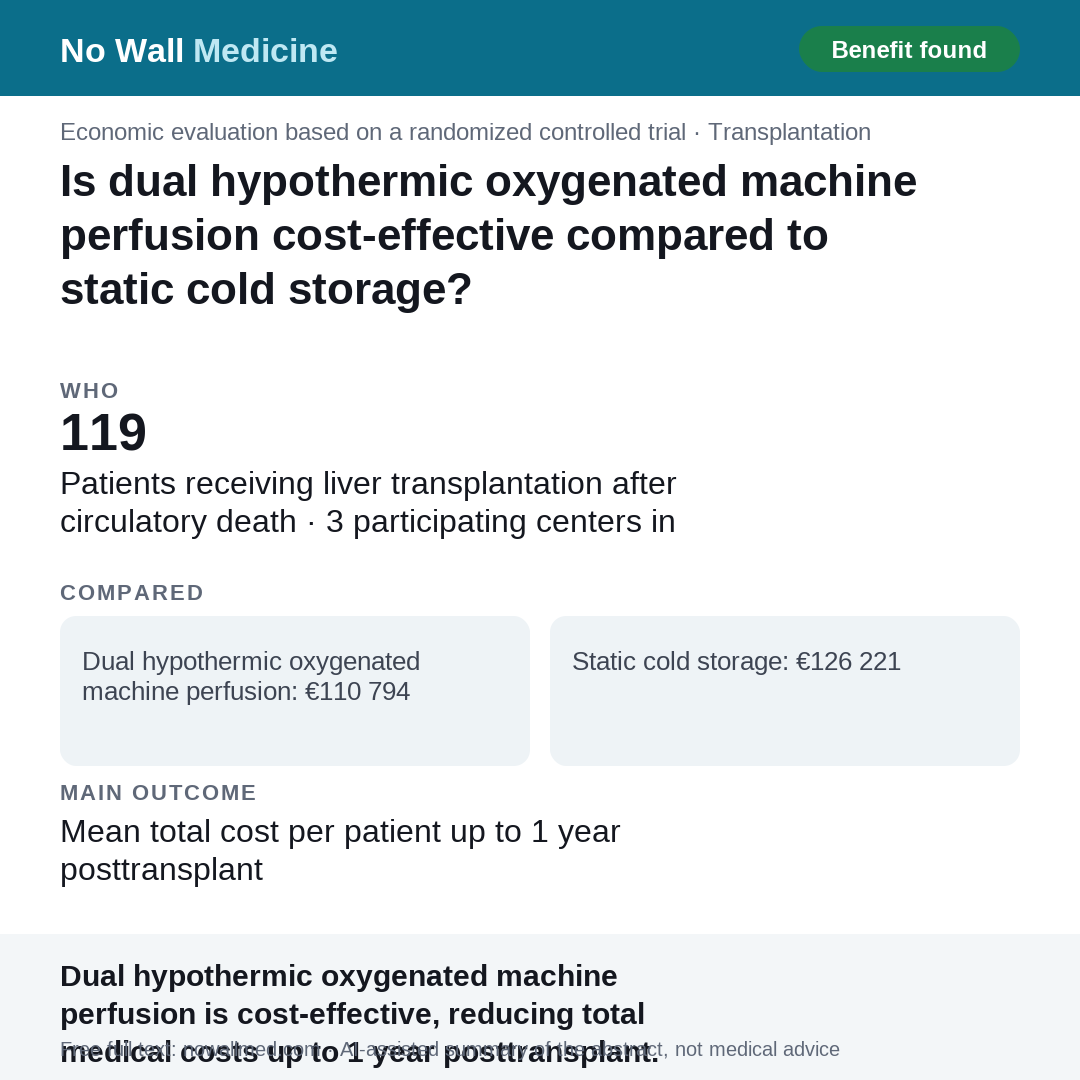
Clinical question: Is dual hypothermic oxygenated machine perfusion cost-effective compared to static cold storage?
Why it matters: Data regarding the cost-effectiveness of dual hypothermic oxygenated machine perfusion in liver transplantation after circulatory death were lacking.
Key points
- Researchers analyzed 119 patients receiving liver transplants after circulatory death, comparing dual hypothermic oxygenated machine perfusion to static cold storage.
- The mean total cost per patient up to 1 y posttransplant was €110 794 for the machine perfusion group and €126 221 for the static cold storage group.
- Machine perfusion was associated with a 28.4% reduction in intensive care costs and a 24.3% reduction in nonsurgical interventions.
Headline and key points written with AI from the paper’s abstract, with every number checked against it. Read the paper before relying on them.
Was this summary helpful?
Abstract
Background
Ex situ machine perfusion of the donor liver, such as dual hypothermic oxygenated machine perfusion (DHOPE), is increasingly used in liver transplantation. Although DHOPE reduces ischemia/reperfusion-related complications after liver transplantation, data on cost-effectiveness are lacking. Our objective was to evaluate the cost-effectiveness of DHOPE in donation after circulatory death (DCD) liver transplantation.Methods
We performed an economic evaluation of DHOPE versus static cold storage (SCS) based on a multicenter randomized controlled trial in DCD liver transplantation (DHOPE-DCD trial; ClinicalTrials.gov number, NCT02584283). All patients enrolled in the 3 participating centers in the Netherlands were included. Costs related to the transplant procedure, hospital stay, readmissions, and outpatients treatments up to 1 y posttransplant were calculated. The cost for machine perfusion was calculated using 3 scenarios: (1) costs for machine perfusion, (2) machine perfusion costs plus costs for personnel, and (3) scenario 2 plus depreciation expenses for a dedicated organ perfusion room.Results
Of 119 patients, 60 received a liver after DHOPE and 59 received a liver after SCS alone. The mean total cost per patient up to 1 y posttransplant was €126 221 for the SCS group and €110 794 for the DHOPE group. The most significant reduction occurred in intensive care costs (28.4%), followed by nonsurgical interventions (24.3%). In cost scenario 1, DHOPE was cost-effective after 1 procedure. In scenarios 2 and 3, cost-effectiveness was achieved after 25 and 30 procedures per year, respectively.Conclusions
Compared with conventional SCS, machine perfusion using DHOPE is cost-effective in DCD liver transplantation, reducing the total medical costs up to 1 y posttransplant.
Abstract reproduced under the article’s CC BY licence.
Subject terms
Cite this article
Endo C, van Rijn R, Huurman V, Schurink I, van den Berg A, Murad SD. Cost-effectiveness of Dual Hypothermic Oxygenated Machine Perfusion Versus Static Cold Storage in DCD Liver Transplantation. Transplantation. 2024. doi:10.1097/TP.0000000000005232
Spotted a mistake? Suggest a correction
Top studies every Monday
The week’s key trials and guidelines in your specialties, plus any topics you follow. By email, free.
Get the weekly digest