Touch-based practitioners used creative methods to adapt services to web formats during the pandemic
Creatively Adapting Touch-Based Practices to the Web Format During the COVID-19 Pandemic: Systematic Review
Systematic reviewBenefit found
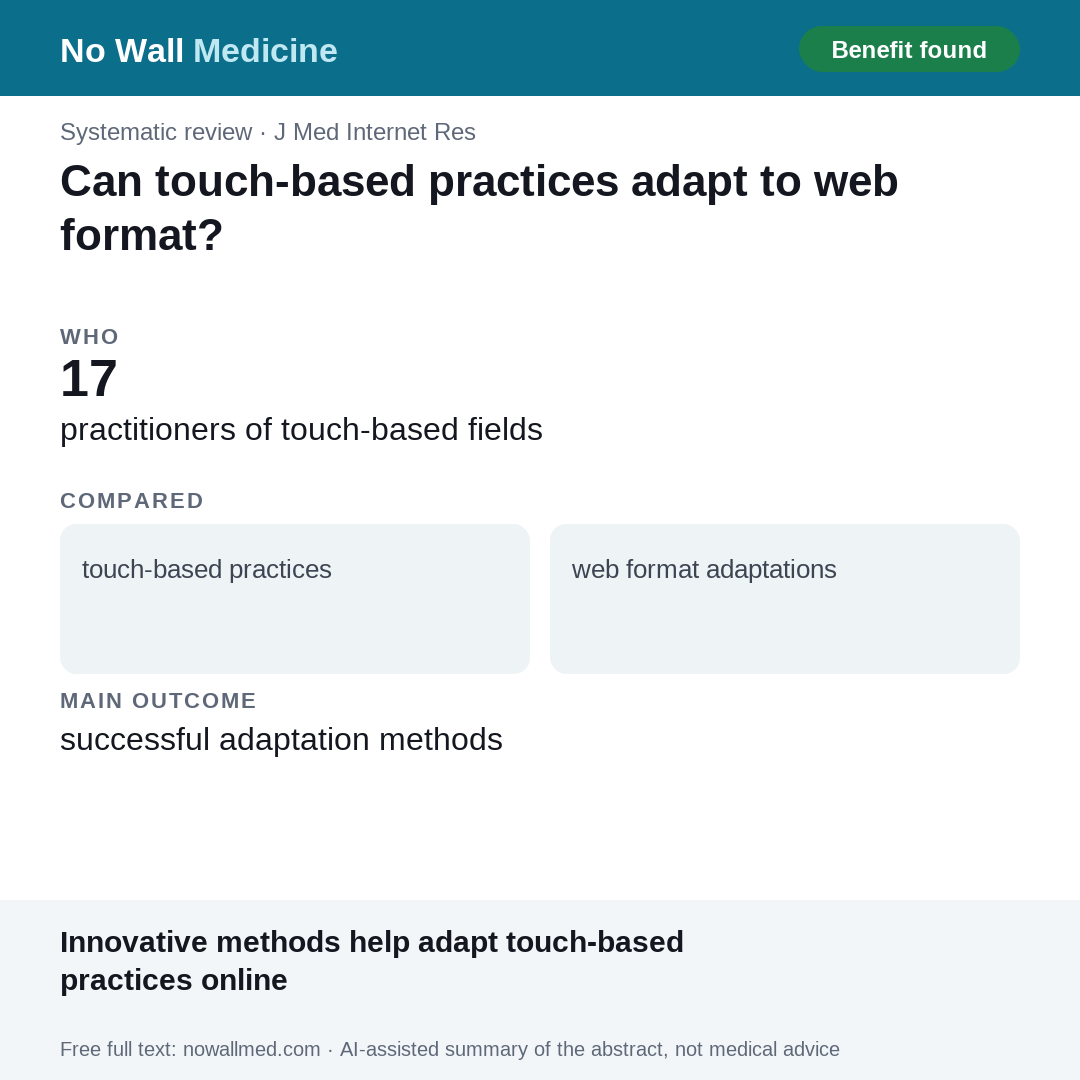
Can touch-based practices adapt to web format?
Who
17
practitioners of touch-based fields
Compared
touch-based practices
web format adaptations
Main outcome
successful adaptation methods
Bottom line: Innovative methods help adapt touch-based practices online
J Med Internet Res · 2023-10-26Download image
Clinical question: Can touch-based practices adapt to web format?
Why it matters: It was unknown how disciplines relying on physical touch and proximity could creatively adapt their services to web formats during the COVID-19 pandemic.
Key points
- Researchers reviewed 17 qualitative studies to identify how fields like manual therapy and fitness adapted to web-based delivery during the COVID-19 pandemic.
- The review identified five themes of adaptation, including using additional tools, creative platform use, and methods for sensorial experiences and nonphysical connections.
- These creative approaches allowed for connection and sensory experiences, though some concerns regarding technology and preparation were noted.
Limitation the authors note: Only qualitative studies were found for inclusion in this review.
Headline and key points written with AI from the paper’s abstract, with every number checked against it. Read the paper before relying on them.
Topics
Cite this article
Gauhe G, Cisneros REK, Ward J, Hohenschurz-Schmidt DJ. Creatively Adapting Touch-Based Practices to the Web Format During the COVID-19 Pandemic: Systematic Review. J Med Internet Res. 2023. doi:10.2196/46355
Spotted a mistake? Suggest a correction
Top studies every Monday
The week’s key trials and guidelines in your specialties, plus any topics you follow. By email, free.
Get the weekly digest