Culturally adapted digital health interventions showed no overall advantage over active controls for health behaviors
Culturally adapting internet- and mobile-based health promotion interventions might not be worth the effort: a systematic review and meta-analysis
Systematic review and meta-analysisNo clear difference
Are culturally adapted internet and mobile health interventions effective for diverse populations?
Who
10747
Culturally diverse populations
Compared
Culturally adapted internet and mobile interventions
Active control conditions
Main outcome
Promoting health behavior
Result: g = 0.10 (95% CI -0.19 to 0.40) short-term; g = 0.20 (95% CI -0.11 to 0.51) long-term
Bottom line: Culturally adapted internet and mobile interventions were non-superior to active controls for promoting health behavior overall.
Limitation: Limited number of trials with varying methodological rigor and substantial between-trial heterogeneity.
NPJ Digit Med · 2022-03-23 · Save PNG
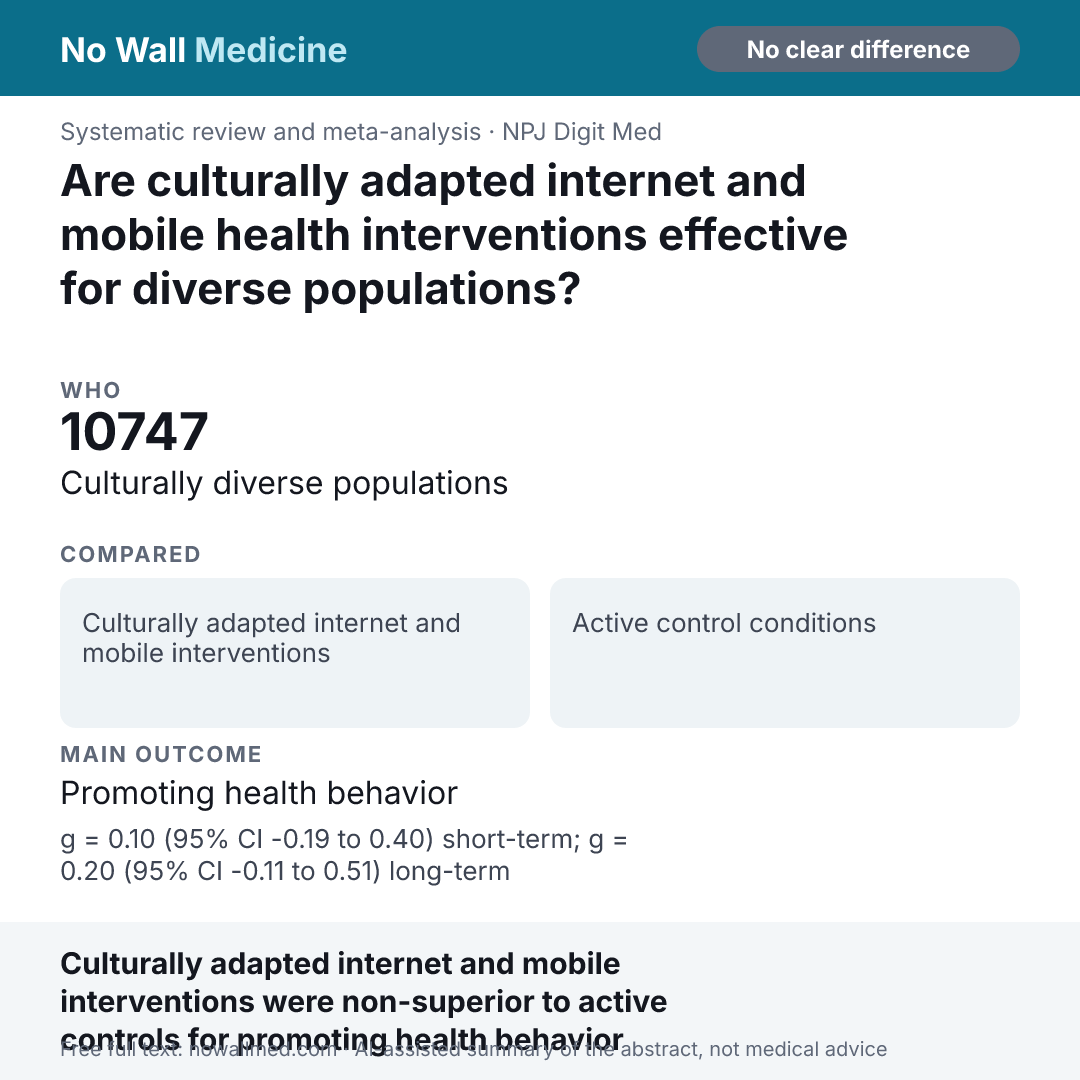
Clinical question: Are culturally adapted internet and mobile health interventions effective for diverse populations?
Key points
- Researchers analyzed 13 randomized controlled trials involving 10,747 participants to compare culturally adapted internet- and mobile-based health interventions against active control conditions.
- Culturally adapted digital interventions were not superior in the short-term (g = 0.10, [95% CI -0.19 to 0.40]) or long-term (g = 0.20, [95% CI -0.11 to 0.51]) for promoting health behavior.
- A beneficial long-term effect was found specifically for physical activity interventions (k = 3, N = 296) compared to active controls (g = 0.48, [95% CI 0.25 to 0.71]).
Limitation the authors note: The findings are considered preliminary due to a limited number of included trials with varying methodological rigor and substantial between-trial heterogeneity.
Headline and key points written with AI from the paper’s abstract, with every number checked against it. Read the paper before relying on them.
Was this summary helpful?
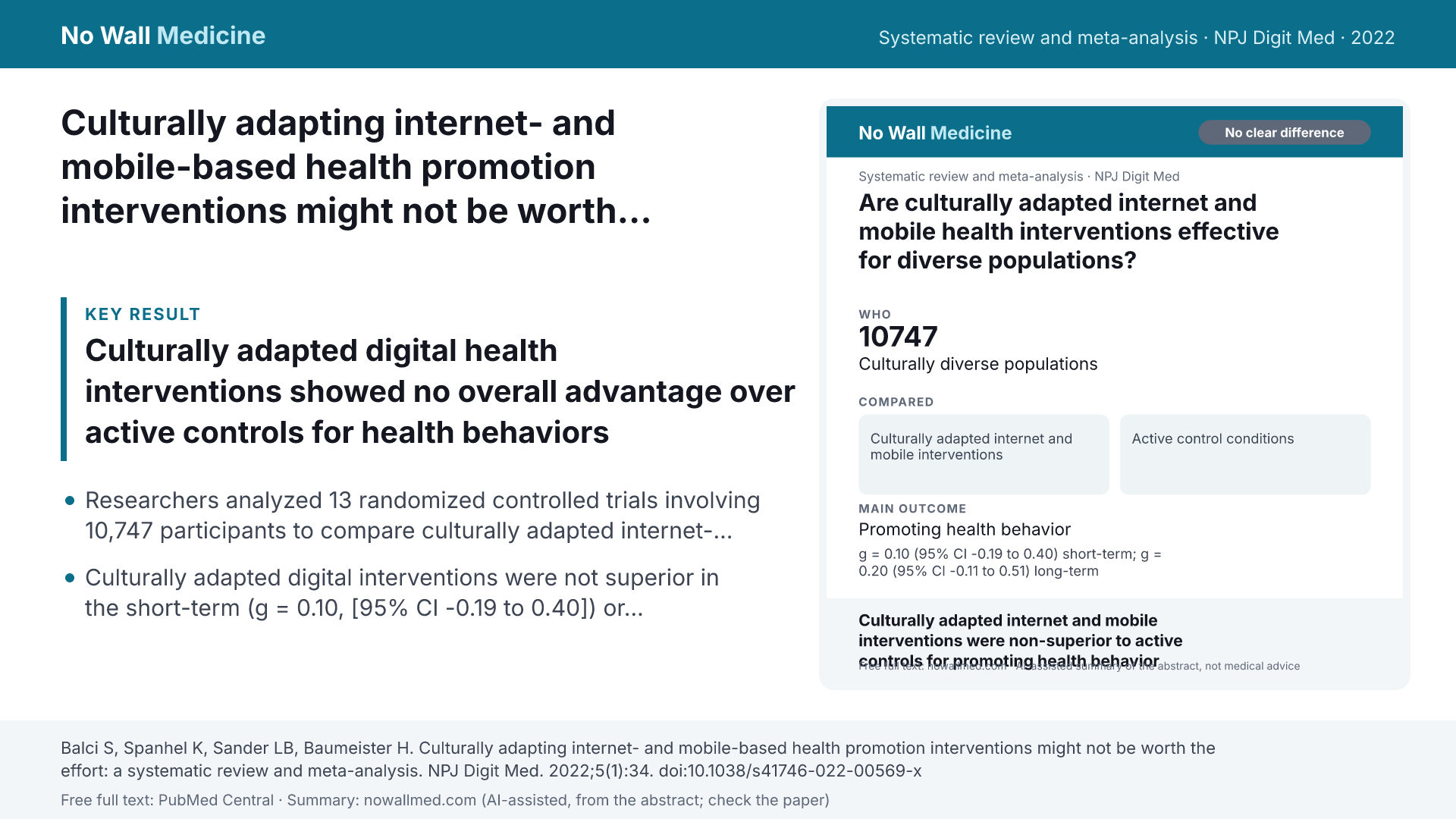
Headline, design, result, key points, caveat and citation as plain text.
Cite this article
Balci S, Spanhel K, Sander LB, Baumeister H. Culturally adapting internet- and mobile-based health promotion interventions might not be worth the effort: a systematic review and meta-analysis. NPJ Digit Med. 2022. doi:10.1038/s41746-022-00569-x
Spotted a mistake? Suggest a correction