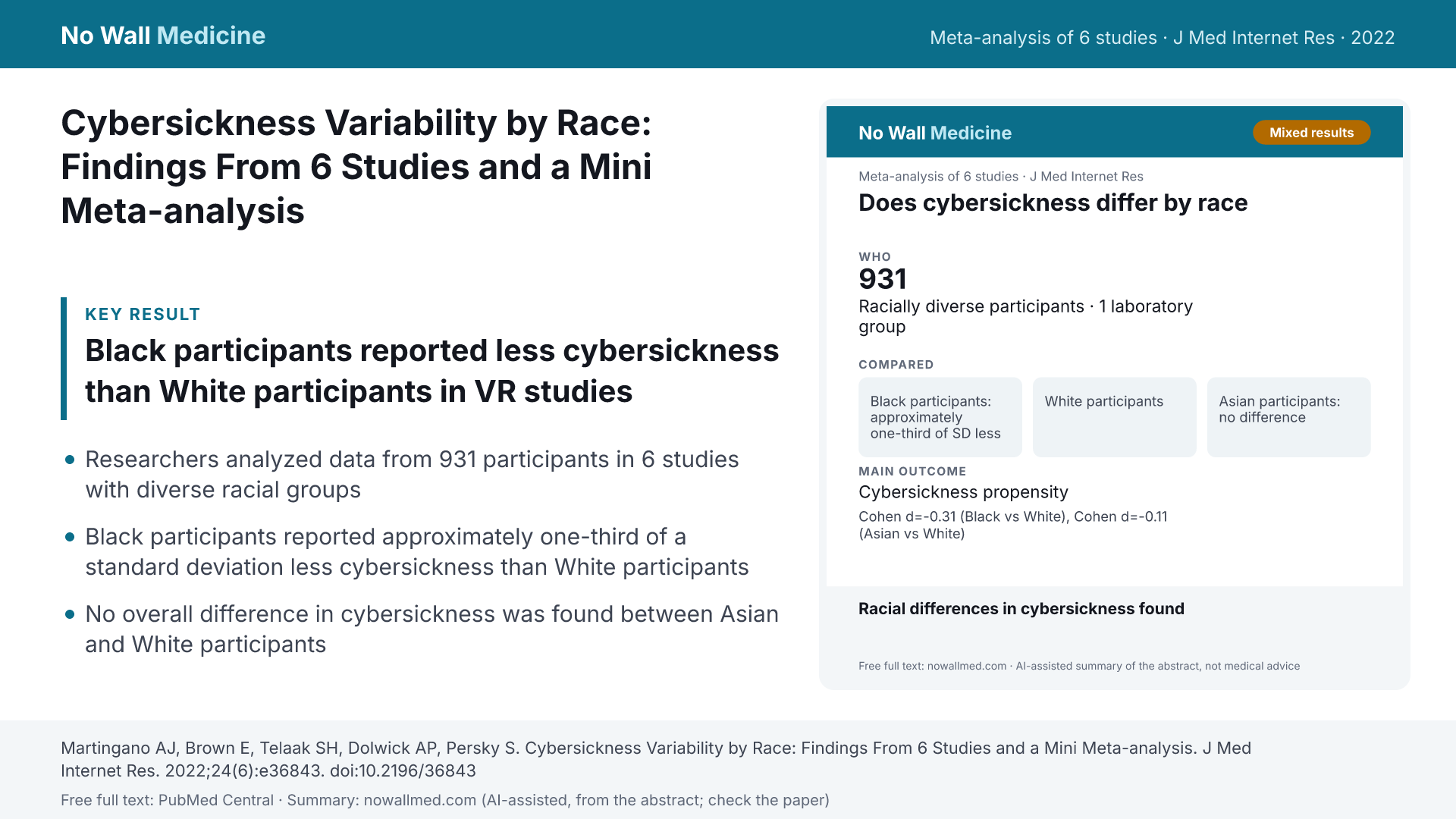
Black participants reported less cybersickness than White participants in VR studies
Cybersickness Variability by Race: Findings From 6 Studies and a Mini Meta-analysis
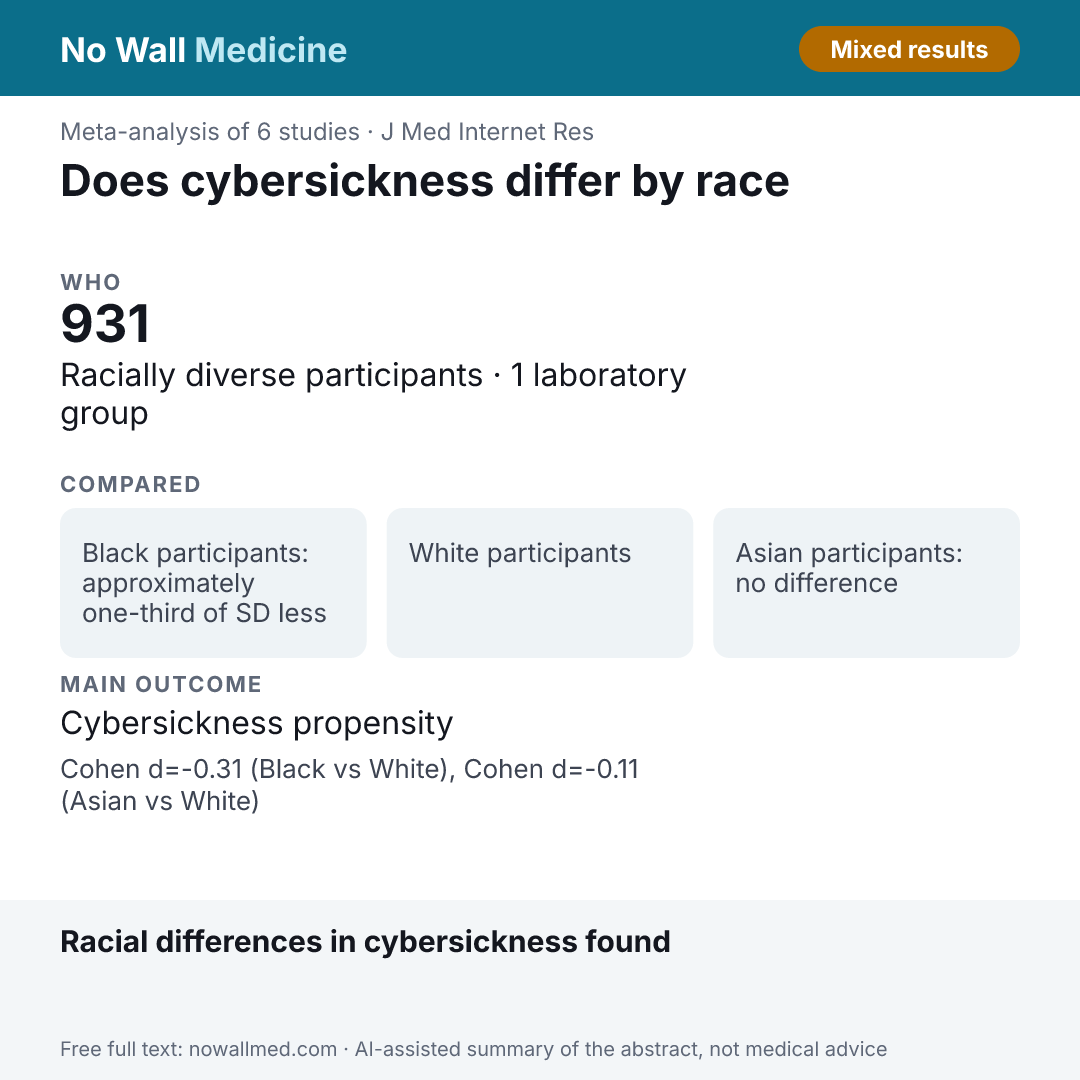
Meta-analysis of 6 studiesMixed results
Does cybersickness differ by race
Who
931
Racially diverse participants · 1 laboratory group
Compared
Black participants: approximately one-third of SD less
White participants
Asian participants: no difference
Main outcome
Cybersickness propensity
Result: Cohen d=-0.31 (Black vs White), Cohen d=-0.11 (Asian vs White)
Bottom line: Racial differences in cybersickness found
J Med Internet Res · 2022-06-01 · Save PNG
Key points
- Researchers analyzed data from 931 participants in 6 studies with diverse racial groups.
- Black participants reported approximately one-third of a standard deviation less cybersickness than White participants.
- No overall difference in cybersickness was found between Asian and White participants.
Limitation the authors note: The study was limited to a single laboratory group
Headline and key points written with AI from the paper’s abstract, with every number checked against it. Read the paper before relying on them.
Was this summary helpful?
Subject terms
Headline, design, result, key points, caveat and citation as plain text.
Cite this article
Martingano AJ, Brown E, Telaak SH, Dolwick AP, Persky S. Cybersickness Variability by Race: Findings From 6 Studies and a Mini Meta-analysis. J Med Internet Res. 2022. doi:10.2196/36843
Spotted a mistake? Suggest a correction