Retrosigmoid ileal conduit showed no significant difference in 90-day complications compared to conventional methods
DaBlaCa-16: Retrosigmoid Versus Conventional Ileal Conduit in Robot-assisted Radical Cystectomy, the MOSAIC Randomized Controlled Trial-Feasibility and 90-day Postoperative Complications
Randomized controlled trialNo clear difference
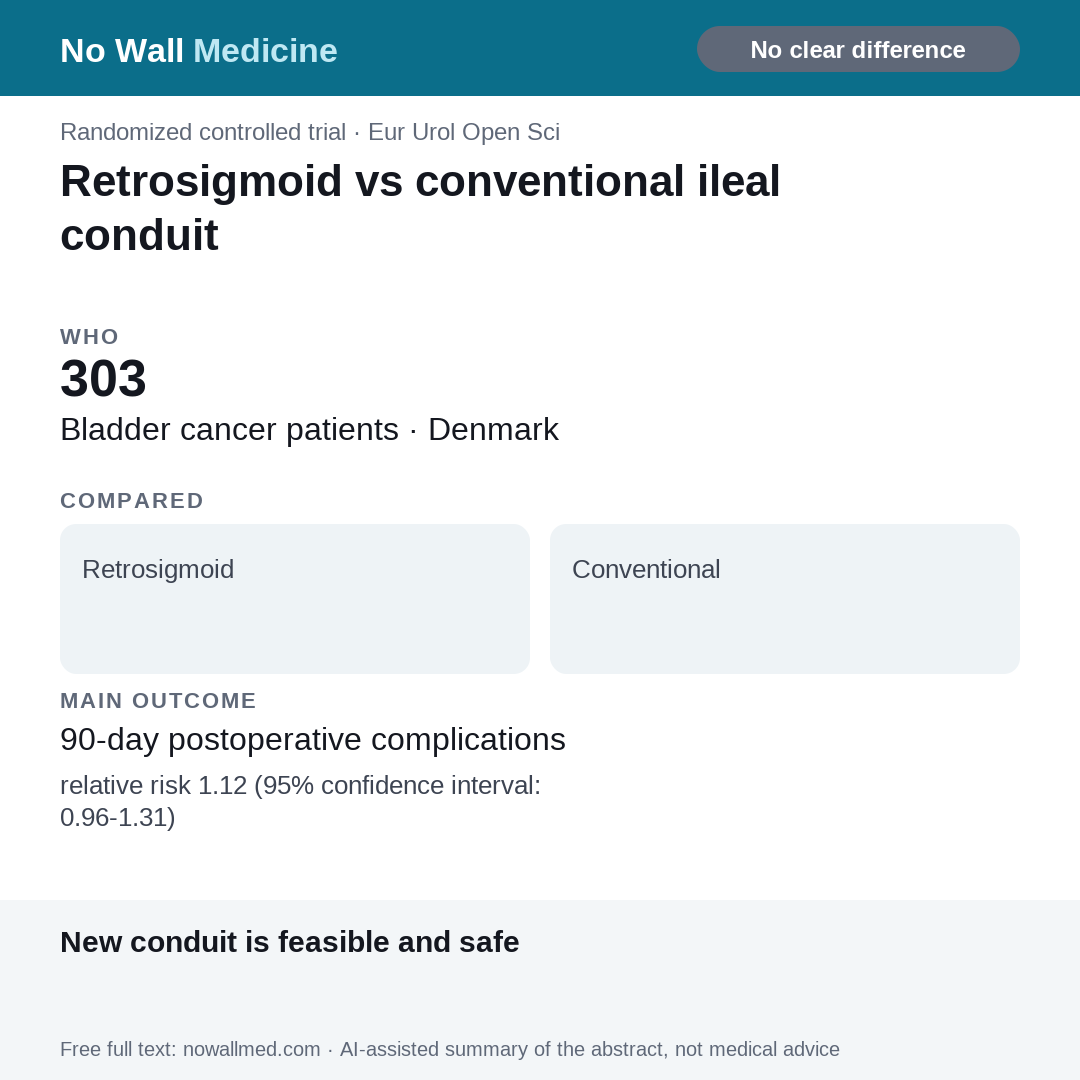
Retrosigmoid vs conventional ileal conduit
Who
303
Bladder cancer patients · Denmark
Compared
Retrosigmoid
Conventional
Main outcome
90-day postoperative complications
Result: relative risk 1.12 (95% confidence interval: 0.96-1.31)
Bottom line: New conduit is feasible and safe
Limitation: short-term follow-up
Eur Urol Open Sci · 2024-01-04Download image
Why it matters: It is unknown if a retrosigmoid ileal conduit is a feasible and safe alternative to prevent benign ureteroenteric strictures, which affect approximately 15% of patients.
Key points
- Researchers randomized 303 bladder cancer patients to receive either a retrosigmoid ileal conduit or a conventional ileal conduit during robot-assisted radical cystectomy.
- The relative risk of major postoperative complications, graded as Clavien-Dindo grade ≥III, was 1.12 (95% confidence interval: 0.96-1.31) for the retrosigmoid group.
- Of the 149 patients assigned to the retrosigmoid group, 137 (92%) successfully received the intended procedure.
Headline and key points written with AI from the paper’s abstract, with every number checked against it. Read the paper before relying on them.
Was this summary helpful?
Cite this article
Brandt SB, Körner SK, Milling RV, Nielsen NK, Kingo PS, Joensen UN. DaBlaCa-16: Retrosigmoid Versus Conventional Ileal Conduit in Robot-assisted Radical Cystectomy, the MOSAIC Randomized Controlled Trial-Feasibility and 90-day Postoperative Complications. Eur Urol Open Sci. 2024. doi:10.1016/j.euros.2023.12.007
Spotted a mistake? Suggest a correction
Top studies every Monday
The week’s key trials and guidelines in your specialties, plus any topics you follow. By email, free.
Get the weekly digest