Double defibrillation results vary between randomized trials and observational studies for refractory ventricular fibrillation
Defibrillation strategies for patients with refractory ventricular fibrillation: A systematic review and meta-analysis
Systematic review and meta-analysisMixed results
Is double defibrillation more effective than standard defibrillation for refractory ventricular fibrillation?
Who
1360
Patients with refractory ventricular fibrillation
Compared
Double defibrillation
Standard defibrillation
Main outcome
Survival to hospital discharge
Result: relative ratio 0.91 (95% CI, 0.46-1.78)
Bottom line: Double sequential defibrillation showed benefit in one randomized trial, but cohort studies showed no benefit for survival to discharge.
Limitation: Further validation is needed through larger-scale and higher-quality trials.
Am J Emerg Med · 2024-08-05Download image
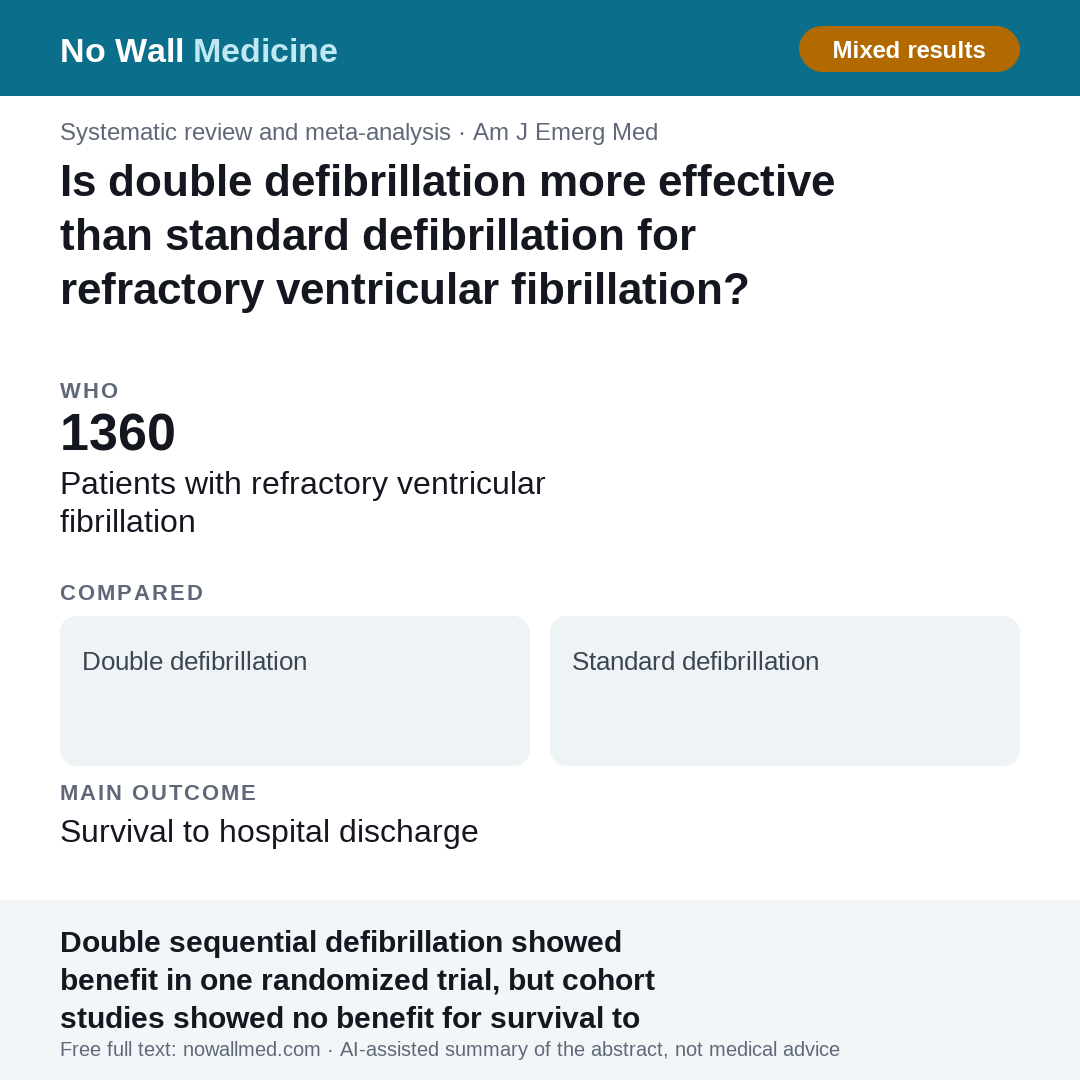
Clinical question: Is double defibrillation more effective than standard defibrillation for refractory ventricular fibrillation?
Why it matters: It is unclear if double defibrillation, either sequential or simultaneous, is more effective than standard defibrillation for patients with refractory ventricular fibrillation.
Key points
- Researchers analyzed 6 trials involving 1360 patients to compare double defibrillation against standard defibrillation for refractory ventricular fibrillation, a heart rhythm that does not respond to initial shocks.
- One randomized controlled trial showed double sequential defibrillation was associated with higher survival to hospital discharge, but pooled cohort studies found no benefit in survival to hospital discharge (RR, 0.91; 95% CI, 0.46-1.78).
- Subgroup analysis suggested simultaneous double defibrillation was linked with a lower return of spontaneous circulation rate compared to standard defibrillation (RR, 0.65; 95% CI, 0.49-0.86).
Limitation the authors note: Further validation is needed through larger-scale and higher-quality trials.
Headline and key points written with AI from the paper’s abstract, with every number checked against it. Read the paper before relying on them.
Topics
Cite this article
Yu J, Yu Y, Liang H, Zhang Y, Yuan D, Sun T. Defibrillation strategies for patients with refractory ventricular fibrillation: A systematic review and meta-analysis. Am J Emerg Med. 2024. doi:10.1016/j.ajem.2024.07.059
Spotted a mistake? Suggest a correction
Top studies every Monday
The week’s key trials and guidelines in your specialties, by email. Free.
Get the weekly digest