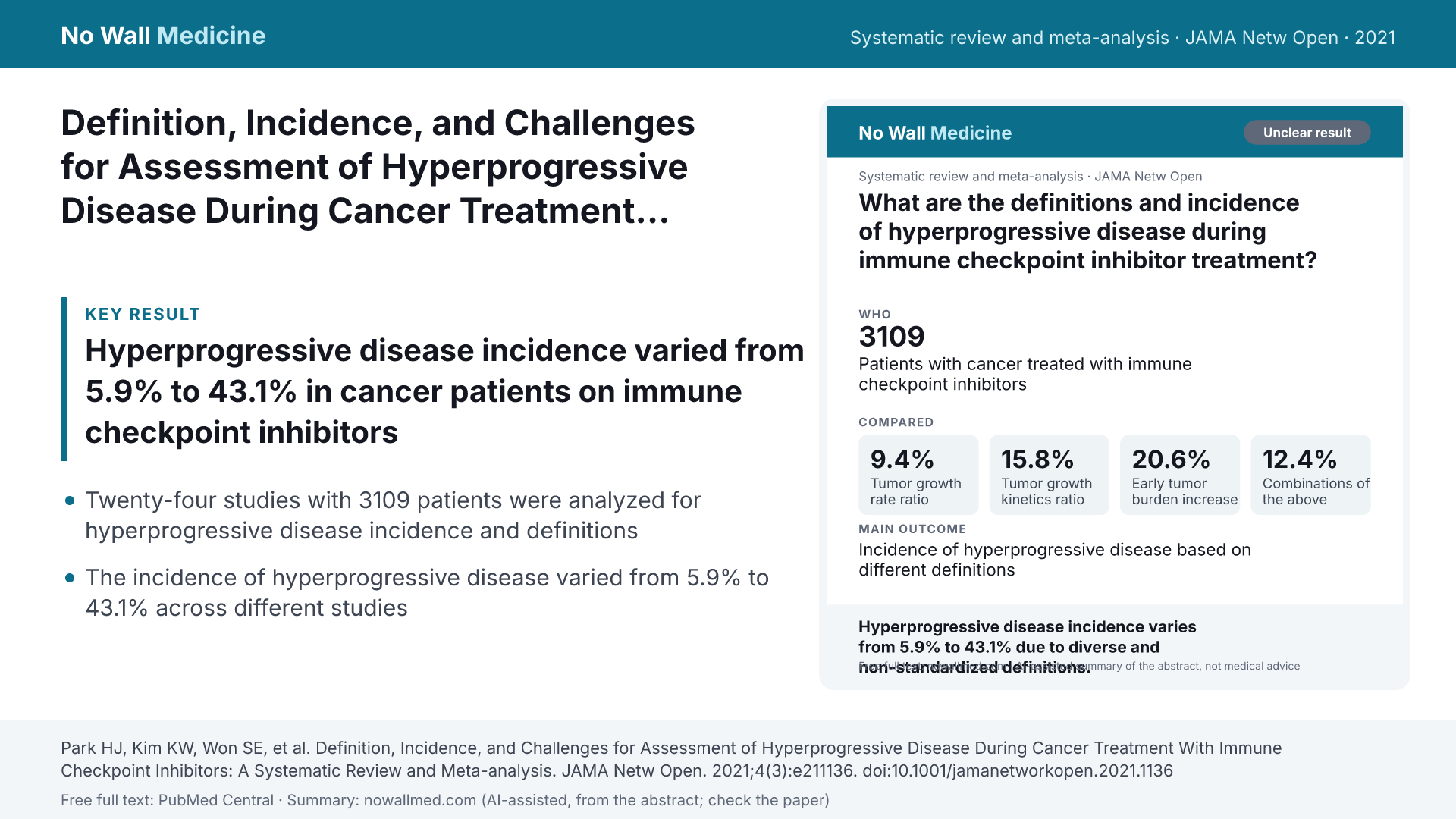
Hyperprogressive disease incidence varied from 5.9% to 43.1% in cancer patients on immune checkpoint inhibitors
Definition, Incidence, and Challenges for Assessment of Hyperprogressive Disease During Cancer Treatment With Immune Checkpoint Inhibitors: A Systematic Review and Meta-analysis
Systematic review and meta-analysisUnclear result
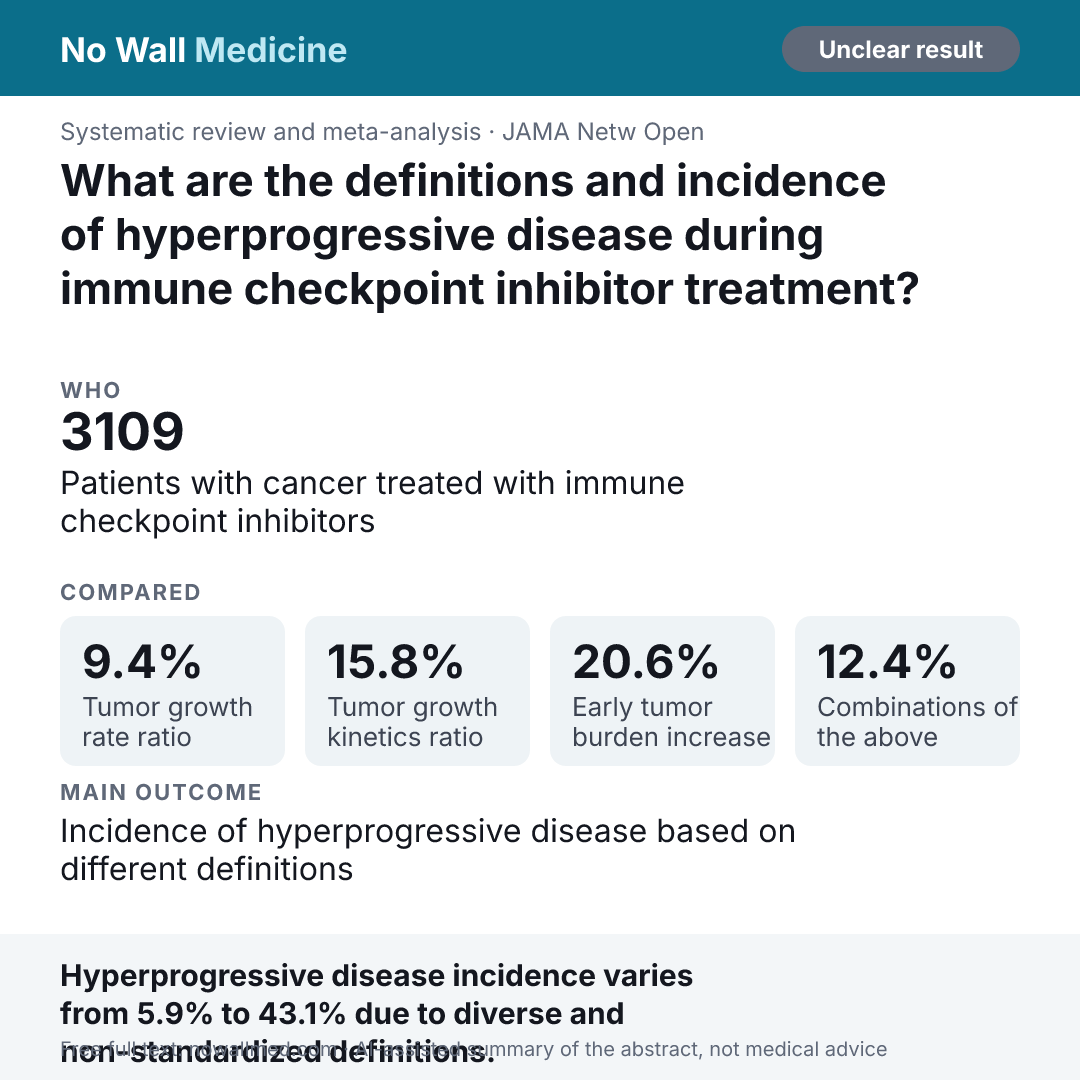
What are the definitions and incidence of hyperprogressive disease during immune checkpoint inhibitor treatment?
Who
3109
Patients with cancer treated with immune checkpoint inhibitors
Compared
9.4%Tumor growth rate ratio (95% CI, 6.9%-12.0%)
15.8%Tumor growth kinetics ratio (95% CI, 8.0%-23.7%)
20.6%Early tumor burden increase (95% CI, 9.3%-31.8%)
12.4%Combinations of the above (95% CI, 7.3%-17.5%)
Main outcome
Incidence of hyperprogressive disease based on different definitions
Bottom line: Hyperprogressive disease incidence varies from 5.9% to 43.1% due to diverse and non-standardized definitions.
Limitation: Study results on clinical outcome were heterogeneous on discriminating patients with hyperprogressive disease from natural progressive disease.
JAMA Netw Open · 2021-03-01 · Save PNG
Clinical question: What are the definitions and incidence of hyperprogressive disease during immune checkpoint inhibitor treatment?
Why it matters: Definitions of hyperprogressive disease have not been standardized, posing a risk of capturing different tumoral behaviors
Key points
- Twenty-four studies with 3109 patients were analyzed for hyperprogressive disease incidence and definitions.
- The incidence of hyperprogressive disease varied from 5.9% to 43.1% across different studies.
- Definitions of hyperprogressive disease were divided into 4 categories with pooled incidence ranging from 9.4% to 20.6%.
Limitation the authors note: Study results on clinical outcome were heterogeneous, making it difficult to discriminate patients with hyperprogressive disease from those with natural progressive disease
Headline and key points written with AI from the paper’s abstract, with every number checked against it. Read the paper before relying on them.
Was this summary helpful?
Subject terms
Headline, design, result, key points, caveat and citation as plain text.
Cite this article
Park HJ, Kim KW, Won SE, et al. Definition, Incidence, and Challenges for Assessment of Hyperprogressive Disease During Cancer Treatment With Immune Checkpoint Inhibitors: A Systematic Review and Meta-analysis. JAMA Netw Open. 2021. doi:10.1001/jamanetworkopen.2021.1136
Spotted a mistake? Suggest a correction