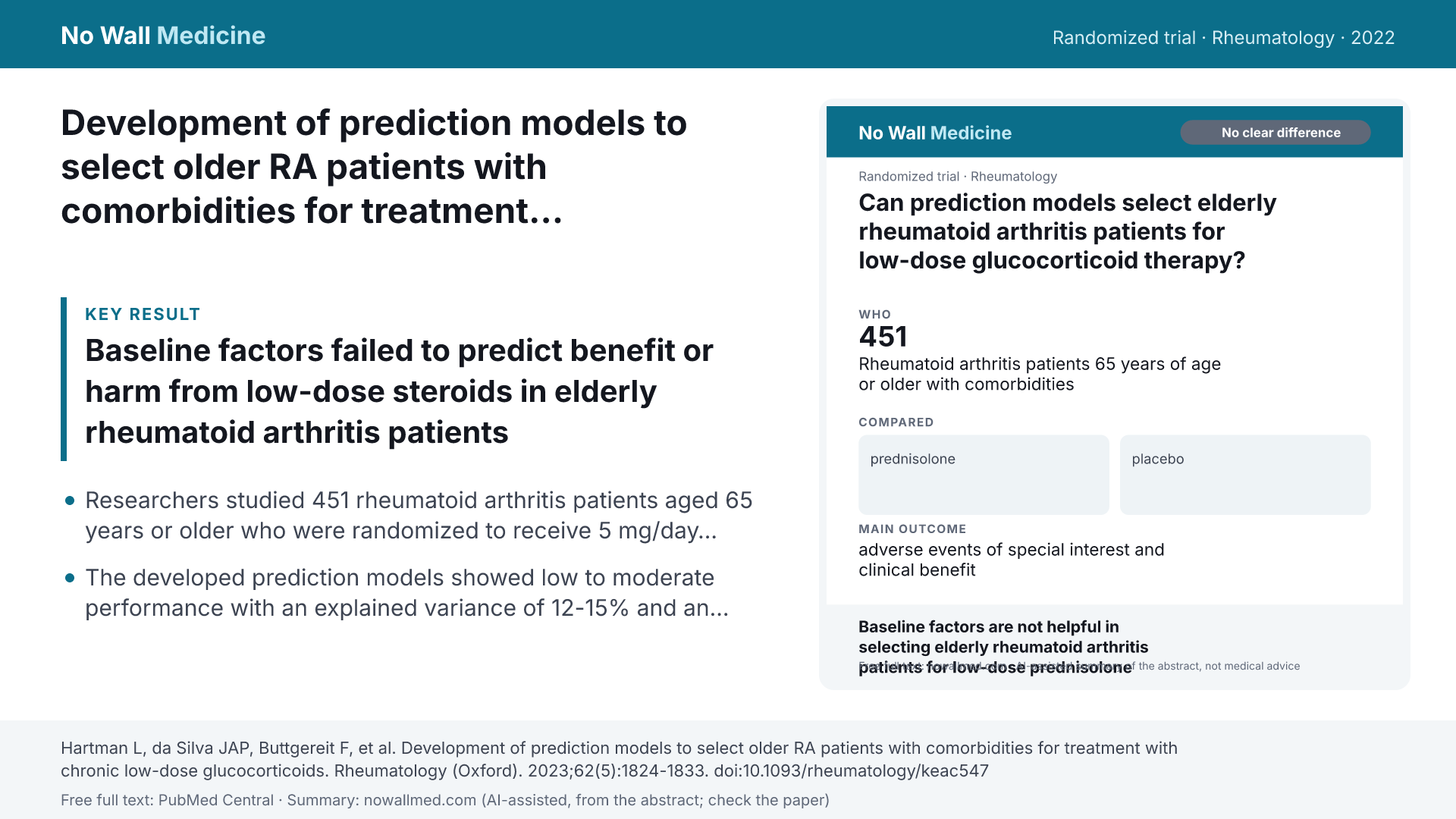
Baseline factors failed to predict benefit or harm from low-dose steroids in elderly rheumatoid arthritis patients
Development of prediction models to select older RA patients with comorbidities for treatment with chronic low-dose glucocorticoids
Randomized trialNo clear difference
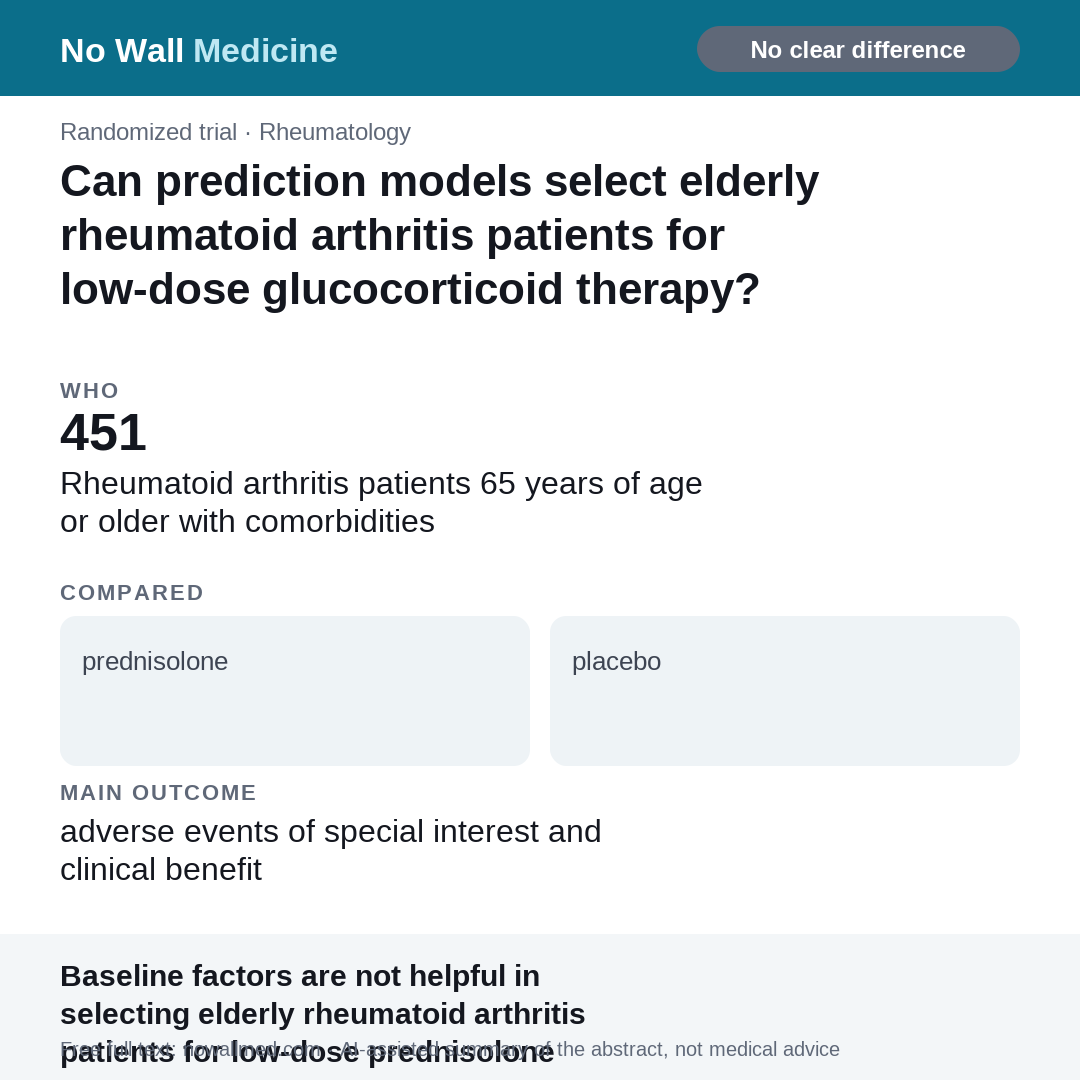
Can prediction models select elderly rheumatoid arthritis patients for low-dose glucocorticoid therapy?
Who
451
Rheumatoid arthritis patients 65 years of age or older with comorbidities
Compared
prednisolone
placebo
Main outcome
adverse events of special interest and clinical benefit
Bottom line: Baseline factors are not helpful in selecting elderly rheumatoid arthritis patients for low-dose prednisolone treatment.
Rheumatology · 2022-09-28Download image
Clinical question: Can prediction models select elderly rheumatoid arthritis patients for low-dose glucocorticoid therapy?
Why it matters: It is unknown if baseline characteristics can help clinicians select which elderly rheumatoid arthritis patients with comorbidities will benefit from or be harmed by chronic low-dose glucocorticoid therapy.
Key points
- Researchers studied 451 rheumatoid arthritis patients aged 65 years or older who were randomized to receive 5 mg/day of prednisolone or a placebo for 2 years.
- The developed prediction models showed low to moderate performance with an explained variance of 12-15% and an area under the curve of 0.67-0.69.
- None of the variables used in the models were found to be of immediate clinical value for predicting outcomes.
Headline and key points written with AI from the paper’s abstract, with every number checked against it. Read the paper before relying on them.
Was this summary helpful?
Subject terms
Cite this article
Hartman L, da Silva JAP, Buttgereit F, et al. Development of prediction models to select older RA patients with comorbidities for treatment with chronic low-dose glucocorticoids. Rheumatology. 2022. doi:10.1093/rheumatology/keac547
Spotted a mistake? Suggest a correction