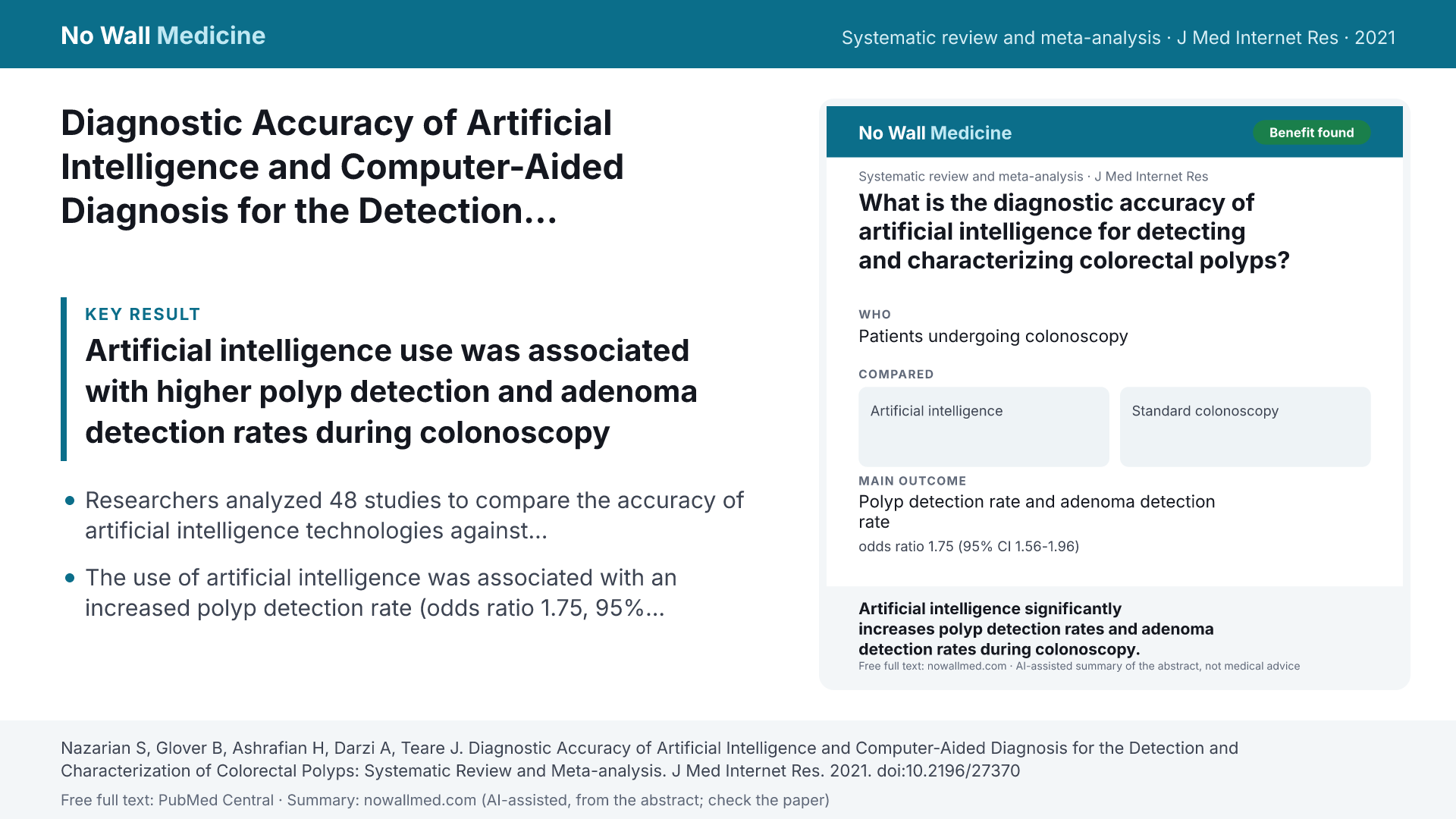
Artificial intelligence use was associated with higher polyp detection and adenoma detection rates during colonoscopy
Diagnostic Accuracy of Artificial Intelligence and Computer-Aided Diagnosis for the Detection and Characterization of Colorectal Polyps: Systematic Review and Meta-analysis
Systematic review and meta-analysisBenefit found
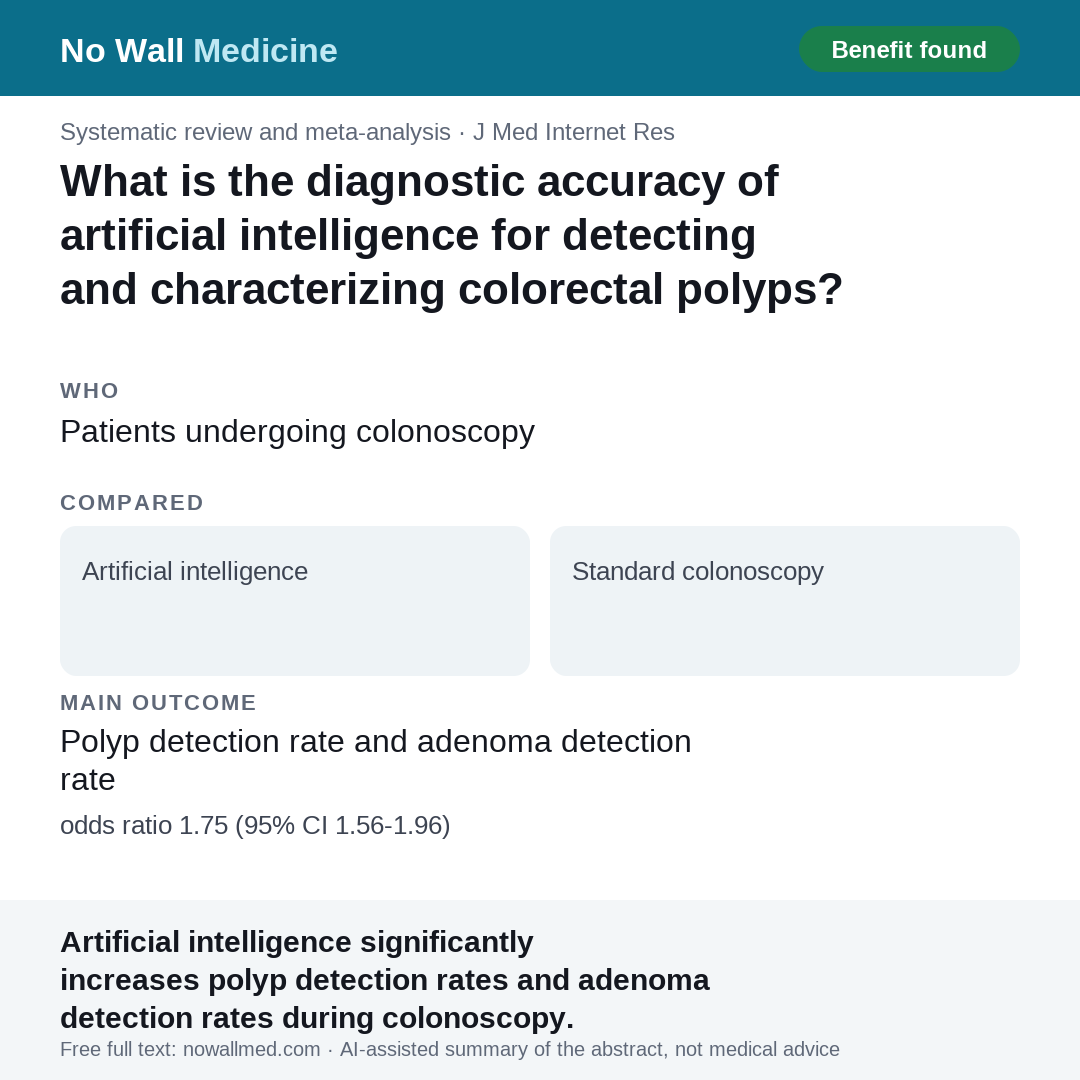
What is the diagnostic accuracy of artificial intelligence for detecting and characterizing colorectal polyps?
Who
Patients undergoing colonoscopy
Compared
Artificial intelligence
Standard colonoscopy
Main outcome
Polyp detection rate and adenoma detection rate
Result: odds ratio 1.75 (95% CI 1.56-1.96)
Bottom line: Artificial intelligence significantly increases polyp detection rates and adenoma detection rates during colonoscopy.
Limitation: AI systems must prove worthy to patients and clinicians before clinical adoption.
J Med Internet Res · 2021-07-14Download image
Clinical question: What is the diagnostic accuracy of artificial intelligence for detecting and characterizing colorectal polyps?
Why it matters: Many small polyps are missed during a single colonoscopy, and it is unclear how much artificial intelligence can improve detection accuracy.
Key points
- Researchers analyzed 48 studies to compare the accuracy of artificial intelligence technologies against standard colonoscopy for finding and identifying colorectal polyps.
- The use of artificial intelligence was associated with an increased polyp detection rate (odds ratio 1.75, 95% CI 1.56-1.96) and an increased adenoma detection rate (odds ratio 1.53, 95% CI 1.32-1.77).
- Adenoma detection rate refers to the frequency at which doctors find adenomas, which are precancerous growths in the colon.
Headline and key points written with AI from the paper’s abstract, with every number checked against it. Read the paper before relying on them.
Was this summary helpful?
Subject terms
Cite this article
Nazarian S, Glover B, Ashrafian H, Darzi A, Teare J. Diagnostic Accuracy of Artificial Intelligence and Computer-Aided Diagnosis for the Detection and Characterization of Colorectal Polyps: Systematic Review and Meta-analysis. J Med Internet Res. 2021. doi:10.2196/27370
Spotted a mistake? Suggest a correction