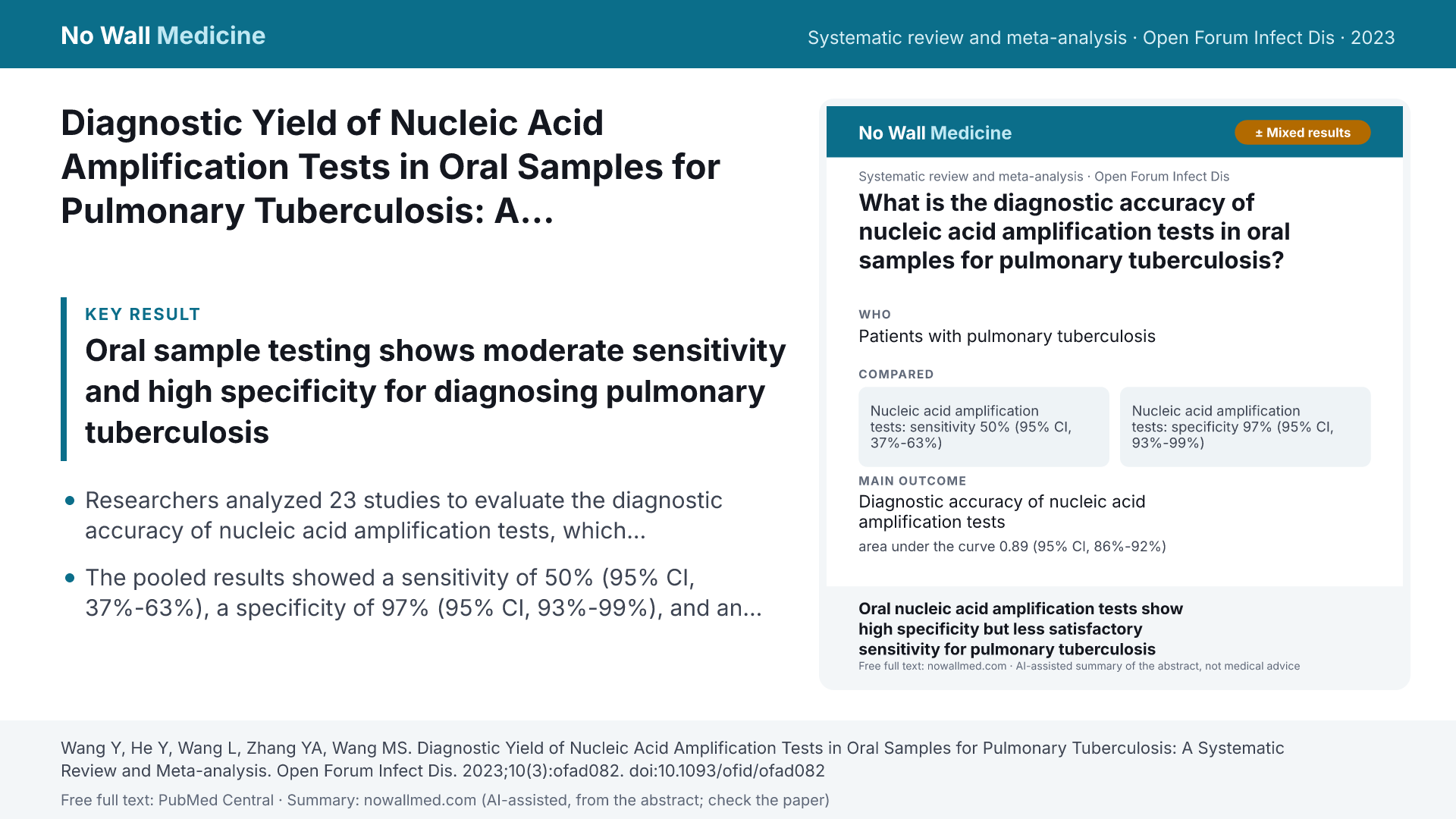
Oral sample testing shows moderate sensitivity and high specificity for diagnosing pulmonary tuberculosis
Diagnostic Yield of Nucleic Acid Amplification Tests in Oral Samples for Pulmonary Tuberculosis: A Systematic Review and Meta-analysis
Systematic review and meta-analysisMixed results
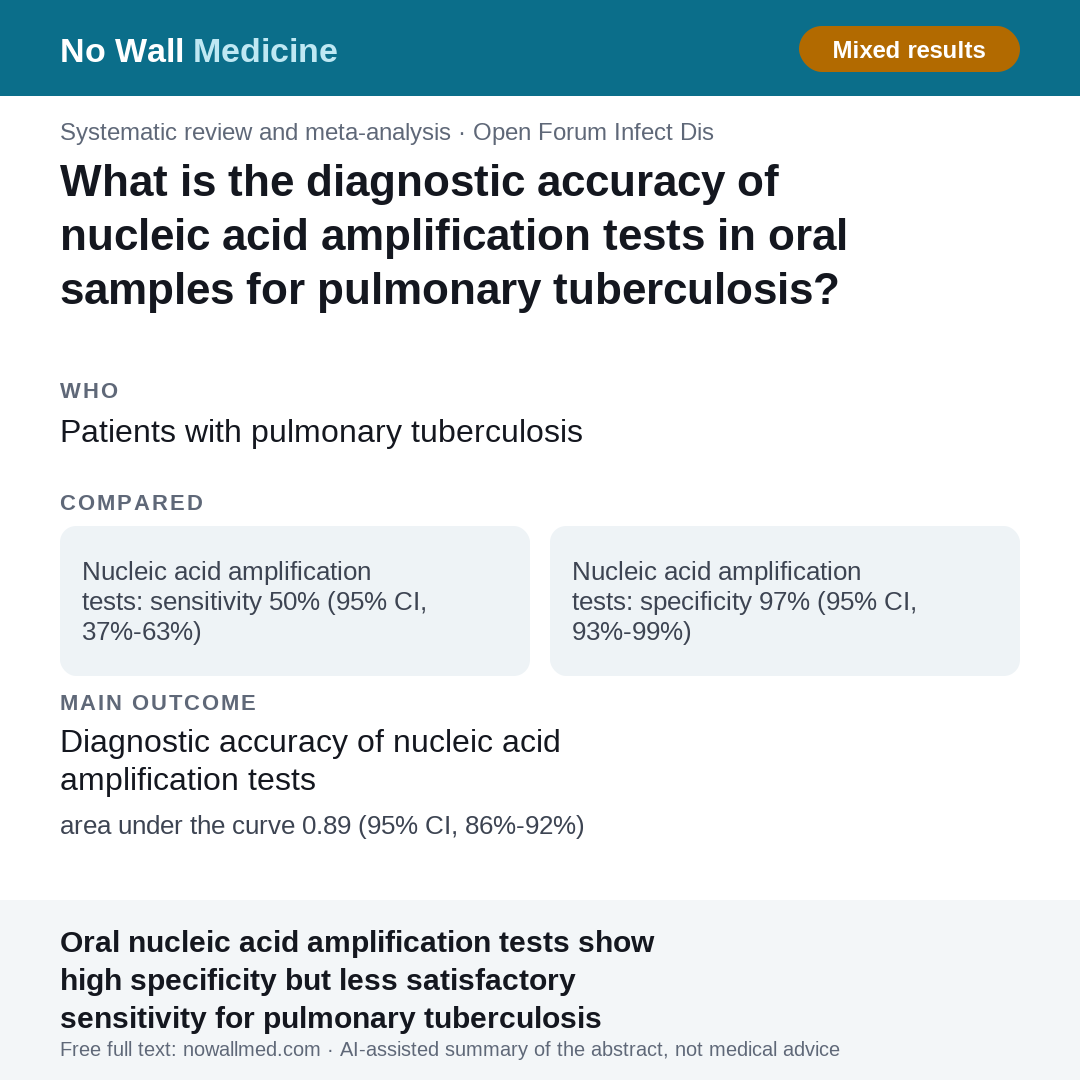
What is the diagnostic accuracy of nucleic acid amplification tests in oral samples for pulmonary tuberculosis?
Who
Patients with pulmonary tuberculosis
Compared
Nucleic acid amplification tests: sensitivity 50% (95% CI, 37%-63%)
Nucleic acid amplification tests: specificity 97% (95% CI, 93%-99%)
Main outcome
Diagnostic accuracy of nucleic acid amplification tests
Result: area under the curve 0.89 (95% CI, 86%-92%)
Bottom line: Oral nucleic acid amplification tests show high specificity but less satisfactory sensitivity for pulmonary tuberculosis diagnosis.
Limitation: Significant heterogeneity, such as heterogeneity in age, requires results to be interpreted with caution.
Open Forum Infect Dis · 2023-02-14Download image
Clinical question: What is the diagnostic accuracy of nucleic acid amplification tests in oral samples for pulmonary tuberculosis?
Why it matters: The diagnostic accuracy of using oral samples for molecular testing of pulmonary tuberculosis remains controversial.
Key points
- Researchers analyzed 23 studies to evaluate the diagnostic accuracy of nucleic acid amplification tests, which are molecular tests that detect genetic material, using oral samples for tuberculosis.
- The pooled results showed a sensitivity of 50% (95% CI, 37%-63%), a specificity of 97% (95% CI, 93%-99%), and an area under the curve of 0.89 (95% CI, 86%-92%).
Limitation the authors note: Significant heterogeneity in the data, such as differences in age, means the results should be interpreted with caution.
Headline and key points written with AI from the paper’s abstract, with every number checked against it. Read the paper before relying on them.
Was this summary helpful?
Cite this article
Wang Y, He Y, Wang L, Zhang YA, Wang MS. Diagnostic Yield of Nucleic Acid Amplification Tests in Oral Samples for Pulmonary Tuberculosis: A Systematic Review and Meta-analysis. Open Forum Infect Dis. 2023. doi:10.1093/ofid/ofad082
Spotted a mistake? Suggest a correction